Backlinks remain one of Google’s strongest ranking signals, but the way they are acquired has changed significantly over the years. Search engines now place greater value on earned backlinks—links that other websites choose to give because your content is genuinely useful, trustworthy, and worth referencing. This approach is known as link earning.
Unlike traditional link building, which often relies on outreach, partnerships, or manual placement, link earning focuses on creating exceptional content and resources that naturally attract editorial links. These backlinks tend to carry more long-term SEO value because they are given voluntarily rather than requested or purchased.
Whether you’re a business owner, marketer, or SEO professional, understanding link earning can help you build a stronger backlink profile while staying aligned with Google’s quality guidelines. It’s a sustainable strategy that improves your website’s authority, increases organic visibility, and reduces the risks associated with manipulative link-building practices.
In this guide, you’ll learn what link earning is, how it differs from traditional link building, why it matters for SEO, and practical strategies to earn high-quality backlinks naturally. You’ll also discover common mistakes to avoid and how to measure the success of your link earning efforts.
What Is Link Earning?
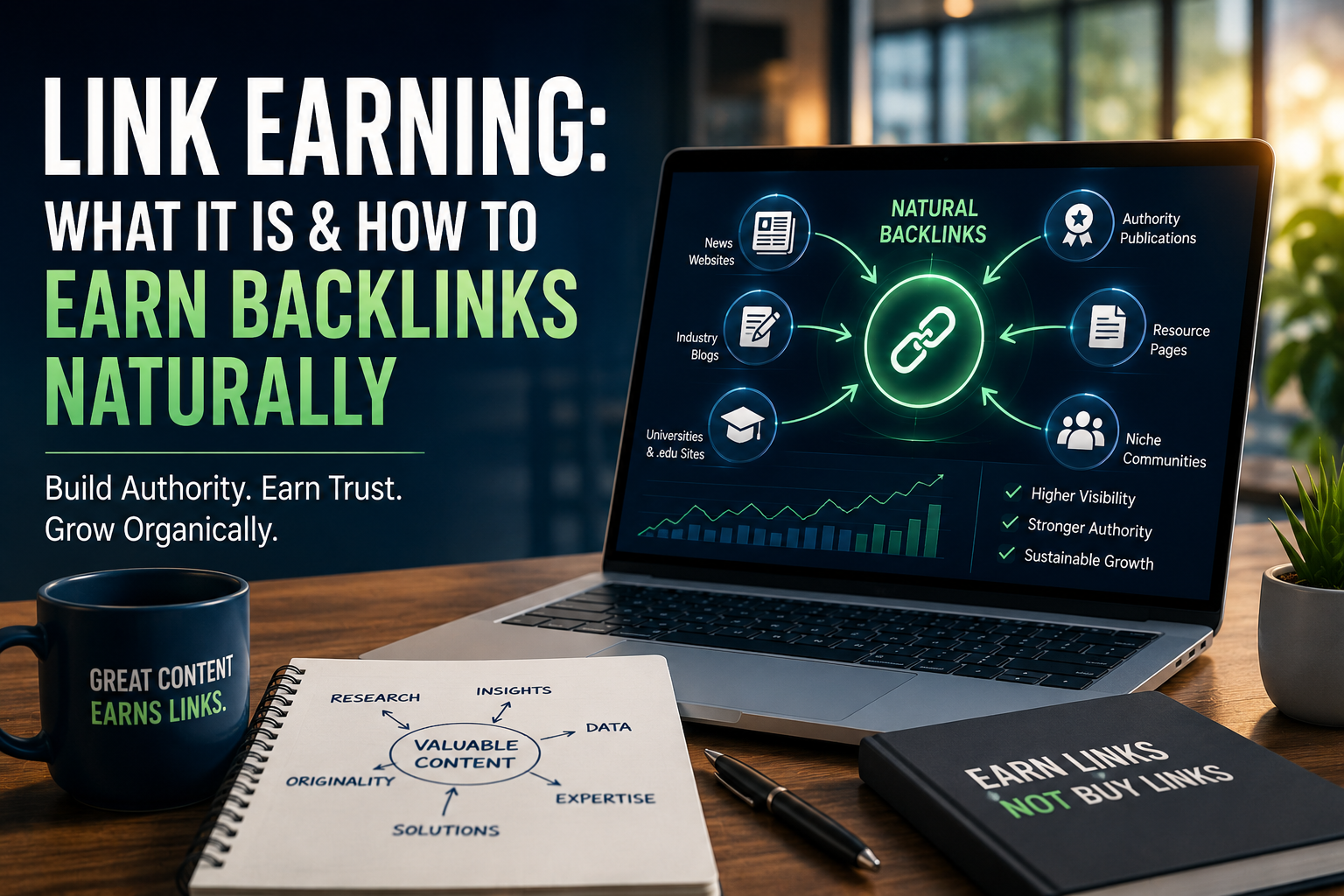
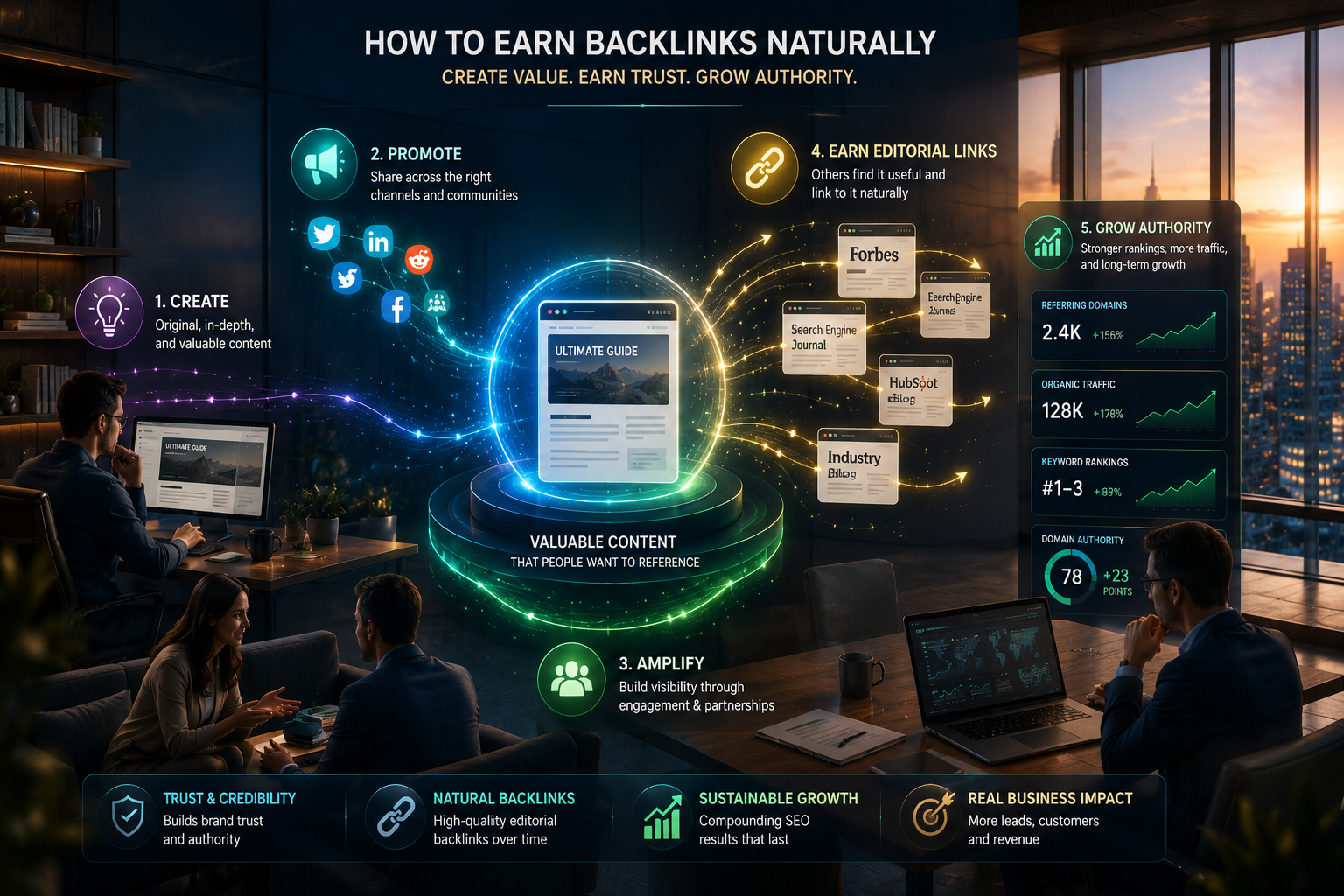
Link earning is the process of gaining backlinks naturally because other websites find your content valuable, relevant, and worth referencing. Instead of asking for links or paying for placements, you earn them by publishing high-quality content that people genuinely want to cite, share, or recommend.
In simple terms, link earning happens when another website voluntarily links to your page without being required or incentivised to do so. These links are often called editorial backlinks because they are added at the publisher’s discretion based on the value your content provides.
Google considers naturally earned links to be one of the strongest indicators of a website’s authority and credibility. When reputable websites choose to reference your content, it signals that your information is trustworthy and useful to users.
Featured Snippet Answer
Link earning is the practice of gaining backlinks naturally by creating valuable, original, and authoritative content that other websites choose to reference without being asked or paid. It is considered one of the safest and most sustainable SEO strategies for building long-term authority.
Example of Link Earning
Imagine your company publishes an in-depth guide on white hat link building with original research, actionable tips, and real-world examples. A digital marketing blog discovers your guide while researching the topic and links to it as a trusted resource for its readers. You didn’t request the link or pay for it—it was earned because your content added value.
This is link earning in action.
Why Link Earning Matters
As search engines become better at evaluating content quality and link authenticity, earning backlinks naturally has become more valuable than relying solely on traditional link acquisition methods. Websites that consistently publish helpful, trustworthy resources are more likely to attract editorial mentions, strengthen their authority, and achieve sustainable organic growth over time.
Related Reading: If you’re new to ethical SEO practices, you may also want to read our guide on White Hat Link Building to understand how link earning fits into a long-term, Google-friendly SEO strategy.
Link Earning vs. Link Building: What’s the Difference?
Although link earning and link building share the same goal—acquiring backlinks that improve your website’s authority—they rely on different approaches.
Link building is a broader SEO practice that involves actively acquiring backlinks through techniques such as link building outreach, guest posting, blogger outreach, broken link building, resource page outreach, digital PR, and strategic partnerships. When carried out ethically and in line with Google’s guidelines, these methods can be highly effective for improving search visibility.
Link earning, on the other hand, focuses on attracting backlinks naturally. Instead of asking another website to link to your content, you create resources that are so useful, informative, or unique that people choose to reference them on their own. These backlinks are typically editorial in nature because they are given voluntarily based on the quality of your content.
The key difference lies in how the backlink is acquired. Link building usually requires proactive promotion or outreach, while link earning depends on the value your content provides to others.
Quick Comparison
Link Building
Link Earning
Involves actively promoting content to acquire backlinks.
Focuses on attracting backlinks naturally through valuable content.
Often includes outreach, guest posting, and relationship building.
Relies on editorial mentions and voluntary citations.
Can produce results more quickly with a well-planned strategy.
Usually takes longer but creates sustainable, long-term authority.
Includes many different white hat SEO techniques.
Represents one of the most natural forms of white hat SEO.
Which Approach Is Better?
The most successful SEO strategies don’t treat link earning and link building as competing methods—they combine them.
For example, you might publish an exceptional industry guide that is capable of earning backlinks naturally. To help more people discover it, you can also promote the guide through ethical outreach, guest posting, or digital PR. This increases its visibility while still allowing you to earn genuine editorial links over time.
Rather than choosing one approach over the other, think of link earning as a powerful subset of white hat link building. High-quality content creates the opportunity to earn links, while strategic promotion helps that content reach the audiences most likely to reference it.
Related Reading: Learn more about ethical backlink acquisition in our guides on Link Building Strategies, Guest Post Outreach, and White Hat Link Building.
Why Link Earning Matters for SEO
Search engines aim to recommend the most helpful, trustworthy, and authoritative content to users. One of the ways they assess a page’s credibility is by analysing the quality and relevance of the websites that link to it. When reputable websites voluntarily reference your content, it sends a strong signal that your information is valuable and deserves visibility in search results.
Unlike backlinks obtained through manipulative tactics, naturally earned links are more likely to remain active over time because they were added to improve the reader’s experience. This makes link earning a sustainable strategy for building long-term SEO success.
Builds Website Authority
Every editorial backlink from a relevant and trusted website strengthens your site’s authority. While not every link carries the same weight, high-quality backlinks can improve your credibility in both the eyes of search engines and your audience.
As your authority grows, it becomes easier for new content to gain visibility and compete for valuable search terms.
Supports Google’s E-E-A-T Principles
Google encourages content that demonstrates Experience, Expertise, Authoritativeness, and Trustworthiness (E-E-A-T). When respected publications, industry blogs, educational websites, or recognised organisations link to your content, they provide independent signals that reinforce your credibility.
Although backlinks are not the only factor Google considers, they complement strong content and help establish your website as a reliable source of information.
Improves Organic Rankings
Quality backlinks remain one of the most influential ranking factors in SEO. Earned links can help search engines:
Discover new pages more quickly.
Better understand your content’s topic and relevance.
Increase confidence in your website’s authority.
Improve rankings for competitive keywords over time.
The emphasis should always be on quality over quantity. A few relevant editorial backlinks from authoritative websites often provide more value than dozens of low-quality links.
Generates Qualified Referral Traffic
Link earning doesn’t only benefit SEO. When your content is featured on respected websites, readers may click through to learn more. These visitors already have an interest in your topic, making them more likely to engage with your content, subscribe to your newsletter, or become customers.
This means every earned backlink has the potential to deliver both ranking improvements and valuable referral traffic.
Creates Long-Term SEO Value
Many link-building campaigns require continuous outreach to acquire new backlinks. Link earning works differently. A high-quality resource can continue attracting links months or even years after publication if it remains accurate, useful, and relevant.
By consistently publishing original research, comprehensive guides, practical tools, and expert insights, you create content assets that continue to earn backlinks and strengthen your website over time.
Key Takeaway: Link earning is more than an SEO tactic—it’s a long-term investment in creating content that people genuinely trust, reference, and recommend. The stronger your content, the more opportunities you have to earn high-quality backlinks naturally.
How to Earn Backlinks Naturally: 10 Proven Link Earning Strategies
1. Create Original, High-Value Content
The foundation of successful link earning is creating content that people genuinely want to reference. If your article offers the same information already available on dozens of other websites, there’s little reason for publishers to link to it. To earn backlinks naturally, your content needs to provide unique value that solves a problem, answers important questions, or presents information in a better way than existing resources.
High-value content doesn’t always mean writing longer articles. Instead, it means creating content that is accurate, well-researched, easy to understand, and genuinely helpful for your target audience. Publishers are far more likely to reference content that saves them time or adds credibility to their own articles.
Characteristics of Link-Worthy Content
Content that naturally attracts backlinks often shares these qualities:
Covers a topic in depth without unnecessary fluff.
Includes original insights, research, or real-world experience.
Uses reliable sources and up-to-date information.
Answers common user questions clearly and accurately.
Is well-structured with headings, visuals, and easy-to-read formatting.
Remains evergreen or is updated regularly to stay relevant.
Examples of Content That Earns Backlinks
Certain content formats consistently perform well when it comes to earning editorial backlinks, including:
Comprehensive beginner’s guides
Original research and industry surveys
Statistics and data roundups
Step-by-step tutorials
Case studies with measurable results
Free tools, templates, and calculators
Infographics and visual resources
Expert interviews and round-up articles
These formats provide information that other content creators naturally reference when writing about similar topics.
Focus on Helping Before Ranking
Rather than asking, “How can I rank this page?”, ask “How can I create the best resource on this topic?” When your content genuinely helps readers, it becomes much easier for bloggers, journalists, businesses, and industry publications to recommend it.
Over time, this approach builds trust, strengthens your brand’s authority, and creates opportunities for backlinks without relying solely on manual outreach.
Pro Tip: Before publishing, compare your article with the top-ranking pages for your target keyword. Look for missing information, outdated advice, or unanswered questions, then improve upon them. Giving readers a more complete and valuable resource significantly increases your chances of earning natural editorial backlinks.
2. Publish Original Research, Data, and Statistics
One of the most effective ways to earn high-quality backlinks is by publishing original research, industry data, or unique statistics. Journalists, bloggers, marketers, and researchers frequently look for credible data to support their content. When your website becomes the original source of that information, other websites are far more likely to cite and link back to you.
Unlike curated statistics from third-party websites, original research gives your content a competitive advantage because it provides information that cannot be found elsewhere. This type of content often attracts editorial backlinks, especially from reputable publications and industry-specific websites.
Why Original Research Attracts Backlinks
Publishers prefer linking to primary sources rather than repeating information from another article. If your research provides valuable insights or uncovers new trends, it naturally becomes a trusted reference.
Original data also helps establish your brand as an authority in your niche, making future content more likely to earn backlinks and mentions.
Types of Research You Can Publish
You don’t need to be a large organisation to create valuable research. Depending on your industry, you can publish:
Industry surveys and poll results
Original case studies with measurable outcomes
Annual trend reports
Market analysis and benchmarking studies
Customer behaviour insights
Performance comparisons between products or services
Data collected from your own business or website
Expert opinion reports based on real-world experience
Even small datasets can become highly linkable if they answer questions that your audience is actively searching for.
Present Data Clearly
The way you present your findings is just as important as the data itself. Improve readability by including:
Easy-to-understand charts and graphs
Tables summarising key findings
Infographics highlighting important statistics
Clear explanations of your research methodology
Key takeaways that readers can quickly reference
Visual elements make your research easier to understand and encourage other websites to reference your findings.
Keep Your Research Updated
Statistics lose value if they become outdated. Review and update your research regularly by adding new data, expanding your analysis, or refreshing outdated figures. Updated reports are more likely to continue earning backlinks and remain relevant in search results.
Pro Tip: If you’re not ready to conduct a large industry survey, start by analysing your own business data. For example, an SEO agency could publish insights from hundreds of completed link-building campaigns, revealing trends in backlink acquisition, outreach response rates, or ranking improvements. Unique first-party data is often more valuable than republished statistics because it offers fresh insights that other websites can’t find elsewhere.
3. Create Free Tools, Templates, and Resources
People naturally link to resources that save time, simplify complex tasks, or help them achieve a goal. That’s why free tools, templates, calculators, checklists, and downloadable resources are among the most effective types of link-worthy content.
Unlike a standard blog post, a useful resource offers practical value that readers can immediately apply. As a result, bloggers, businesses, educators, and industry websites are more likely to recommend it as a helpful reference.
Why Free Resources Earn Backlinks
When someone discovers a genuinely useful tool or template, they often share it with their audience. These recommendations frequently appear in blog posts, resource pages, newsletters, and social media, creating natural opportunities for editorial backlinks.
The more useful your resource is, the more likely it is to attract links without requiring ongoing outreach.
Examples of Link-Worthy Resources
Depending on your niche, you could create resources such as:
SEO audit checklists
Link building outreach email templates
Guest posting pitch templates
Website migration checklists
Content brief templates
Keyword research spreadsheets
ROI calculators
Cost estimation tools
PDF guides and downloadable workbooks
Industry-specific planning templates
Choose resources that solve common problems your audience faces regularly.
Prioritise Simplicity and Usability
A resource doesn’t need to be overly complex to be valuable. In many cases, a well-designed checklist or spreadsheet can attract more backlinks than an advanced tool because it’s easier to use and share.
Focus on creating resources that are:
Easy to access without unnecessary barriers.
Simple to understand and use.
Professionally designed and well organised.
Relevant to your target audience.
Updated regularly as industry practices evolve.
The easier it is for people to benefit from your resource, the greater the likelihood they’ll recommend it to others.
Promote Your Resources
Although great resources can earn backlinks naturally, initial promotion helps them reach the right audience. Share them through:
Your email newsletter.
Social media platforms.
Relevant online communities.
Industry forums.
Existing outreach relationships.
Resource page outreach campaigns.
Promotion increases visibility, while the quality of the resource encourages natural backlinks over time.
Pro Tip: Instead of creating resources that already exist in abundance, identify gaps in your industry. For example, if you run an SEO website, consider developing a Guest Post Quality Checklist, Backlink Evaluation Template, or Anchor Text Planning Spreadsheet. Practical resources tailored to real-world workflows are more likely to earn editorial backlinks because they offer immediate value that users can apply in their daily work.
4. Develop Comprehensive Evergreen Guides
Evergreen guides are in-depth resources that remain valuable long after they’re published. Unlike news articles or trend-based content, evergreen content addresses topics with lasting relevance, making it more likely to earn backlinks consistently over time.
When your guide becomes one of the most complete and trustworthy resources on a subject, other websites naturally reference it instead of creating their own explanation from scratch. This is why comprehensive guides often attract editorial backlinks from blogs, businesses, educational websites, and industry publications.
What Makes an Evergreen Guide Link-Worthy?
A guide should do more than introduce a topic. It should answer the reader’s questions from start to finish, helping them understand both the fundamentals and practical applications.
The best evergreen guides typically:
Cover the topic comprehensively.
Explain concepts in simple, easy-to-understand language.
Include practical examples and actionable advice.
Answer frequently asked questions.
Reference credible sources where appropriate.
Use clear headings, tables, images, and step-by-step instructions.
Stay relevant with regular updates.
The goal is to create the resource that people naturally choose to reference.
Examples of Evergreen Content
Evergreen guides can be created in almost any industry. Examples include:
Complete beginner’s guides
Ultimate how-to tutorials
Industry best practices
Step-by-step process guides
Frequently asked question hubs
Comprehensive buying guides
Educational resource centres
Because these topics remain useful year after year, they have more opportunities to attract natural backlinks.
Keep Your Content Fresh
Even evergreen content requires maintenance. Search engines and readers favour content that reflects current best practices and accurate information.
Review your guides periodically to:
Update outdated statistics.
Replace broken links.
Add new examples.
Expand sections that need more detail.
Improve readability and user experience.
Regular updates help preserve rankings and encourage continued backlink growth.
Build Topic Clusters Around Your Guide
An evergreen guide becomes even more valuable when supported by related articles. Instead of covering every topic in one page, create detailed supporting content and connect it through internal links.
For example, a comprehensive guide about link building can naturally link to more focused articles covering:
Guest posting
Blogger outreach
Broken link building
White hat link building
Link earning
Anchor text optimisation
Editorial backlinks
This structure helps readers explore related topics while strengthening your website’s topical authority.
Pro Tip: Before publishing an evergreen guide, search your target keyword and study the top-ranking results. Don’t copy them—instead, identify what they’re missing. Add clearer explanations, better examples, updated information, original visuals, or practical insights from real experience. The most link-worthy guides aren’t simply longer—they’re genuinely more useful than anything else available.
5. Create Original Visual Content
Not everyone prefers reading long blocks of text. Many readers—and content creators—look for visuals that explain concepts quickly and clearly. By creating original infographics, charts, diagrams, illustrations, and process visuals, you give other websites valuable assets they can reference while linking back to your original source.
High-quality visuals simplify complex topics, improve user engagement, and make your content more shareable across blogs, presentations, newsletters, and social media. When publishers use your visuals with proper attribution, you earn natural editorial backlinks.
Why Visual Content Earns Backlinks
Visuals save content creators time. Instead of designing their own graphic, they can reference an existing, well-designed image that explains the topic accurately.
Original visuals are commonly cited because they:
Simplify complex information.
Improve the reader’s understanding.
Make articles more engaging.
Support data and research with visual evidence.
Are easy to embed and share.
The more useful and unique your visual is, the greater its potential to earn backlinks.
Types of Visual Content That Attract Links
Different formats work well depending on your industry. Popular examples include:
Infographics
Process flow diagrams
Comparison charts
Statistical graphics
Decision trees
Checklists
Timelines
Framework illustrations
Step-by-step workflows
Tables that summarise key information
Visuals that help readers make decisions or understand a process tend to attract the most editorial references.
Make Your Visuals Easy to Reference
Creating a great graphic is only part of the process. Make it simple for others to use and credit your work by:
Publishing the visual on a dedicated page with supporting context.
Including a short explanation of what the graphic shows.
Adding descriptive alt text for accessibility and image SEO.
Using high-resolution images that remain clear on all devices.
Clearly identifying your brand within the graphic without making it distracting.
This increases the likelihood that publishers will reference your original page instead of copying the image without attribution.
Update Visual Assets When Information Changes
If your visual includes statistics, industry trends, or process diagrams, review it regularly to ensure it remains accurate. Updated visuals continue attracting backlinks long after publication and reinforce your reputation as a reliable source of information.
Pro Tip: Instead of creating decorative graphics, design visuals that solve a problem. For example, an SEO website could publish a Link Building Strategy Flowchart, Backlink Quality Checklist, or Guest Posting Process Diagram. Practical visuals are far more likely to be referenced by bloggers, marketers, educators, and industry publications because they provide immediate value that readers can understand at a glance.
6. Publish Case Studies and Real-World Success Stories
People trust proven results more than theoretical advice. That’s why case studies are among the most effective types of content for earning natural backlinks. Instead of simply explaining what works, they show readers how a strategy was applied, the challenges involved, and the measurable outcomes that followed.
Whether you’re an SEO agency, SaaS company, e-commerce brand, or local business, sharing genuine experiences demonstrates credibility and gives other websites valuable examples they can reference in their own content.
Why Case Studies Attract Backlinks
Content creators often look for real-world examples to support their articles. A well-documented case study provides evidence that helps explain a concept, making it a valuable resource for bloggers, journalists, educators, and industry professionals.
Case studies also stand out because they offer original insights that cannot be copied from other sources.
What Makes a Strong Case Study?
The most effective case studies follow a clear structure that readers can easily understand.
Include sections such as:
The background or initial situation.
The problem or challenge.
The strategy or solution implemented.
The steps taken.
The measurable results.
Key lessons learned.
Presenting information in a logical order makes your case study more credible and easier for others to reference.
Include Real Data Whenever Possible
Specific results make your case study far more convincing than vague claims. Where appropriate, include metrics such as:
Organic traffic growth.
Keyword ranking improvements.
Backlink acquisition.
Conversion rate increases.
Revenue growth.
Lead generation.
User engagement metrics.
Supporting your findings with charts, screenshots, or graphs can further strengthen the credibility of your content.
Be Honest About the Process
Not every campaign produces perfect results, and that’s perfectly acceptable. Readers appreciate transparency. Explain any challenges you encountered, adjustments you made, and lessons you learned along the way.
Authentic case studies often earn more trust—and more backlinks—than content that only highlights successes.
Turn Successful Projects into Evergreen Assets
Every successful campaign has the potential to become a long-term link-earning asset. Rather than keeping your best work private, document the process and publish it as an educational resource.
As more people search for practical examples, your case studies can continue attracting editorial backlinks, referral traffic, and qualified leads for months or even years after publication.
Pro Tip: Don’t wait until you’ve completed a massive project. Even a small but well-ddocumented success story can become highly linkable if it includes clear objectives, a transparent process, and measurable results. For example, an SEO agency could publish a case study showing how a client earned high-quality backlinks and improved organic rankings over six months. Original, experience-based content is difficult to replicate, making it especially valuable for both readers and search engines.
7. Create Expert Roundups and Interview Industry Leaders
One of the fastest ways to build credibility and earn natural backlinks is by featuring recognised experts in your content. Expert roundups and interviews bring together unique insights from experienced professionals, creating original content that readers can’t find elsewhere.
Because the contributors have a personal connection to the content, they’re often willing to share it with their audiences. This increases your visibility and creates additional opportunities for editorial backlinks from blogs, newsletters, social media, and industry websites.
Why Expert Content Earns Backlinks
Expert opinions add depth, credibility, and first-hand experience to your content. Instead of presenting a single perspective, you offer readers a collection of valuable insights from professionals who actively work in the industry.
This makes your content more authoritative and more likely to be referenced by other publishers looking for trustworthy sources.
Ways to Collaborate with Experts
There are many ways to create expert-driven content, including:
Expert roundup articles.
One-on-one interviews.
Q&A sessions.
Panel discussions.
Podcast or webinar summaries.
Industry prediction articles.
Collaborative research reports.
Choose a format that provides genuine value rather than collecting short quotes simply for promotional purposes.
Ask Questions That Generate Valuable Insights
The quality of your questions directly affects the quality of the content.
Instead of asking broad questions like:
“What is your favourite link building strategy?”
Ask questions that encourage practical, experience-based answers, such as:
What link earning strategy has produced the most consistent results for you?
What common mistake do businesses make when trying to earn backlinks?
How has Google’s approach to backlinks changed in recent years?
What advice would you give to someone building links for a brand-new website?
Detailed answers make your content more useful and more likely to attract editorial references.
Build Long-Term Relationships
Expert collaborations shouldn’t end after publication.
Stay connected with contributors by:
Thanking them for participating.
Sharing the published article.
Mentioning them when discussing related topics.
Inviting them to future collaborations.
Strong professional relationships often lead to future mentions, partnerships, guest posting opportunities, and additional backlinks.
Prioritise Quality Over Quantity
Featuring five experienced professionals with meaningful insights is usually more valuable than collecting brief comments from dozens of contributors.
Focus on publishing conversations that educate readers, solve real problems, and offer perspectives backed by genuine experience.
Pro Tip: When your article is published, let each contributor know and provide a direct link to the finished piece. Many experts naturally share interviews and roundups on their websites, newsletters, and social media channels. While you should never expect a backlink, creating genuinely valuable content significantly increases the likelihood that contributors and other publishers will reference it organically.
8. Leverage Digital PR and Newsworthy Content
Digital PR is the practice of creating and promoting stories that are genuinely newsworthy, with the goal of earning editorial coverage from journalists, publishers, and industry media. Unlike traditional outreach that asks for a backlink, digital PR focuses on providing valuable information that news outlets naturally want to report.
When your content is featured by reputable publications, you don’t just gain backlinks—you also increase brand awareness, build credibility, and reach a much wider audience.
Why Digital PR Earns High-Quality Backlinks
Journalists and editors are constantly looking for reliable sources, fresh insights, and interesting stories. If your business provides timely information or unique data, it can become a trusted source for future articles.
Digital PR campaigns often result in backlinks from:
News websites
Industry publications
Business magazines
Trade journals
Popular blogs
Educational websites
These editorial links are often among the most authoritative backlinks a website can earn.
Create Content That Journalists Want to Cover
Not every article is newsworthy. Focus on content that offers something new or noteworthy, such as:
Original industry research
Annual trend reports
Market surveys
Consumer behaviour studies
Company milestones
Product launches
Unique case studies
Expert commentary on breaking industry news
The more original your content is, the greater its potential to earn media attention.
Respond Quickly to Industry Trends
News moves fast. Publishing expert opinions or useful resources soon after a major industry update can significantly increase your chances of being referenced by journalists and bloggers.
For example, if Google releases a major search algorithm update, publishing a detailed analysis or practical guide can position your website as a valuable resource while interest is at its highest.
Build Relationships with Journalists
Successful digital PR isn’t just about sending press releases. It also involves building genuine relationships with journalists and editors who regularly cover your industry.
You can strengthen these relationships by:
Providing accurate and well-researched information.
Responding promptly to media requests.
Offering expert insights without being overly promotional.
Becoming a reliable source that journalists can return to for future stories.
Trust and consistency often lead to repeat media coverage over time.
Measure More Than Just Backlinks
While backlinks are an important outcome, digital PR also delivers broader business benefits, including:
Increased brand visibility.
Higher referral traffic.
Improved online reputation.
Greater audience trust.
More opportunities for future media mentions.
These long-term advantages make digital PR one of the most valuable investments in a sustainable SEO strategy.
Pro Tip: Instead of sending generic press releases, focus on creating stories backed by real evidence. Original data, expert analysis, or unique industry insights are far more likely to capture a journalist’s attention than promotional announcements. The stronger the story, the more likely it is to earn high-quality editorial backlinks naturally.
9. Build Genuine Relationships Within Your Industry
Behind many natural backlinks is a simple factor that’s often overlooked—strong professional relationships. When people know your brand, trust your expertise, and value your contributions, they’re far more likely to mention your content, recommend your resources, or reference your website in their own articles.
Building relationships isn’t about exchanging links or asking for favours. It’s about becoming an active and respected member of your industry by consistently providing value and engaging with others.
Why Relationships Lead to Natural Backlinks
People are more likely to cite content from sources they recognise and trust. As you build credibility within your niche, your articles, research, and resources naturally become part of industry conversations.
Over time, these relationships can result in:
Editorial mentions in blog posts.
Invitations to contribute guest articles.
Podcast and webinar appearances.
Expert interview opportunities.
Collaborative research projects.
Resource page inclusions.
Brand mentions that turn into backlinks.
These opportunities often develop organically through ongoing interaction rather than direct link requests.
Ways to Build Meaningful Industry Connections
Developing professional relationships takes time, but the long-term benefits extend far beyond SEO.
Consider:
Engaging thoughtfully with industry discussions on LinkedIn and other professional platforms.
Attending webinars, conferences, and networking events.
Participating in relevant online communities and forums.
Sharing and commenting on valuable content from other experts.
Collaborating on research, guides, or educational resources.
Supporting other creators by referencing their work where appropriate.
The goal is to contribute to your industry, not simply promote your own website.
Give Value Before Expecting Anything in Return
One of the biggest mistakes businesses make is approaching every interaction with the expectation of receiving a backlink.
Instead, focus on helping others by:
Sharing useful knowledge.
Offering practical advice.
Answering questions.
Making introductions.
Promoting valuable content from other experts.
When you consistently contribute without expecting immediate returns, you build trust and credibility that often lead to natural backlink opportunities over time.
Maintain Long-Term Relationships
Professional relationships shouldn’t end after a single collaboration.
Stay connected by:
Congratulating peers on their achievements.
Sharing updates that may interest them.
Collaborating on future projects.
Continuing conversations beyond SEO.
Strong relationships often lead to repeated mentions, referrals, partnerships, and editorial backlinks that no outreach template can easily replicate.
Pro Tip: Think of networking as reputation building rather than link building. When your business becomes known for producing helpful content and contributing positively to the community, backlinks become a natural by-product of the trust you’ve earned—not the primary objective.
10. Promote Your Content Strategically
Creating exceptional content is only half the equation. If your target audience never discovers it, even the most valuable resource may struggle to earn backlinks. Strategic content promotion increases visibility, helping your content reach the people most likely to reference, share, and recommend it.
Promotion isn’t about aggressively asking for links. It’s about ensuring your content is seen by journalists, bloggers, publishers, businesses, and industry professionals who may genuinely find it useful.
Why Content Promotion Matters
Natural backlinks don’t happen in isolation. Most people need to discover your content before they can reference it.
Strategic promotion helps you:
Increase the visibility of new content.
Reach relevant audiences.
Generate referral traffic.
Encourage social sharing.
Create more opportunities for editorial backlinks.
The wider your content reaches, the greater the chance that someone will cite it in their own work.
Effective Ways to Promote Your Content
After publishing a valuable resource, consider promoting it through:
Your email newsletter.
LinkedIn and other professional social platforms.
Industry-specific communities and forums.
Relevant Facebook or Slack groups.
SEO and marketing communities.
Your existing customer or client network.
Resource pages where your content provides genuine value.
The goal is to introduce your content to people who are already interested in the topic.
Repurpose Content for Greater Reach
One article can become multiple pieces of content, helping you reach different audiences without creating everything from scratch.
For example, you can transform a comprehensive guide into:
A LinkedIn carousel.
A short educational video.
An infographic.
A newsletter feature.
A podcast discussion.
A series of social media posts.
A downloadable checklist.
Repurposing extends your content’s lifespan and creates additional opportunities for it to be discovered and referenced.
Promote Consistently—Not Just Once
Many websites promote a new article on the day it’s published and never mention it again. Instead, revisit your best-performing content regularly.
You can:
Share evergreen articles every few months.
Update older content with fresh information.
Highlight relevant articles when industry news breaks.
Link to your resources from new blog posts.
Include valuable guides in email campaigns.
Consistent promotion ensures your content continues reaching new audiences long after its publication date.
Focus on Relevance Over Volume
Promotion is most effective when it targets the right audience. Sharing a technical SEO guide in a community of SEO professionals is far more valuable than broadcasting it to a general audience with little interest in the topic.
Prioritise relevance, genuine engagement, and value over mass distribution.
Pro Tip: Don’t promote every article the same way. Reserve your greatest promotional effort for your highest-value content—such as original research, comprehensive guides, free tools, and case studies. These “linkable assets” have the strongest potential to earn editorial backlinks, making them the best candidates for ongoing promotion and outreach.
Common Link Earning Mistakes to Avoid
Even the best content won’t earn backlinks if it fails to provide real value or reach the right audience. Many businesses assume that simply publishing blog posts is enough, but successful link earning requires a thoughtful strategy, consistent effort, and a focus on helping readers.
Avoid these common mistakes to improve your chances of earning high-quality editorial backlinks.
1. Creating Content That Offers Nothing New
One of the biggest reasons content fails to earn backlinks is because it repeats information that already exists.
If your article provides the same advice as dozens of competing pages, there’s little incentive for other websites to reference it.
Instead, aim to add unique value by:
Sharing original insights or experience.
Publishing new research or data.
Including practical examples.
Explaining complex topics more clearly.
Providing actionable solutions.
The more useful and original your content is, the more likely it is to attract natural backlinks.
2. Prioritising Quantity Over Quality
Publishing large volumes of average content rarely leads to sustainable link earning.
A single comprehensive, well-researched guide often earns more backlinks than dozens of short, low-value articles.
Focus on creating fewer resources that genuinely deserve to be referenced rather than producing content simply to increase your publishing frequency.
3. Ignoring Content Promotion
Even exceptional content needs visibility.
Many website owners publish an article and expect backlinks to appear automatically. In reality, your audience must first discover your content before they can reference it.
Promote your best resources through:
Email newsletters.
Social media.
Industry communities.
Professional networks.
Ethical outreach campaigns.
Promotion creates awareness, while quality content earns the backlinks.
4. Publishing Outdated Information
Information becomes less valuable as industries evolve.
Statistics, screenshots, tools, and best practices should be reviewed regularly to ensure they remain accurate.
Refreshing evergreen content helps maintain search rankings and increases the likelihood that publishers will continue referencing your work.
5. Focusing Only on Search Engines
Some websites create content primarily to rank for keywords rather than solve readers’ problems.
While SEO is important, content written solely for search engines often lacks originality and practical value.
Always write for people first.
When readers genuinely benefit from your content, search engines are more likely to reward it with better visibility.
6. Expecting Immediate Results
Link earning is a long-term strategy.
Unlike paid promotions or aggressive outreach campaigns, editorial backlinks often accumulate gradually as more people discover and trust your content.
Patience and consistency are essential. Continue publishing valuable resources, updating existing content, and promoting your best work over time.
7. Neglecting User Experience
Even outstanding content can lose potential backlinks if visitors have a poor experience on your website.
Common issues include:
Slow page loading.
Difficult navigation.
Excessive advertisements.
Poor mobile responsiveness.
Large walls of text without clear formatting.
A clean, fast, and user-friendly website encourages visitors to stay longer, engage with your content, and share it with others.
Key Takeaway: Successful link earning isn’t about shortcuts or quick wins. It’s about consistently creating exceptional content, promoting it to the right audience, and maintaining a website that people trust and want to recommend. Avoiding these common mistakes puts you in a much stronger position to earn high-quality backlinks naturally.
Frequently Asked Questions (FAQs)
Is link earning better than link building?
Link earning is considered one of the most sustainable forms of link building because it focuses on attracting backlinks naturally through valuable content. However, the best SEO strategies combine link earning with ethical link building techniques, such as guest posting, digital PR, and blogger outreach, to maximise visibility and long-term growth.
How long does link earning take?
Link earning is a long-term strategy, and results vary depending on your industry, content quality, competition, and promotion efforts. Some content may attract backlinks within a few weeks, while evergreen resources can continue earning editorial links for months or even years after publication.
What type of content earns the most backlinks?
Content that provides unique value tends to earn the most backlinks. This includes:
Original research and surveys
Industry statistics
Comprehensive guides
Case studies
Free tools and templates
Infographics and visual resources
Expert interviews and roundups
The more useful and original your content is, the more likely other websites are to reference it.
Does Google recommend link earning?
Google encourages websites to earn backlinks naturally by creating high-quality content that people genuinely want to reference. While Google doesn’t prohibit ethical link building, it discourages manipulative practices that attempt to artificially influence search rankings.
Can a new website earn backlinks naturally?
Yes. Even a new website can earn backlinks if it publishes original, helpful, and trustworthy content. Although established websites may have greater visibility, new sites can attract editorial links by creating resources that solve real problems, provide unique insights, or fill gaps in existing content.
Do social media shares help with link earning?
Social media shares are not direct ranking factors for Google, but they can increase your content’s visibility. Greater exposure means more people—including bloggers, journalists, and publishers—may discover your content and choose to link to it naturally.
What’s the difference between editorial backlinks and earned backlinks?
Editorial backlinks are links that editors or content creators add voluntarily because they believe your content provides value to their readers. Since these links are given without payment or obligation, they are often considered earned backlinks. In many cases, the terms are used interchangeably, although “earned backlinks” refers to the overall process, while “editorial backlinks” describes the specific type of link.
Can I earn backlinks without doing outreach?
Yes, but it often takes longer. Exceptional content can naturally attract backlinks over time, especially if it includes original research, practical tools, or comprehensive guides. However, ethically promoting your content through newsletters, social media, digital PR, and professional networks can significantly increase its visibility and create more opportunities for natural link earning.
🚀 Ready to Build High-Quality Backlinks?
Access our database of 5,000+ vetted publisher websites or request a custom website list tailored to your niche, target country, budget, and SEO goals.
Link earning is about more than gaining backlinks—it’s about earning trust. When you consistently publish valuable, accurate, and original content, other websites are far more likely to reference your work because it genuinely helps their readers. These editorial backlinks not only strengthen your SEO performance but also establish your website as a credible resource within your industry.
While link earning requires patience, the long-term benefits are well worth the investment. High-quality content, original research, practical resources, and genuine industry relationships can continue generating backlinks, referral traffic, and brand authority long after they’re published.
Remember that the most successful SEO strategies don’t rely on a single tactic. Combining link earning with ethical white hat link building, strategic content promotion, and ongoing content improvements creates a sustainable approach to growing your website’s authority and organic visibility.
If you’re looking to build a backlink profile that aligns with Google’s best practices, focus on creating content that people genuinely want to cite—not because you asked for a link, but because your content deserves one.