You publish a page, optimize it properly, and wait for it to move up Google. Then comes the obvious question: how many backlinks do I need to actually rank?
Is it 10? 50? 100?
The frustrating answer is that there is no universal number. A page targeting a low-competition keyword may rank with very few backlinks, while another competing in a difficult SERP may need dozens—or considerably more—relevant referring domains.
For most pages, the best starting point is the median number of referring domains pointing to comparable page-one competitors—not a universal backlink target.
That doesn’t mean you have to guess.
A more useful way to estimate your backlink target is to look at the pages already ranking for your keyword: how many unique websites link to them, how strong and relevant those links are, and how your own page compares.
In this guide, we’ll break down how many backlinks you may need to rank on Google in 2026, then show you a practical way to calculate a realistic target for your own page using competitor and SERP data.
How Many Backlinks Do I Need to Rank on Google?
There is no fixed number of backlinks you need to rank on Google. For one keyword, a page might compete with fewer than 10 relevant referring domains. For another, the pages on page one may have dozens or even hundreds.
That’s why choosing a target like “I need 50 backlinks” before looking at the search results usually doesn’t make sense.
A better starting point is to compare your page with similar pages already ranking on page one for your target keyword.
For example, suppose the comparable ranking pages have:
18 referring domains
24 referring domains
31 referring domains
36 referring domains
45 referring domains
The median is 31 referring domains.
If your page currently has 10 relevant referring domains, that gives you an initial gap of roughly 21 referring domains.
But that does not mean building exactly 21 backlinks will automatically put you on page one. Google does not publish a required backlink count, and links are only part of the ranking picture. The relevance and quality of those links, the strength of your content, search intent, internal linking, and the competition in the SERP can all affect how much link authority your page needs.
The practical takeaway: don’t ask, “What is the perfect number of backlinks?” Ask, “How far is my page from the backlink profiles of realistic page-one competitors?”
We’ll calculate that gap step by step later in this guide.
Backlinks vs. Referring Domains: What Should You Count?
When estimating how many backlinks you need, raw backlink count can be misleading. A better starting point is usually the number of referring domains pointing to a page.
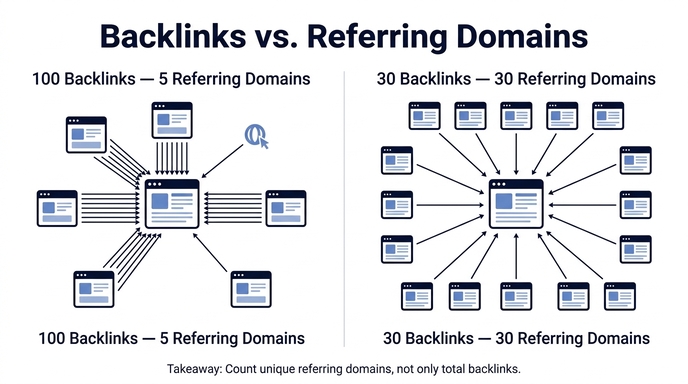
A backlink is an individual link from another page to your website. A referring domain is a unique website that sends one or more of those backlinks.
For example, imagine two pages:
Page
Total Backlinks
Referring Domains
Page A
100
5
Page B
30
30
Page A has more than three times as many backlinks, but they come from only five websites. Page B has fewer total links, but those links come from 30 different websites.
That distinction matters when you’re analyzing competitors. If one website links to a competitor 50 times, you shouldn’t automatically treat that as equivalent to earning links from 50 independent websites.
This is also why SEO tools often use referring domains when evaluating ranking competition. Ahrefs, for example, calculates its Keyword Difficulty metric partly from the number of unique websites linking to the pages currently ranking in Google’s top 10.
Should You Ignore Total Backlinks?
No. Total backlinks can still reveal useful information about a page’s link profile. But when your goal is to estimate how many links you may need to compete, page-level referring domains usually provide a cleaner starting point.
Even then, the number alone isn’t enough.
Ten relevant editorial links from websites closely connected to your topic may represent a very different competitive signal from ten unrelated, low-value domains.
So throughout this guide, when we talk about calculating a backlink target, we’ll focus primarily on relevant referring domains, while also considering the quality of the links behind those numbers.
That gives us a more realistic benchmark than simply trying to match a competitor’s raw backlink count.
What Determines How Many Backlinks You Actually Need?
Two pages can be equally well written and still need very different backlink profiles to compete. The reason is simple: you are not trying to reach a universal backlink threshold—you are trying to compete in a specific SERP.
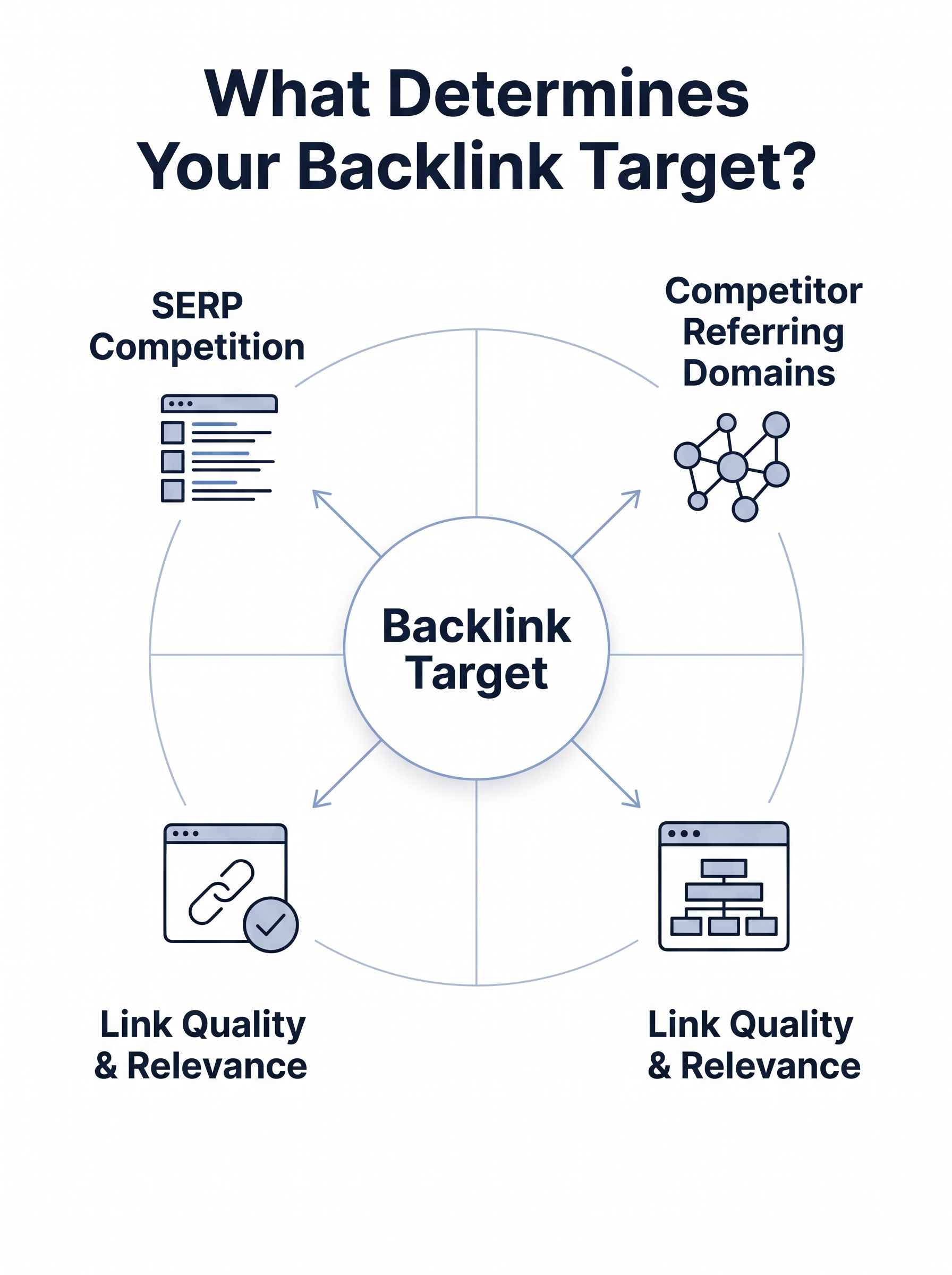
Before setting a backlink target, look at these four factors.
1. Your Keyword and SERP Competition
Start with the search results themselves.
If the first page is filled with established websites and individual pages backed by strong link profiles, breaking into that SERP will generally be more difficult than competing for a keyword where several ranking pages have few referring domains.
This is why the same backlink target should not be applied across every keyword on your site.
A page targeting a specific long-tail query might already be competitive with a relatively small number of relevant referring domains. A commercial keyword contested by established brands may require a much larger link gap to be closed.
Keyword Difficulty scores from SEO tools can help you identify this difference, but they should be treated as estimates—not Google requirements. The actual SERP is ultimately the better place to investigate your competition.
2. The Backlink Profiles of Comparable Page-One Results
Not every result on page one should become your benchmark.
Imagine that most relevant ranking pages have between 20 and 40 referring domains, but one result from a major publisher has 2,000. Using the average across all of those pages could give you a highly inflated backlink target.
Instead, identify comparable competitors.
Look for pages that:
target the same or closely related search intent,
use a similar content format,
genuinely compete for the same audience, and
aren’t extreme authority or backlink outliers.
Then compare their page-level referring domains with yours.
This gives you a much more realistic picture of what it may take to become competitive than simply trying to exceed the backlink count of the #1 result.
3. Your Website and Page’s Existing Strength
Backlinks do not operate in isolation.
A well-established website with years of relevant content, strong internal linking, existing external links, and topical depth may not start from the same position as a new website publishing its first article on the subject.
The individual page matters too.
A new page may already receive internal authority from relevant pages elsewhere on the site. Another page may sit several clicks deep with few internal links supporting it.
Metrics such as Domain Rating, Domain Authority, or Authority Score can be useful for comparing websites, but they are third-party SEO metrics. They should not be treated as Google ranking scores or as proof that one page will outrank another.
The goal is to understand the broader competitive context—not chase a particular authority score.
4. The Quality and Relevance of the Links
Two pages can each have 30 referring domains and still have very different backlink profiles.
One may have links from websites that are relevant to its industry, placed naturally within useful editorial content. The other may have accumulated links from unrelated pages, weak directories, duplicate sources, or sites with little connection to the topic.
Simply matching the second page’s number does not mean you’ve matched the first page’s link profile.
This is why backlink quantity should always be interpreted alongside quality and relevance.
For the purpose of estimating how many backlinks you need, referring-domain counts give us a useful starting benchmark. But before turning that number into a link-building target, we need to inspect what is actually behind it.
So rather than choosing an arbitrary backlink number, the next step is to calculate the gap between your page and the competitors already ranking for your target keyword.
How to Calculate How Many Backlinks You Need
Instead of starting with a fixed target such as 20, 50, or 100 backlinks, estimate your requirement from the pages already competing for the keyword you want to rank for.
The goal isn’t to copy the backlink count of the #1 result. It’s to identify realistic page-one competitors, understand their link profiles, and measure the gap between those pages and yours.
Here is a practical way to do it.
Step 1: Choose the Exact Keyword You Want to Rank For
Calculate your backlink target at the keyword and SERP level, not for your website as a whole.
Suppose you sell SEO services and want to rank for both:
“link building services”
“link building services for SaaS”
Those keywords may look closely related, but the pages ranking for each query can have completely different levels of competition.
Search your exact target keyword and analyze the results currently appearing on page one.
Don’t start by asking:
“How many backlinks does my website need?”
Start with:
“What does the competition look like for this specific keyword?”
Step 2: Analyze the Top 10 Ranking Pages
Record the pages currently ranking in Google’s top 10.
For each result, collect:
Metric
Why It Matters
Ranking position
Shows where the page currently appears
Page URL
Identifies the exact ranking page
Referring domains
Shows how many unique websites link to that page
Total backlinks
Provides additional context around the link profile
DR/DA/Authority Score
Helps compare overall site strength
Content type
Helps identify comparable results
Search intent
Shows whether the page is competing for the same purpose
Tools such as Ahrefs, Semrush, or Moz can help collect this data.
Remember that DR, DA, and Authority Score are third-party comparative metrics, not Google ranking scores. Use them as context rather than as targets you need to “beat.”
Step 3: Identify Your Real Competitors
This is where backlink calculations often go wrong.
You don’t necessarily need to beat every website ranking above you.
Suppose the SERP contains:
several specialist SEO agencies,
two informational SEO blogs,
Reddit,
a major publication,
and an extremely authoritative SEO platform.
If your page is an in-depth commercial guide, some of those results may not be useful benchmarks.
Focus on pages that are reasonably comparable to yours in search intent, content type, topic, and competitive position.
Also watch for obvious outliers.
For example, imagine the page-level referring domains for comparable-looking results are:
12, 18, 22, 27, 31, 38, 44, 96, 850, 3,400
Simply averaging all ten would produce a number that says very little about what a realistic page needs.
Step 4: Find the Typical Referring-Domain Level
Once you’ve identified the results that genuinely represent your competition, look for the typical page-level referring-domain count.
A median can often be more useful than a simple average because extreme values have less influence on it.
Suppose your comparable competitors have:
18, 24, 27, 31, and 44 referring domains.
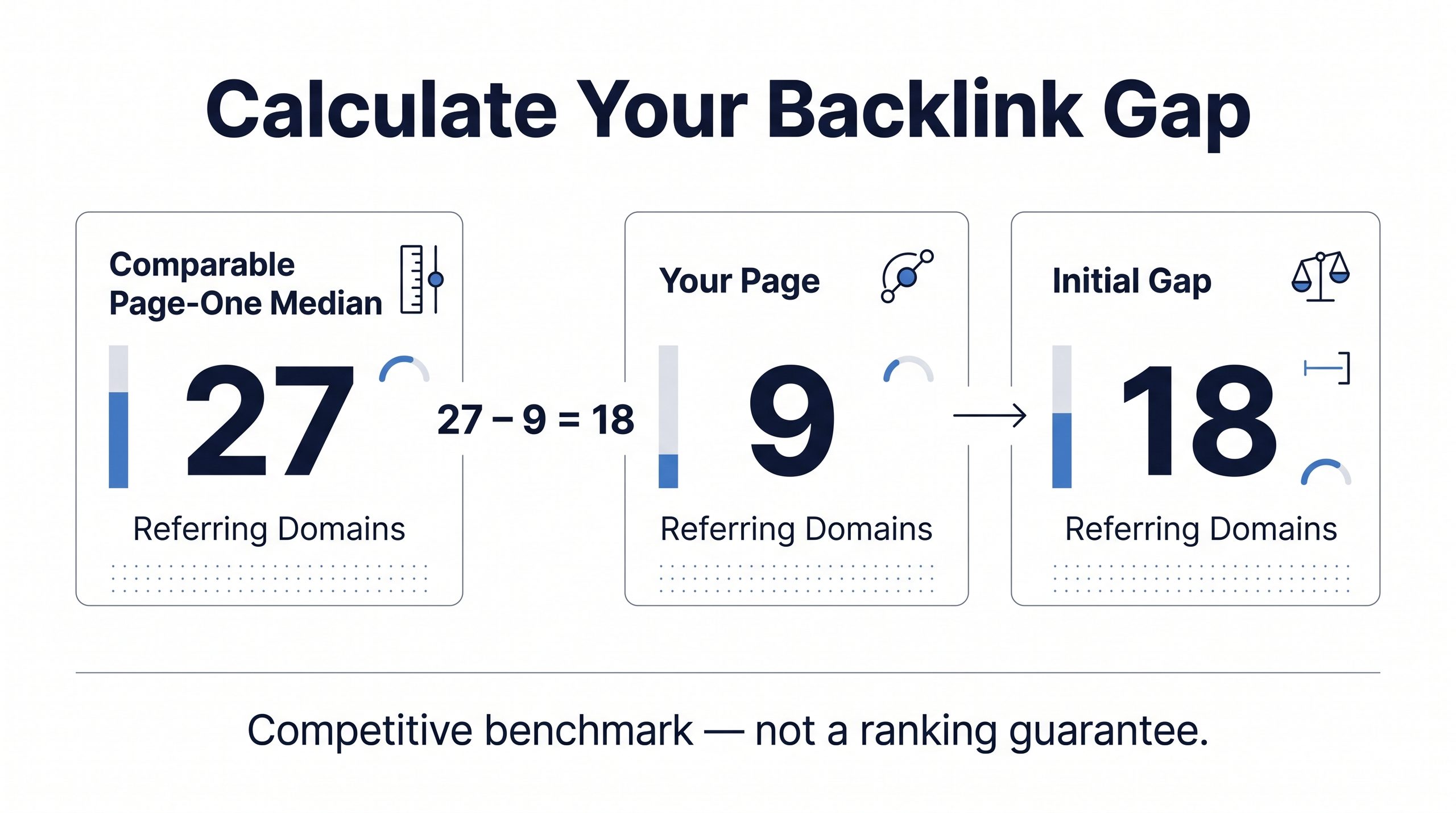
The median is 27.
If your page currently has 9 referring domains, the simple gap is:
27 − 9 = 18 referring domains
That gives you a much more useful starting point than deciding in advance that every page needs 50 backlinks.
But 18 is not a ranking guarantee or a final link-building target.
It’s the beginning of the analysis.
Backlink Gap Formula Typical referring domains among comparable page-one pages − your page’s relevant referring domains = initial referring-domain gap
Example: 27 − 9 = 18 referring domains
This is a competitive benchmark, not a prediction that 18 additional links will produce a specific ranking.
Step 5: Look Behind the Referring-Domain Count
Before deciding that you need another 18 referring domains, inspect the links supporting those competitors.
Ask:
Are the linking sites relevant to the topic?
Are the links placed within useful editorial content?
Do several backlinks come from the same domains?
Are there obvious low-value or irrelevant sources inflating the number?
Are a small number of particularly strong links doing much of the work?
This step matters because two pages with 27 referring domains can have very different link profiles.
A raw count tells you how many domains are linking. It doesn’t tell you whether those links are equally useful.
Step 6: Compare the Competitors With Your Own Page
Now look at your page using the same criteria.
Don’t compare only:
Competitor: 27 referring domains Your page: 9 referring domains
Also compare:
relevance of the referring websites,
strength of individual links,
overall site strength,
search-intent alignment,
content depth and usefulness,
and internal links pointing to the page.
You may discover that the raw backlink gap looks large but your existing links are particularly relevant and strong.
Or you may discover the opposite: your referring-domain count looks competitive, but many of those links provide little meaningful support.
Step 7: Set a Backlink Range, Not an Exact Number
After analyzing the SERP, turn your findings into a working range rather than a precise promise.
For example:
Comparable page-one competitors have a median of 27 relevant referring domains. Our page currently has nine. After reviewing link quality and overall competition, we might initially target approximately 15–25 additional relevant referring domains and then reassess performance.
Notice the difference.
We’re not saying:
“Build 18 backlinks and you’ll rank.”
We’re saying:
“The current SERP suggests a measurable competitive gap. Here’s a reasonable range to work toward and test.”
Rankings can change while you’re building links. Competitors can earn new links, Google can reassess pages, search intent can shift, and improvements elsewhere on your site can also affect performance.
Your backlink target should therefore be treated as a working benchmark that you revisit, not a number carved in stone.
The simplest version of the process is:
Identify comparable page-one competitors → measure their page-level referring domains → compare them with your page → inspect link quality → estimate the gap → set a range → monitor rankings and reassess.
That gives you a backlink target based on the SERP you’re actually trying to enter, rather than a generic number that may have little connection to your keyword.
Real SERP Example: How Many Backlinks Do Ranking Pages Actually Have?
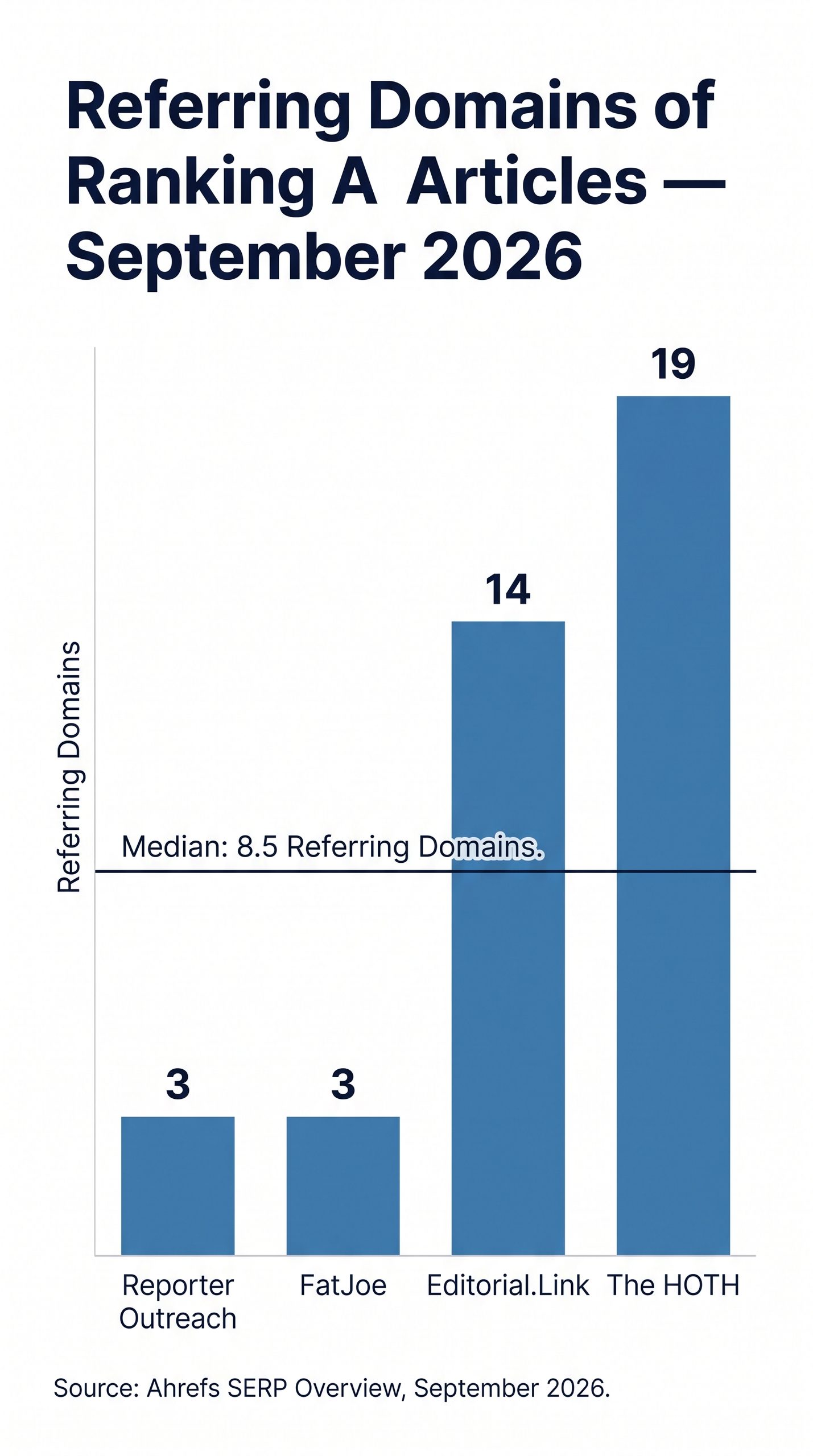
To see what backlink requirements look like in a real search result, we analysed the SERP for “how many backlinks do I need” using Ahrefs data from September 2026.
Instead of looking at the total backlink profile of each website, we focused on the individual pages ranking for the query. We also separated directly comparable informational articles from results such as Reddit, YouTube, Google forum discussions, and SERP features.
Here is what we found among four directly comparable ranking articles:
Ranking Page
Position
DR
UR
Backlinks
Referring Domains
Reporter Outreach
#4
56
4
3
3
The HOTH
#5
75
4
21
19
FatJoe
#8
72
4
3
3
Editorial.Link
#9
73
7
19
14
Source: Ahrefs SERP Overview, September 2026. Rankings and backlink metrics can change over time.
Methodology: We reviewed the Ahrefs SERP Overview for “how many backlinks do I need” and compared directly relevant informational articles. SERP features and substantially different result types, including Reddit, Quora, YouTube, and forum pages, were excluded from the referring-domain benchmark.
The referring-domain counts were:
3, 3, 14, and 19.
That produces a median of:
(3 + 14) ÷ 2 = 8.5 referring domains.
At first glance, you might conclude that a page needs around nine referring domains to compete for this keyword.
That would be the wrong takeaway.
What the Numbers Actually Tell Us
Look beyond the page-level backlink counts and another pattern appears.
The four ranking articles are published on websites with Ahrefs Domain Rating scores between 56 and 75, even though the individual pages have only 3–19 referring domains.
This doesn’t prove that higher DR caused those pages to rank. DR is an Ahrefs metric, not a Google ranking score. But it does show why page-level backlink counts should never be interpreted in isolation.
A new website with nine referring domains pointing to a page is not automatically in the same competitive position as an established website with nine referring domains pointing to a similar page.
The surrounding site, existing link equity, internal links, topical relevance, content quality, search intent, and the quality of the individual backlinks can all affect the competitive picture.
Why the Median Is a Starting Point, Not Your Target
This example also demonstrates why our backlink-gap calculation should produce a benchmark rather than a promise.
If your page had three relevant referring domains, you could calculate:
Comparable SERP median: 8.5 RDs Your page: 3 RDs Raw gap: 5.5 RDs
But it would be misleading to conclude:
“Build six backlinks and you’ll reach page one.”
Instead, the useful conclusion would be:
Comparable ranking pages currently have a median of 8.5 referring domains, so closing the page-level link gap is one reasonable objective. Before setting a target, however, you would also need to compare link quality, site strength, internal linking, content, and the rest of the SERP.
That distinction is important.
Backlink-gap analysis tells you where the competition currently stands. It does not tell you the exact number of links Google requires—because no such published threshold exists.
What This Means for Your Own Backlink Target
Don’t copy the backlink count of one ranking page.
Instead:
Identify several genuinely comparable page-one competitors.
Calculate their typical page-level referring-domain count.
Compare it with your own page.
Examine the quality and relevance behind those numbers.
Use the resulting gap to establish an initial range.
Reassess as your rankings and the SERP change.
Our example is particularly useful because it shows that you don’t necessarily need hundreds of backlinks to compete simply because you’re targeting an SEO keyword. What matters is the competitive environment of the specific SERP you’re trying to enter.
That’s why the question shouldn’t end with “How many backlinks do I need?”
The more useful question is:
What backlink profile do I need to become competitive with the pages currently ranking on page one for this search?
How Keyword Difficulty Changes the Number of Backlinks You Need
Keyword Difficulty (KD) can give you a quick idea of how competitive a search term may be, but it should not be treated as a backlink requirement.
In Ahrefs, for example, Keyword Difficulty is calculated primarily from the number of referring domains pointing to the pages currently ranking in Google’s top 10. The higher the KD score, the more referring domains you may generally need to compete.
According to Ahrefs’ published Keyword Difficulty scale at the time of writing:
Ahrefs KD
Estimated Referring Domains Needed for Top 10
0
0
10
~10
20
~22
30
~36
40
~56
50
~84
60
~129
70
~202
80
~353
90
~756
These numbers can be useful for initial planning, but they shouldn’t become your backlink target automatically.
A KD of 40, for example, does not mean:
“Google requires 56 referring domains before my page can rank.”
It means Ahrefs estimates that roughly this level of referring-domain competition is associated with reaching the top 10 for keywords around that difficulty level. Ahrefs also notes that its KD calculation doesn’t account for every factor that can affect ranking difficulty.
Why the Actual SERP Matters More Than the KD Score
Our own SERP analysis from the previous section illustrates the problem well.
For “how many backlinks do I need,” the comparable ranking articles we examined had:
3, 3, 14, and 19 referring domains.
Their median was 8.5 referring domains.
That real SERP information is more useful for setting a page-specific backlink target than looking at a generic KD score and assuming every keyword at that difficulty requires the same number of links.
KD is useful for answering:
“How competitive might this keyword be?”
The SERP helps answer:
“Who am I actually competing against, and what do their pages look like?”
Those are different questions.
Use KD as a Filter, Not a Formula
A practical workflow is:
Keyword Difficulty → inspect the SERP → identify comparable competitors → analyze page-level referring domains → evaluate link quality → calculate your gap.
So if Ahrefs shows a high KD, don’t immediately decide that you need hundreds of backlinks. Open the SERP and investigate why the keyword received that score.
You might find that most ranking pages have substantial link profiles.
Or you might discover that one or two unusually strong pages are influencing the competitive picture while several realistic page-one competitors have much smaller backlink profiles.
The same applies in reverse. A low KD score doesn’t guarantee that a weak page will rank easily. Search intent, content quality, topical competition, internal linking, and the strength of the sites already ranking still matter.
The simplest rule is this: use Keyword Difficulty to understand the landscape, but use the actual SERP to estimate your backlink target.
That keeps KD in its proper role: a useful SEO metric, not a Google ranking formula.
Can You Rank With Fewer Backlinks Than Your Competitors?
Yes. You can rank with fewer backlinks than competing pages, because Google does not rank pages based on backlink count alone.
This is one of the biggest reasons you should avoid treating a competitor’s referring-domain count as a number you must automatically beat.
Suppose three competing pages have 25, 40, and 65 referring domains. That doesn’t necessarily mean your page needs 66 referring domains before it can outrank them. The strength and relevance of those links—and the quality of the page they’re supporting—matter too.
A Smaller Number of Better Links Can Be More Competitive
Not all referring domains contribute the same value.
A relevant editorial link from a respected website in your industry can be very different from a link on an unrelated or low-value page. Two competitors can therefore have the same number of referring domains while having very different backlink profiles.
This is why counting links without examining where they come from and how relevant they are can produce misleading targets.
Better Search Intent Can Reduce the Gap
Backlinks can’t compensate for a page that doesn’t give searchers what they’re looking for.
If Google is primarily showing detailed informational guides and your page is a short sales page, matching the referring-domain count of the ranking articles doesn’t suddenly make the content equivalent.
The reverse is also important.
If your page answers the query more completely, uses the appropriate format, and gives the searcher what they came for, it may be able to compete without matching every competitor link for link.
Internal Links Can Strengthen the Page Too
External backlinks aren’t the only links supporting a page.
Relevant internal links help search engines discover pages, understand site structure and context, and connect related content across your website.
For example, a new backlink guide supported by internal links from several established SEO resources on the same site starts in a different position from an isolated article with no internal support.
That’s another reason two pages with identical external referring-domain counts may perform differently.
Existing Site Strength Changes the Starting Point
Our earlier SERP analysis provided a useful example.
The comparable articles ranking for “how many backlinks do I need” had only 3 to 19 page-level referring domains, but they were published on websites with Ahrefs DR scores between 56 and 75.
That does not mean DR caused those rankings—DR is an Ahrefs metric, not a Google ranking factor.
It does show why looking at the ranking page’s backlink count without considering the website around it gives you an incomplete picture.
An established site may have years of relevant content, internal links, brand recognition, and backlinks distributed across other pages. A newer site may need to overcome a different competitive gap.
Don’t Try to “Win” by Having the Biggest Number
The objective of backlink analysis isn’t:
Competitor has 40 referring domains, so I need 41.
It’s to determine whether backlinks appear to be a meaningful part of the gap between your page and the pages currently ranking.
If your competitors have stronger backlink profiles, closing some of that gap may help make your page more competitive.
But if you’ve already reached a similar level and your page still isn’t moving, simply building more backlinks may not solve the problem.
The goal is not to have more backlinks than everyone else. It’s to build enough relevant authority that backlinks are no longer the obvious weakness holding the page back.
How Many Backlinks Should You Build Per Month?
There is no universal number of backlinks you should build per month. A target like 5, 10, or 50 links might make sense for one website and be completely disconnected from the needs of another.
Instead of choosing a monthly number first, start with the backlink gap you identified for the page and decide how quickly it makes sense to close that gap.
For example, if your analysis suggests that a page is roughly 20 relevant referring domains behind comparable page-one competitors, the goal isn’t automatically to acquire all 20 links in the next 30 days. You should also consider how quickly your site and its competitors are already earning links.
Look at Your Existing Link Acquisition
Start by reviewing how your backlink profile has grown over the past several months.
A newer website that rarely earns links is in a different position from an established publication that naturally attracts new referring domains every week.
This doesn’t mean you need to maintain a perfectly consistent number of new links each month. Backlink growth can naturally rise and fall.
The point is to understand what is normal for your website before setting an acquisition target.
Check How Quickly Your Competitors Are Earning Links
Your competitors’ backlink profiles aren’t static either.
Suppose your page is 20 relevant referring domains behind today. If the competing pages continue earning new links while you’re working to close that gap, your target can move.
Look at the growth of referring domains to comparable ranking pages over time. This gives you a better idea of whether you’re trying to catch a relatively stable SERP or competitors that are continuing to strengthen their pages.
Prioritize Quality Over Hitting a Monthly Quota
A monthly backlink target can become counterproductive when the number becomes more important than the links themselves.
If you’ve decided you “need 20 links this month,” it becomes tempting to lower your standards simply to hit the quota.
That’s the wrong way around.
If five genuinely relevant opportunities are available this month, acquiring those five can make more sense than forcing another 15 placements simply because they were included in a spreadsheet.
Your backlink plan should determine the number—not the number determine which links you’re willing to accept.
Spread Your Effort Across the Pages That Actually Need It
You also don’t need to send every new backlink to the same URL.
If you’re building authority across a topic cluster, some links may naturally point to the main resource while others support related articles, research, tools, or commercial pages.
Strong internal linking can then help connect those resources and distribute relevance and authority throughout the cluster.
For example, this article answers how many backlinks you may need, while our guide to building high-quality backlinks explains how to approach the quality side of that equation.
So, What Is a Good Monthly Number?
The most accurate answer is:
Build as many relevant, worthwhile backlinks as your strategy and competitive gap justify—not an arbitrary number designed to fill a monthly quota.
If your estimated gap is 20 referring domains, you might work toward that target gradually and reassess along the way rather than assuming all 20 must be acquired immediately.
Watch what happens as links are earned. If rankings and impressions begin improving before you’ve closed the entire estimated gap, you may not need to reach the original number.
If nothing changes, investigate whether backlinks are actually the limiting factor before simply increasing the monthly target.
The right pace is the one that helps you close a real competitive gap while maintaining your standards for relevance and quality.
When Should You Stop Building Backlinks to a Page?
You don’t necessarily need to keep building backlinks to a page indefinitely.
Once a page becomes competitive, continuing to add links simply because “more backlinks are better” can waste time and budget that could be used on pages with a larger authority gap.
The better question is:
Are backlinks still the main thing holding this page back?
Your Backlink Gap Has Mostly Closed
Go back to the comparable competitors you identified earlier.
If your page started with 5 referring domains while similar page-one results typically had around 25, backlinks represented an obvious competitive gap.
But suppose your page later reaches 20–25 relevant referring domains.
At that point, continuing to chase the original number may be less useful. Re-run the SERP analysis because competitors may have changed, new pages may have entered the results, and some existing pages may have gained or lost links.
If your backlink profile is now reasonably competitive, look elsewhere before assuming you need another 25 links.
Your Rankings Are Already Moving in the Right Direction
Backlink acquisition should be evaluated alongside actual search performance.
Google Search Console can help you monitor whether the page is gaining:
impressions for relevant queries,
clicks,
stronger average positions,
visibility across related searches.
Suppose a page moves from position 35 to 18 and then into the top 10 while its relevant referring domains increase.
That doesn’t prove the backlinks alone caused the improvement, because rankings can change for many reasons. But it does tell you that the page is progressing.
You may be better off monitoring that progress rather than immediately increasing link acquisition.
You Are Competitive on Links but Still Not Ranking
This is one of the most important signals to investigate.
Imagine your page has 30 relevant referring domains, while comparable page-one pages typically have 20–35. Yet your page remains on page three.
Building another 30 links shouldn’t automatically be your next move.
Instead, investigate other potential weaknesses.
Does the page actually satisfy the dominant search intent? Is important information missing? Is the title aligned with what searchers want? Are relevant pages internally linking to it? Is the page indexed correctly? Are stronger competitors providing something genuinely more useful?
When your backlink gap has largely disappeared but the ranking gap remains, more backlinks may no longer be the highest-priority solution.
Your Link Opportunities Are Becoming Worse
Another warning sign appears when maintaining a backlink quota forces you to accept weaker opportunities.
If your first links came from relevant websites with genuine editorial context but your next options are unrelated sites, questionable placements, or links created primarily to manipulate rankings, the strategy is moving in the wrong direction.
Google’s spam policies specifically warn against link schemes intended to manipulate search rankings, including buying or selling links for ranking purposes, excessive link exchanges, automated link creation, and certain low-quality link-building practices.
Don’t lower your standards just to make the backlink count bigger.
Reassess Instead of Permanently Stopping
“Stop” doesn’t have to mean never build another backlink to the page.
A better approach is to move from active acquisition to monitoring.
Once the page has a competitive backlink profile and is performing well, shift resources toward other pages with clearer gaps. The original page can still earn links naturally, and you can return to active link acquisition if rankings decline or the SERP becomes substantially more competitive.
A useful decision rule is:
Backlink gap still large → continue selectively. Gap closing and rankings improving → slow down and monitor. Gap closed but rankings weak → investigate other SEO factors. Page ranking strongly → prioritize other opportunities.
The objective isn’t to build the maximum number of backlinks possible.
It’s to build enough relevant authority for backlinks to stop being the obvious competitive disadvantage—then focus your resources wherever the next biggest ranking opportunity exists.
Quality vs. Quantity: Does One Great Backlink Replace Multiple Average Ones?
Sometimes—but there is no reliable conversion formula such as “one high-quality backlink equals 10 average backlinks.”
Backlinks aren’t assigned a publicly known fixed value by Google. Their usefulness depends on factors such as the linking page, relevance, placement, context, and the overall relationship between the linking page and the page receiving the link.
That means 20 referring domains aren’t automatically better than 10.
A page with fewer links from relevant, credible websites can potentially compete with another page that has a much larger but weaker backlink profile.
What Makes a Backlink More Valuable?
When comparing your links with competitors, look beyond the number of referring domains. Consider whether the link:
comes from a website and page relevant to your topic,
appears naturally within useful editorial content,
is placed in context where the link makes sense for readers,
comes from a page with genuine visibility and credibility,
isn’t simply one of many artificial or repetitive placements.
This is also why third-party authority metrics shouldn’t make the decision for you. A high DR or DA can provide useful context when evaluating a website, but it doesn’t automatically make every link from that domain valuable.
Google itself recommends creating links naturally and warns against link spam designed primarily to manipulate search rankings.
So, Should You Build More Links or Better Links?
Don’t think of the decision as quality versus quantity.
You need enough referring domains to become competitive, but those links also need to be worth having.
If your competitors typically have 30 relevant referring domains and your page has five, one excellent backlink probably doesn’t make the entire numerical gap irrelevant.
At the same time, acquiring 25 weak links simply to make your spreadsheet say “30” isn’t the answer either.
The goal is to build a competitive number of relevant, editorially worthwhile referring domains.
We’ve covered the quality question in more depth in our guide to How to Build High Quality Backlinks in 2026, including what to look for when evaluating backlink opportunities.
For this calculation, remember one principle:
Use referring-domain counts to measure the size of the gap, but use link quality to decide which backlinks are actually worth pursuing.
Frequently Asked Questions About How Many Backlinks You Need
Can You Rank Without Backlinks?
Yes, a page can rank without backlinks, especially when the query has low competition and the page closely satisfies search intent.
Our September 2026 SERP research even found ranking pages with zero page-level referring domains for some queries. However, that doesn’t mean backlinks are unnecessary across SEO. As competition increases, relevant backlinks can become an important part of making a page competitive.
The question isn’t whether every page must have backlinks. It’s whether your page has enough authority to compete in its particular SERP.
Is 100 Backlinks Enough?
There is no way to determine that from the number 100 alone.
One hundred backlinks could come from 100 relevant websites—or from the same website repeated 100 times. Those are very different backlink profiles.
That’s why you should examine referring domains, relevance, quality, and the backlink profiles of comparable ranking pages rather than asking whether an arbitrary backlink total is enough.
For one keyword, 100 backlinks could be far more than necessary. For another highly competitive SERP, they may not be enough.
How Many Backlinks Should a New Website Have?
There is no minimum number of backlinks a new website is required to have.
A new website should focus on building useful content and earning relevant links rather than trying to reach an arbitrary total as quickly as possible.
Start by analyzing the SERPs for the keywords you actually want to rank for. If comparable ranking pages consistently have relevant referring domains that your pages lack, that gives you a much more meaningful target than a sitewide number such as 50 or 100 backlinks.
Do I Need Backlinks to Every Page?
No. Not every page on your website needs its own external backlinks.
Some pages can rank through a combination of strong search-intent alignment, useful content, internal linking, and the broader strength of the website.
For your most competitive pages, however, page-level backlinks may become more important—particularly when the pages ranking above you have substantially stronger backlink profiles.
This is another reason to analyze backlinks page by page and keyword by keyword instead of applying one backlink target to your entire website.
Can Too Many Backlinks Hurt SEO?
A large number of backlinks is not automatically harmful. Popular pages and websites can naturally attract many links.
The concern is how those links were acquired.
Google’s spam policies identify practices such as buying or selling links for ranking purposes, excessive link exchanges, automated link creation, and certain other manipulative linking practices as link spam.
So the problem isn’t reaching a particular number of backlinks.
The risk comes from pursuing links in ways intended to manipulate rankings rather than earning or acquiring legitimate, relevant links.
If your backlink strategy requires lowering your standards just to increase the count, the number has become the wrong goal.
How Many Backlinks Do You Really Need?
There is no universal backlink number that guarantees a Google ranking.
The more useful approach is to calculate your own competitive gap.
Start with the pages already ranking for your target keyword. Compare their page-level referring domains, remove misleading outliers, evaluate the quality and relevance of those links, and then compare that benchmark with your own page.
As our September 2026 SERP analysis showed, even pages ranking for the same keyword can have very different backlink profiles. That is why a target such as 10, 50, or 100 backlinks means very little without context.
Your backlink target should ultimately come down to three questions:
How strong are the pages and websites you’re competing against?
How far behind them is your current page? Are backlinks actually the biggest remaining obstacle to ranking?
Once your page becomes competitive, reassess instead of continuing to build links simply to increase the number.
If your analysis shows that backlinks are the missing piece, focus on earning relevant links that strengthen the page rather than chasing volume for its own sake.
And if you need help analyzing your backlink gap and building the links needed to compete, Elite Link Agency can develop a link-building strategy around your actual SERP competition—not an arbitrary backlink quota.
Ready to close your backlink gap? Contact Elite Link Agency to discuss your link-building goals.