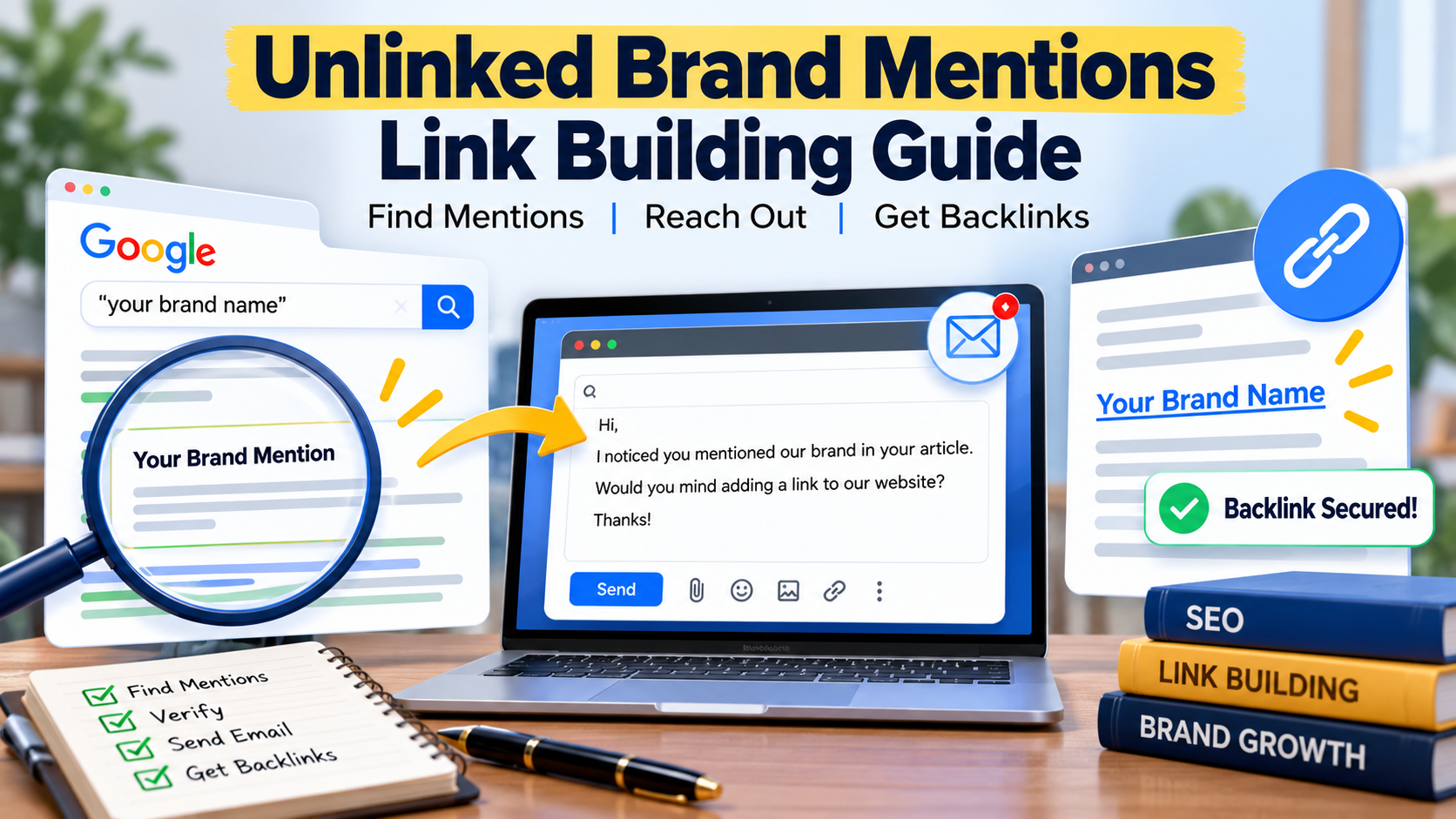
When another website mentions your brand, product, or business without linking to your website, it may create an opportunity to earn a relevant backlink. These references are called unlinked brand mentions, and they can give you a natural starting point for link-building outreach.
However, not every mention deserves a link request. You first need to find relevant pages, confirm that the mention is genuinely unlinked, and decide whether a link would help readers.
In this guide, you’ll learn how to find unlinked brand mentions using free methods and SEO tools, verify potential opportunities, evaluate websites, and request a backlink with a practical email template.
What Are Unlinked Brand Mentions?
An unlinked brand mention occurs when a website refers to your business, brand, product, or service without including a clickable link to your website. For example, a marketing blog might mention Elite Link Agency while discussing guest posting services but leave the brand name as plain text.
If the publisher links the brand name to your website, the mention is already linked. If no hyperlink exists, it may be worth investigating as a potential link-building opportunity. Before contacting the publisher, always check the original page and confirm that adding a link would be relevant and useful to readers.
Why Are Unlinked Brand Mentions Worth Finding?
Unlinked brand mentions can create opportunities to earn relevant backlinks because the publisher has already referenced your brand. A polite, personalized request may encourage the publisher to add a link to a useful page on your website.
These opportunities can also help readers discover your resources, products, or services. However, not every mention will lead to a backlink, and no link guarantees better search rankings. Focus on mentions where a link would genuinely add value for the reader.
Unlinked Brand Mentions vs. Broken Link Building
Unlinked brand mentions and broken link building are two different link-building techniques. With unlinked brand mentions, a website refers to your brand without linking to it. With broken link building, you identify a broken link on another website and suggest a relevant replacement resource.
Understanding this difference helps you choose the right outreach approach. For a more detailed explanation of broken link building, read our Broken Link Building guide.
How to Find Unlinked Brand Mentions for Free
You can start finding unlinked brand mentions without paying for SEO software. Google Search helps you discover webpages that mention your brand, while Google Alerts can notify you when Google detects new matching content.
The process is straightforward: search for your brand name and its variations, open relevant results, check whether each mention contains a link to your website, and record promising opportunities. The following free methods will help you get started.
Method 1: Use Google Search Operators
Google search operators help you find webpages that mention your brand while excluding results from your own website. This is one of the easiest ways to start discovering potential unlinked brand mentions without purchasing an SEO tool.
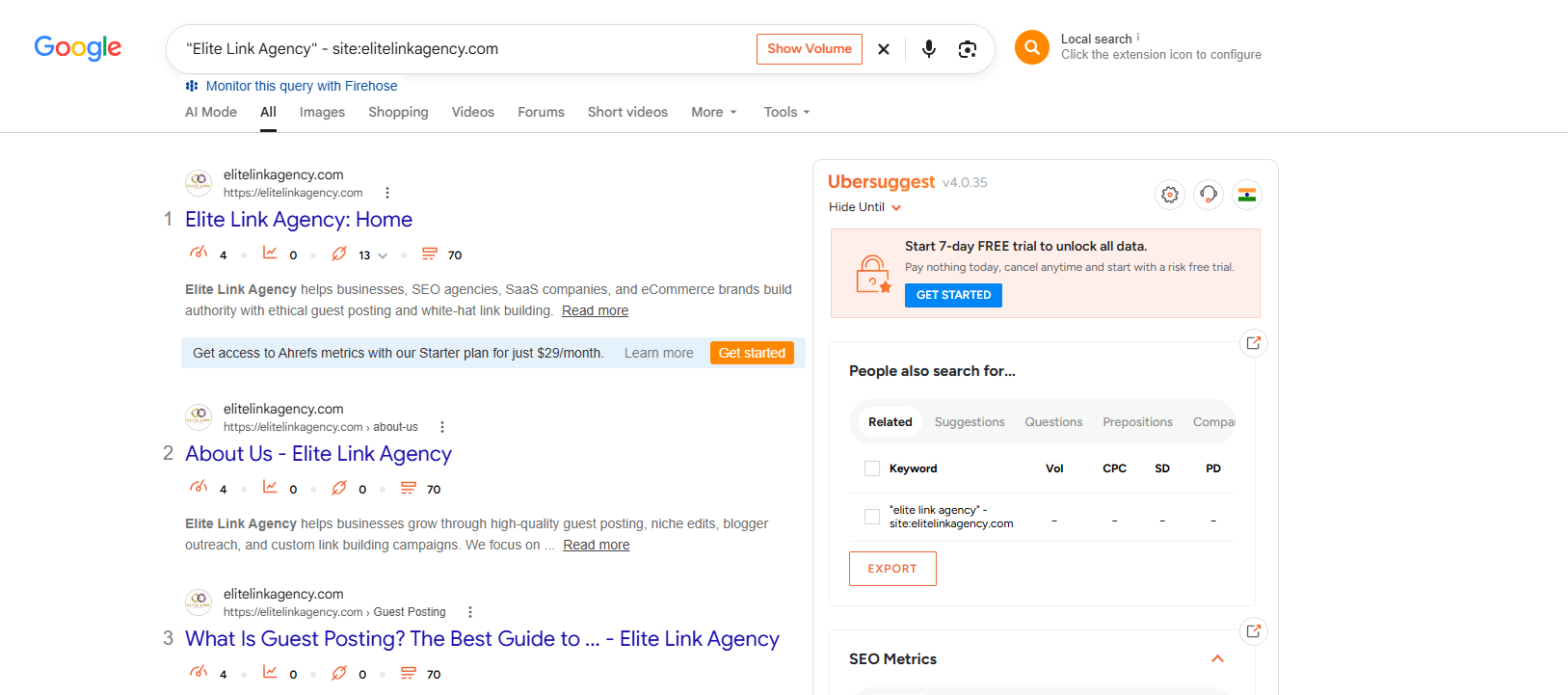
For example, search for your exact brand name in quotation marks and exclude your domain. Then review the results manually to identify relevant pages that may mention your business without linking to your website.
"Elite Link Agency" - site:elitelinkagency.com
Practical Example: Finding an Unlinked Brand Mention
Suppose you want to find webpages that mention Elite Link Agency but may not link to your website. Start with this Google search:
"Elite Link Agency" -site:elitelinkagency.com
Review the external results and open relevant pages. Use your browser’s Find feature (Ctrl + F on Windows) to locate the brand name in each article.
Next, check whether the mention contains a clickable link to your website. If no relevant link exists, assess whether adding one would help readers. Record suitable opportunities in your tracking spreadsheet, including the source URL and the most relevant destination page on your website.
Important: This search finds potential mentions, not confirmed unlinked mentions. You must inspect each original page manually before adding it to your outreach list.
Method 2: Search for Brand and Product Name Variations
Your brand may appear online under different names. A publisher might use your company name, domain name, product name, or a common spelling variation. Searching these variations can help you discover mentions that a single search would miss.
Create a short list of the names associated with your business, then search for each one separately. Use quotation marks around distinctive names to find exact phrases, and exclude your own domain when you want to focus on external websites. Review each result manually because some variations may produce unrelated pages.
Method 3: Set Up Google Alerts
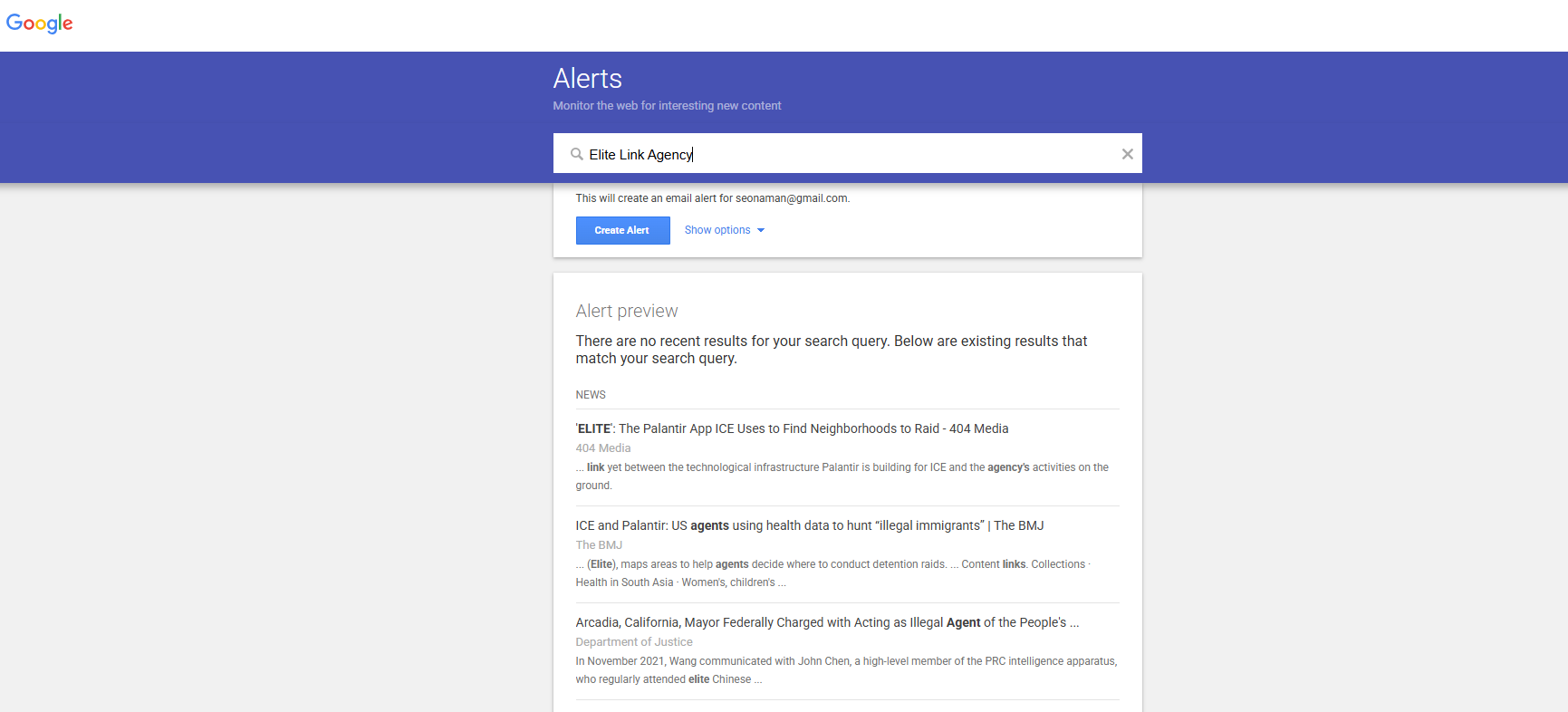
Google Alerts is a free service that can notify you when Google detects new online content matching a search query. It can help you discover newly published articles that mention your brand, although it won’t find every mention or guarantee that each alert will lead to a backlink opportunity.
To get started, visit Google Alerts, enter your brand name in the search field, and review the available alert settings. Choose how often you want to receive notifications and which sources you want to monitor. When an alert arrives, open the original page and check whether the mention includes a link to your website.
Method 4: Search Industry Blogs and Publications
Industry blogs, online magazines, news websites, and niche publications can be useful places to look for brand mentions. Search for your brand alongside topics related to your industry, products, or services to discover relevant articles.
For example, a digital marketing agency could search for its name alongside terms such as SEO, link building, or guest posting. When you find a promising result, open the original page, locate the mention, and check whether it already links to your website. Prioritize relevant editorial pages where a link would provide additional context or help readers find a useful resource.
How to Find Unlinked Mentions With SEO Tools
Free search methods are useful for getting started, but SEO tools can make it easier to investigate mentions across a larger number of webpages. Depending on the tool and subscription, you may be able to discover brand mentions, inspect referring pages, and check whether a website already links to your domain.
You don’t need every tool listed below. Choose a method that fits your budget and the number of mentions you need to investigate. Always verify potential opportunities on the original webpage before contacting its publisher. For a broader comparison of SEO tools, see our guide to the best link building tools.
Method 1: Use Ahrefs to Find Brand Mentions
Ahrefs Content Explorer can help you discover webpages that mention your brand and investigate potential unlinked brand mentions. You can search for your brand name, exclude your own domain, and review relevant pages in Ahrefs’ database. Available features and access may depend on your plan.
To find potential opportunities, open Content Explorer and search for your exact brand name. Use the -site:yourdomain.com operator to exclude your own website, then review relevant results. Where available, use the unlinked mentions feature to identify pages that do not link to your domain. Finally, open each promising page and verify the mention and link manually before contacting the publisher.
Keep in mind that available features and access levels can change. Check Ahrefs’ current documentation and pricing before choosing a workflow.
Method 2: Use Semrush to Discover Brand Mentions
Semrush’s Brand Monitoring app can help you discover and track online mentions of your brand, including mentions that do not contain a backlink to your website. Depending on the available product and subscription, it can show mention details and let you filter results by backlink status.
To use it, create a query for your brand name, add your website URL for backlink tracking, and review the results. Filter for mentions without backlinks, then open each original page to confirm that a link is genuinely missing and that adding one would help readers. Check Semrush’s current product options and pricing before subscribing, as availability may vary.
Before subscribing, review Semrush’s current features and pricing to confirm that the plan meets your needs.
Method 3: Use Google Search Console to Check Existing Links
Google Search Console is a free tool that helps website owners understand how Google sees their websites. Its Links report can show external links Google has discovered, including pages that link to your website.
Although Search Console is not a tool for discovering every unlinked brand mention, it can help you verify existing backlinks and avoid contacting publishers unnecessarily. If a website mentions your brand, check its page manually and compare the destination with the external links reported in Search Console. Remember that the report may not include every link Google knows about in real time.
Which Unlinked Mention Research Method Should You Choose?
1. Google Search — Best for Beginners
Cost: Free
Use Google Search to find webpages mentioning your brand. You can search exact brand names and exclude your own domain. The main limitation is that you must inspect the results manually.
2. Google Alerts — Best for Monitoring New Mentions
Cost: Free
Google Alerts can notify you when Google detects new content matching your brand name. It is useful for ongoing monitoring, but it won’t discover every mention.
3. Ahrefs — Best for SEO and Backlink Research
Cost: Paid features vary by plan
Ahrefs offers SEO research and backlink analysis capabilities. Check the available features in your subscription before choosing it for your workflow.
4. Semrush — Best for SEO Research
Cost: Paid features vary by plan
Semrush provides SEO research and backlink analysis tools. Review its current features to determine whether they meet your needs.
5. Google Search Console — Best for Checking Existing Backlinks
Cost: Free
Google Search Console reports external links Google has discovered for your website. It can help you review existing backlinks, but it is not a complete unlinked-mention discovery tool.
Which method should you choose?
If you’re just starting, use Google Search and Google Alerts first. If you need to investigate many pages, consider a paid SEO platform. Use Google Search Console to review existing backlinks and manually verify every potential opportunity before contacting a publisher.
How to Verify That a Brand Mention Is Actually Unlinked
Step 1: Find the Exact Mention on the Original Page
Open the original webpage where your brand appears and locate the exact mention. Read the surrounding sentence to confirm that the reference is genuinely about your business, product, or service.
Record the page URL and the sentence containing your brand mention. This information will help you verify the link status and personalize your outreach later.
Step 2: Check Whether the Mention Already Contains a Link
Locate the brand mention and check whether it contains a clickable hyperlink to your website. On a desktop, hover over the link to preview its destination or click it to inspect the URL. On mobile, tap the link and check the destination carefully.
If the mention already links to a relevant page on your website, it is not an unlinked mention opportunity. If the link points to an outdated or incorrect destination, investigate whether it needs to be updated rather than treating it as a completely unlinked mention.
Always inspect the original webpage. SEO tools can help with research, but manual verification helps prevent unnecessary outreach.
Step 3: Check the Link Destination
Check whether the webpage already links to your website through another relevant phrase, even if the brand name itself is not clickable. Open the link and confirm that it points to the correct, relevant page on your domain.
If a suitable link already exists, another link may not be necessary. If the destination is broken, outdated, or incorrect, consider whether a correction would genuinely help readers. Treat this as a potential link-update opportunity rather than automatically classifying it as an unlinked brand mention.
Step 4: Evaluate the Page Before Outreach
Before adding a mention to your outreach list, assess whether the website and article are relevant to your business. Look for useful editorial content, a genuine connection to your industry, and a natural reason to link to a resource on your website.
Don’t judge a prospect by Domain Rating alone. Review the page’s content, relevance, and editorial quality. Be cautious with websites that publish copied or thin content, contain excessive unrelated outbound links, or appear to exist mainly to sell backlinks.
Prioritize mentions that are genuinely unlinked and appear on relevant, trustworthy pages where a link could help readers. If a page offers little value or has no clear connection to your business, skip it and focus on better prospects.
How to Evaluate an Unlinked Mention Before Requesting a Backlink
Not every unlinked brand mention is worth pursuing. Before contacting a publisher, assess whether the website is relevant to your business, whether the article provides useful information, and whether a link to your website would benefit readers.
Focus on three factors: topical relevance, editorial quality, and the usefulness of the proposed link. These checks can help you prioritize genuine opportunities instead of spending time on unsuitable websites.
Check Topical Relevance and Editorial Quality
Check whether the website publishes content related to your industry, audience, or area of expertise. For example, a digital marketing agency may find a mention on an SEO publication more relevant than one on an unrelated entertainment website.
Review the article for useful information, original content, clear writing, and signs of genuine editorial oversight. Don’t rely on Domain Rating alone. A website’s relevance and the quality of the actual page matter when deciding whether a backlink request makes sense.
Check Whether a Link Would Help Readers
Before requesting a backlink, consider whether readers would genuinely benefit from clicking through to your website. The destination should provide useful information that supports the context of the original article.
For example, if an article mentions your guest posting service, a link to the relevant service page may help readers learn more. However, if your website offers nothing useful for that particular mention, requesting a link may not be appropriate.
Focus on links that add context or help readers find relevant resources. Don’t ask publishers to add links solely because your brand appears in their content.
Identify Spam Signals and Low-Quality Websites
Before contacting a publisher, look for warning signs such as thin or copied content, excessive unrelated outbound links, intrusive advertisements, and articles that appear to exist mainly to sell backlinks.
Don’t judge a website by Domain Rating alone. Review the actual article, its relevance to your audience, and whether the website appears to maintain genuine editorial standards. A high score does not automatically make a website trustworthy, just as a low score does not automatically make it unsuitable.
Skip websites that appear manipulative or offer little value to readers. Focus on relevant publications where a link would make sense in the context of the article.
For more guidance on ethical link-building practices, read our guide to white hat link building.
How to Turn an Unlinked Brand Mention Into a Backlink
Once you’ve verified and evaluated an unlinked brand mention, decide whether contacting the publisher is worthwhile. Your goal is to explain why a link to a relevant page could help readers, without assuming the publisher must add one.
Keep your outreach specific, brief, and respectful. Refer to the article, identify the brand mention, and suggest a useful destination on your website. The publisher should always be free to decide whether the link fits their content and editorial guidelines.
Find the Right Editor or Website Owner
Identify the person responsible for the article or website. Depending on the publication, this may be the article’s author, an editor, a content manager, or the website owner.
Check the website’s author page, contact page, or editorial team information to find the appropriate contact. Use a publicly listed professional email address when available, and personalize your message to the specific article. Avoid guessing private email addresses or sending identical messages to unrelated contacts.
A relevant, personalized request makes it easier for the recipient to understand why you’re contacting them.
Choose the Most Relevant Destination Page
Before sending your request, choose the page on your website that best supports the context of the original article. Your homepage may suit a general company mention, while a relevant service page, product page, or informative resource may be more useful for a specific reference.
For example, if an article mentions your guest posting services, linking to your guest posting service page may help readers find relevant information. Make sure the destination accurately matches the mention and provides value to the reader.
Don’t insist on a specific anchor text. Let the publisher choose wording and link placement that fit naturally within the article and their editorial guidelines.
Write a Personalized Link Request
Write a short email that identifies the article, mentions where your brand appears, and politely suggests a relevant page on your website. Explain how the link could help readers find additional information, without demanding a backlink.
Personalize the message for each publisher. Avoid generic compliments, exaggerated SEO claims, and pressure tactics. Keep the request clear and respectful, and let the publisher decide whether the link fits their editorial guidelines.
For more tips on writing effective outreach messages, read our guide to guest post outreach.
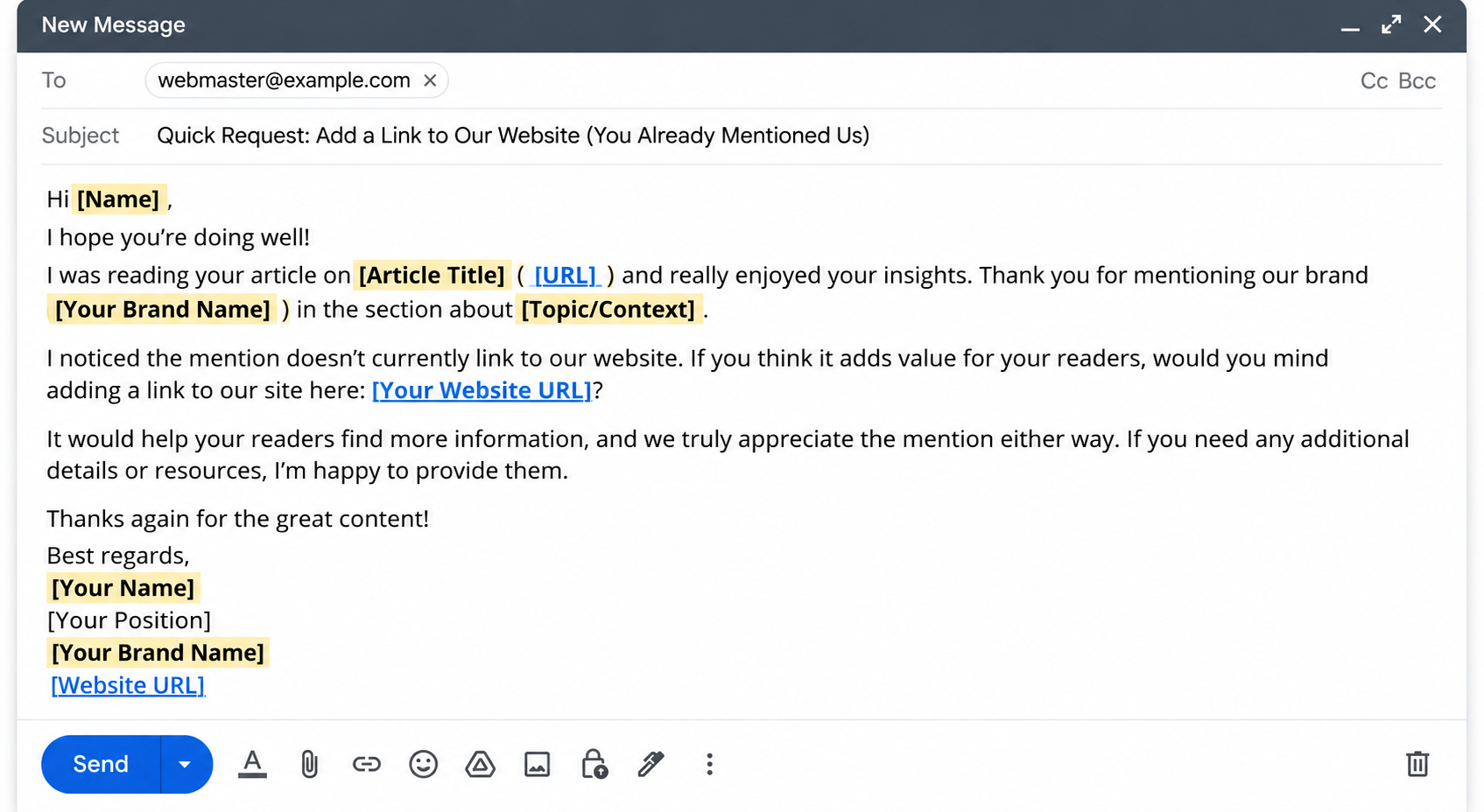
Unlinked Brand Mention Outreach Email Template
Once you find a relevant unlinked brand mention, a short, personalized email can help you ask the publisher to consider adding a link. The goal is to explain the opportunity clearly without pressuring the recipient or assuming they must make the change.
Use the following template as a starting point. Replace the placeholders with accurate details about the article, your brand, and the page that would be useful to readers.
Sample Email for Requesting a Backlink
Subject: Quick question about your article on [Topic]
Hi [Name],
I came across your article, [Article Title], and noticed the mention of [Your Brand Name].
Thanks for including us in your article. I wanted to ask whether you’d consider linking the mention to [Relevant Page URL], so readers can easily find more information.
Of course, I understand if it doesn’t fit your editorial guidelines.
Thanks for your time.
Best regards, [Your Name] [Your Company]
How to Follow Up on a Link Request
If you don’t receive a reply, consider sending one polite follow-up after five to seven business days. Keep it brief, refer to your original message, and make it easy for the recipient to respond. Avoid repeated follow-ups if they don’t reply or indicate that they’re not interested.
Example follow-up email
Subject: Following up on my link request
Hi [Name],
I wanted to briefly follow up on my earlier email about the mention of [Your Brand Name] in your article, [Article Title].
If you think linking to [Relevant Page URL] would be useful for your readers, I’d appreciate your consideration. No worries if it isn’t a fit.
Thanks for your time.
Best regards, [Your Name]
How to Track and Prioritize Unlinked Mention Opportunities
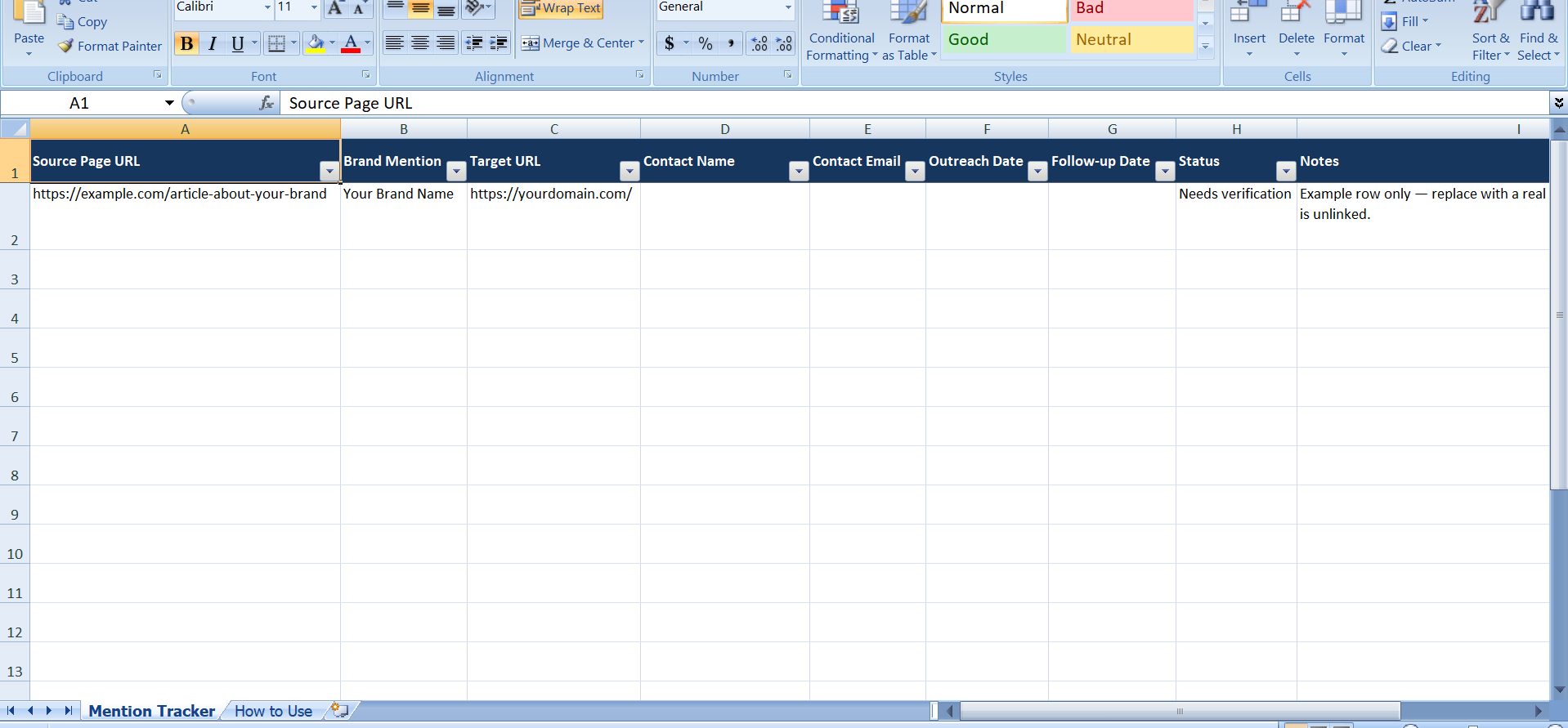
Once you’ve found and verified unlinked brand mentions, organize them in a spreadsheet so you can manage opportunities and track your outreach. Recording each prospect helps you avoid duplicate emails and remember which publishers have responded.
Focus on relevant websites where a link could genuinely help readers. Track the source page, brand mention, suggested destination, contact details, outreach status, and follow-up date so you can manage each opportunity efficiently.
Create a Simple Unlinked Mention Tracking Spreadsheet
Use Google Sheets or Excel to create a simple tracker for every unlinked brand mention you verify. Add one row per opportunity so you can organize prospects and monitor outreach without contacting the same publisher twice.
Include these columns:
Source page URL
Brand mention
Suggested destination URL
Website relevance or priority
Publisher’s name and public contact email
Outreach date
Follow-up date
Status (Not Contacted, Contacted, Followed Up, Accepted, Declined, or No Response)
Update the tracker whenever you contact a publisher or receive a reply. This will help you identify pending follow-ups and keep your outreach organized.
Prioritize the Most Relevant Opportunities First
Review your tracker and prioritize mentions based on their relevance to your business, the quality of the article, and whether a link would genuinely help readers.
Mark each opportunity as High, Medium, or Low priority. For example, a relevant industry article that discusses your service may deserve attention before an unrelated page that mentions your brand only in passing.
Use SEO metrics such as Domain Rating as supporting information, not your only selection criteria. Focus first on relevant, useful opportunities and record each publisher’s response so you can refine your outreach process over time.
Common Mistakes to Avoid When Finding Unlinked Brand Mentions
Finding unlinked brand mentions can help you identify backlink opportunities, but mistakes in research and outreach can waste time or damage relationships with publishers.
Avoid the following common mistakes to keep your process focused, professional, and useful to both you and the publisher.
Mistake 1: Assuming Every Brand Mention Deserves a Link
Not every brand mention is a suitable backlink opportunity. Some references are incidental, appear on unrelated websites, or provide no natural reason to link to your business.
Before contacting the publisher, ask yourself whether a link would help readers find useful information. If the connection is weak or the proposed link adds no value, skip the opportunity and focus on more relevant mentions.
Mistake 2: Sending Generic Outreach Emails
Sending the same email to every publisher can make your request feel impersonal. Instead, mention the specific article, identify where your brand appears, and explain why a link to your suggested page could help readers.
Keep each message brief and relevant to the recipient. Check the article details before sending, avoid exaggerated claims, and make the request polite enough that the publisher can easily decide whether to consider it.
Mistake 3: Prioritizing Domain Rating Over Relevance
A high Domain Rating does not automatically make a website a good backlink prospect. A website with strong SEO metrics may still be unrelated to your business, while a smaller publication may have relevant content and a genuine audience.
Evaluate the article’s relevance, editorial quality, and the usefulness of the proposed link. Use Domain Rating as one supporting metric rather than the main reason to contact a publisher.
Mistake 4: Forgetting to Verify Existing Links
A brand mention may already have a relevant link to your website, even if the brand name itself is not clickable. For example, another phrase in the same article may link to your service page.
Before sending an outreach email, inspect the original webpage and check whether a suitable link already exists. This simple check helps you avoid unnecessary requests and keeps your outreach focused on genuine opportunities.
Mistake 5: Sending Too Many Follow-Up Emails
Repeatedly emailing a publisher who hasn’t responded can damage your professional relationship. They may be busy, uninterested, or unable to update the article.
If you choose to follow up, send one brief, polite reminder after five to seven business days. If the publisher declines or doesn’t respond after your follow-up, close the opportunity and focus on other prospects.
Frequently Asked Questions
Here are answers to common questions about finding unlinked brand mentions, checking potential backlink opportunities, and contacting website publishers.
How Do I Find Unlinked Brand Mentions on Google?
Search Google for your exact brand name in quotation marks and exclude your own domain using the -site: operator. For example, search "Your Brand Name" -site:yourdomain.com. Review relevant results, locate the brand mention, and check whether it links to your website. Repeat the process with product names and common brand variations to find additional opportunities.
Can I Find Unlinked Brand Mentions for Free?
Yes. You can find unlinked brand mentions for free using Google Search and Google Alerts. Search for your brand name and its variations, exclude your own domain where appropriate, and manually check relevant pages for links to your website.
Google Search Console can help you review existing backlinks, but it does not discover every unlinked mention. Paid SEO tools may save time when researching many pages, but they aren’t essential for getting started.
Are Unlinked Brand Mentions Backlinks?
No. An unlinked brand mention is a reference to your brand without a hyperlink to your website, so it is not itself a backlink. It becomes a backlink only if the publisher adds a link to your website.
The value of that link depends on factors such as relevance, context, and how it is implemented. Not every backlink will improve search rankings.
How Do I Ask a Website to Link to My Brand?
Find the author, editor, or website owner responsible for the article mentioning your brand. Send a short, personalized email that identifies the article, refers to your brand mention, and politely suggests a relevant page on your website.
Explain how the link could help readers find useful information. Avoid demanding a backlink or sending repeated follow-ups, and respect the publisher’s editorial decision.
Are Unlinked Brand Mentions a Google Ranking Factor?
Google has not confirmed unlinked brand mentions as a direct ranking factor. A mention without a hyperlink is not the same as a backlink, so you should not assume that every mention will improve your search rankings.
Unlinked mentions can still help people discover your brand and may create opportunities to earn relevant editorial links. Focus on useful content, genuine brand visibility, and relevant links rather than treating every mention as a ranking signal.
Can I Find Unlinked Mentions of Competitors?
Yes. Search Google for competitors’ brand names, product names, and distinctive terms using quotation marks where appropriate. Review relevant results to discover which websites and publications cover businesses in your industry.
Use these findings to identify relevant publications and understand the topics they cover. A competitor’s brand mention is not automatically a backlink opportunity for your website, so focus on creating or recommending resources that genuinely fit the publication’s content.
Final Thoughts on Finding Unlinked Brand Mentions
Finding unlinked brand mentions is a practical way to discover potential backlink opportunities. Start with Google Search and Google Alerts, use SEO tools when needed, and manually verify each mention before contacting a publisher.
Prioritize relevant websites, choose a destination page that genuinely helps readers, and send personalized, respectful outreach. Some publishers may add a link, while others may decline or not respond. No backlink is guaranteed, and no single link guarantees better rankings.
By consistently finding, verifying, evaluating, and tracking mentions, you can build a more organized outreach process and focus on opportunities that make sense for your business.