If you’ve spent any time learning about SEO, you’ve probably come across the term niche edits. Also known as contextual link insertions, niche edits have become one of the most popular link-building strategies because they place backlinks inside existing, relevant content rather than creating entirely new articles. When executed correctly, this approach can help improve a website’s authority, increase organic visibility, and support long-term search engine rankings.
Unlike guest posting, where new content is written specifically to earn a backlink, niche edits involve adding a relevant link to an already published article. Since these pages may already have established authority, indexed content, and existing traffic, many SEO professionals consider niche edits an efficient way to strengthen a backlink profile.
However, not all niche edits are created equal. The quality of the website, the relevance of the content, and the way the link is placed all play a crucial role in determining whether the strategy provides lasting value or introduces unnecessary risk.
In this guide, you’ll learn what niche edits are, how they work, their benefits and potential risks, how they compare with guest posting, and the best practices for using contextual link insertions as part of a sustainable SEO strategy
What Are Niche Edits in SEO?
Niche edits are an SEO link-building strategy where a backlink is added to an existing, already-published webpage instead of creating a brand-new article. The link is inserted naturally into relevant content that has already been indexed by search engines, making it a contextual backlink placed within an established page.
Because the content already exists, niche edits are often called contextual link insertions, link insertions, or curated links. The objective is to enhance the article with a relevant reference that benefits readers while directing them to additional useful information.
Unlike many other link-building methods, niche edits don’t require writing new content from scratch. Instead, the website owner or editor updates an existing article by adding a contextual link where it makes editorial sense. When the surrounding content is relevant and the destination page genuinely helps the reader, the link feels like a natural part of the article rather than an advertisement.
However, the value of a niche edit depends on the quality of the website, the relevance of the topic, and the editorial standards of the publisher. A contextual link placed on a trusted, well-maintained website is generally far more valuable than multiple links from low-quality or unrelated domains.
Quick Definition
Niche edits are contextual backlinks added to existing, relevant, already-published webpages to improve a website’s authority and organic search visibility.
Why Are They Called Contextual Link Insertions?
The term contextual link insertion comes from the way the backlink is added. Instead of appearing in a sidebar, footer, or author bio, the link is inserted directly into the main body of an article where it naturally fits the discussion.
For example, imagine an article about improving local SEO that already discusses different backlink strategies. If the article is updated with a sentence linking to a detailed guide about niche edits, readers receive additional information without disrupting the flow of the content. This editorial placement is what makes contextual link insertions different from many traditional backlink types.
How Are Niche Edits Different from Other Backlinks?
Not every backlink is created the same way. Some require publishing a new article, while others are earned naturally through citations or editorial mentions. Niche edits stand out because they build upon content that already exists.
Link Building Method
How It Works
New Content Required?
Niche Edits
Adds a contextual backlink to an existing article
❌ No
Guest Posting
Publishes a new article with one or more backlinks
✅ Yes
Resource Page Links
Adds your website to a curated resource page
Usually No
Editorial Mentions
A publisher links to your content voluntarily
❌ No
For businesses looking to build authority efficiently, niche edits can complement strategies like guest posting, digital PR, and editorial link building as part of a balanced SEO campaign.
How Do Niche Edits Work?
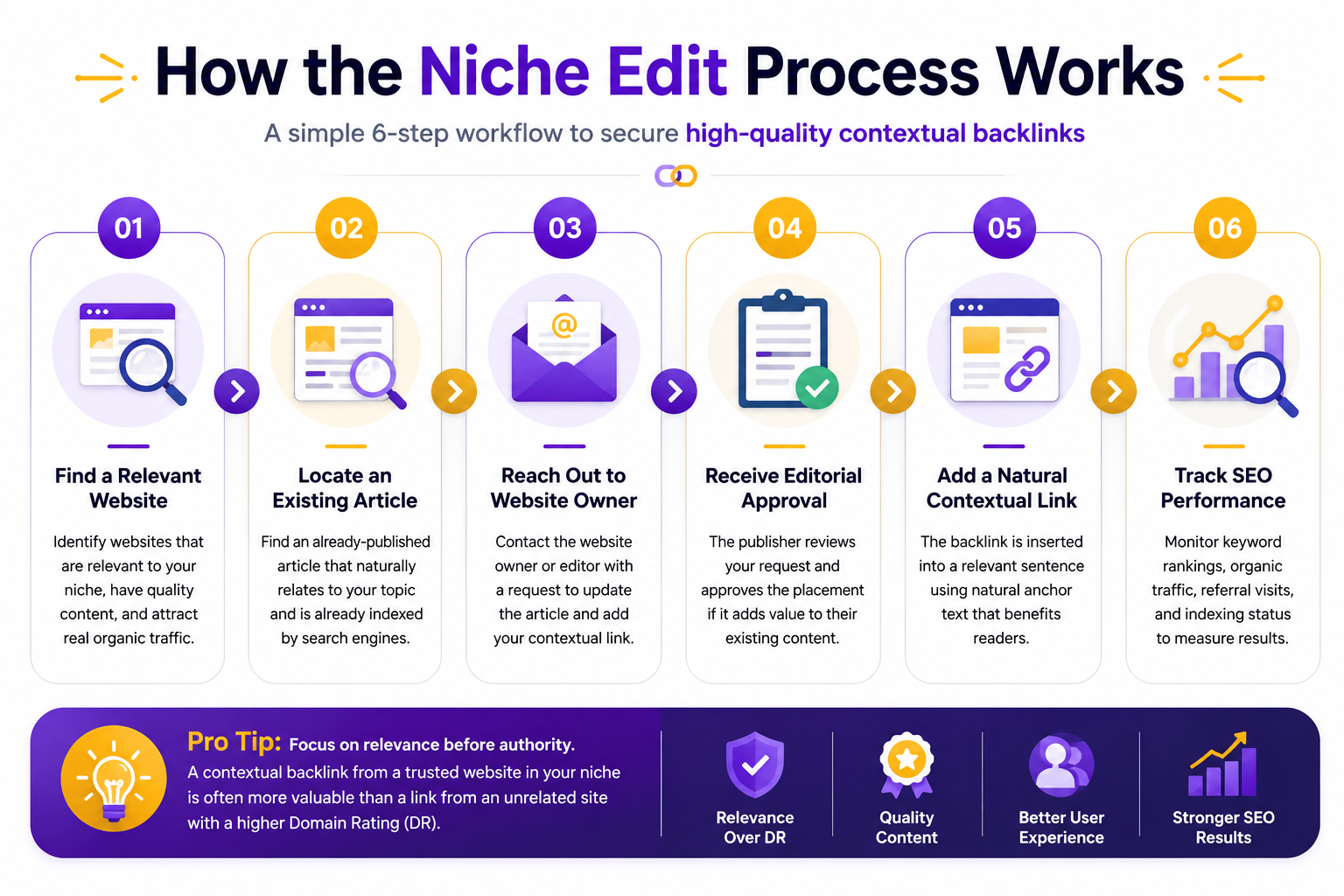
A niche edit campaign involves updating an existing article with a relevant contextual backlink rather than publishing new content. The objective is to place the link naturally where it provides additional value to readers while maintaining the quality and relevance of the original page.
Although the process appears straightforward, successful niche edits require careful website selection, editorial approval, and thoughtful link placement. Below is a typical workflow followed by reputable SEO agencies.
Step 1: Identify Relevant Websites
The first step is finding websites that are closely related to your niche. Relevance is often more important than simply choosing the highest Domain Rating (DR). A backlink from a trusted website within your industry generally provides greater long-term value than a link from an unrelated high-authority domain.
Step 2: Find an Existing Article
Instead of writing a new post, locate an already-published article that naturally relates to your topic. The content should already be indexed by search engines, informative, and capable of supporting an additional contextual reference without feeling forced.
Contact the website owner or editor using a personalized link building outreach strategy and request an editorial update. If they agree, they will review the suggested placement to ensure the backlink improves the article rather than appearing promotional.
Step 4: Add the Contextual Link
Once approved, the backlink is inserted into a relevant sentence using natural anchor text. The link should blend seamlessly with the surrounding content and provide readers with useful additional information.
Step 5: Monitor Performance
After the update is published, monitor your SEO performance over the following weeks. Keep an eye on keyword rankings, organic traffic, referral visits, and indexing status to evaluate the impact of the backlink within your overall link-building strategy.
💡 SEO Best Practice
Focus on relevance before authority. A contextual backlink from a trusted website within your niche is usually more valuable than a link from an unrelated website with a higher Domain Rating (DR). Always prioritize editorial quality, organic traffic, and topical relevance over SEO metrics alone.
Why Are Niche Edits Important for SEO?
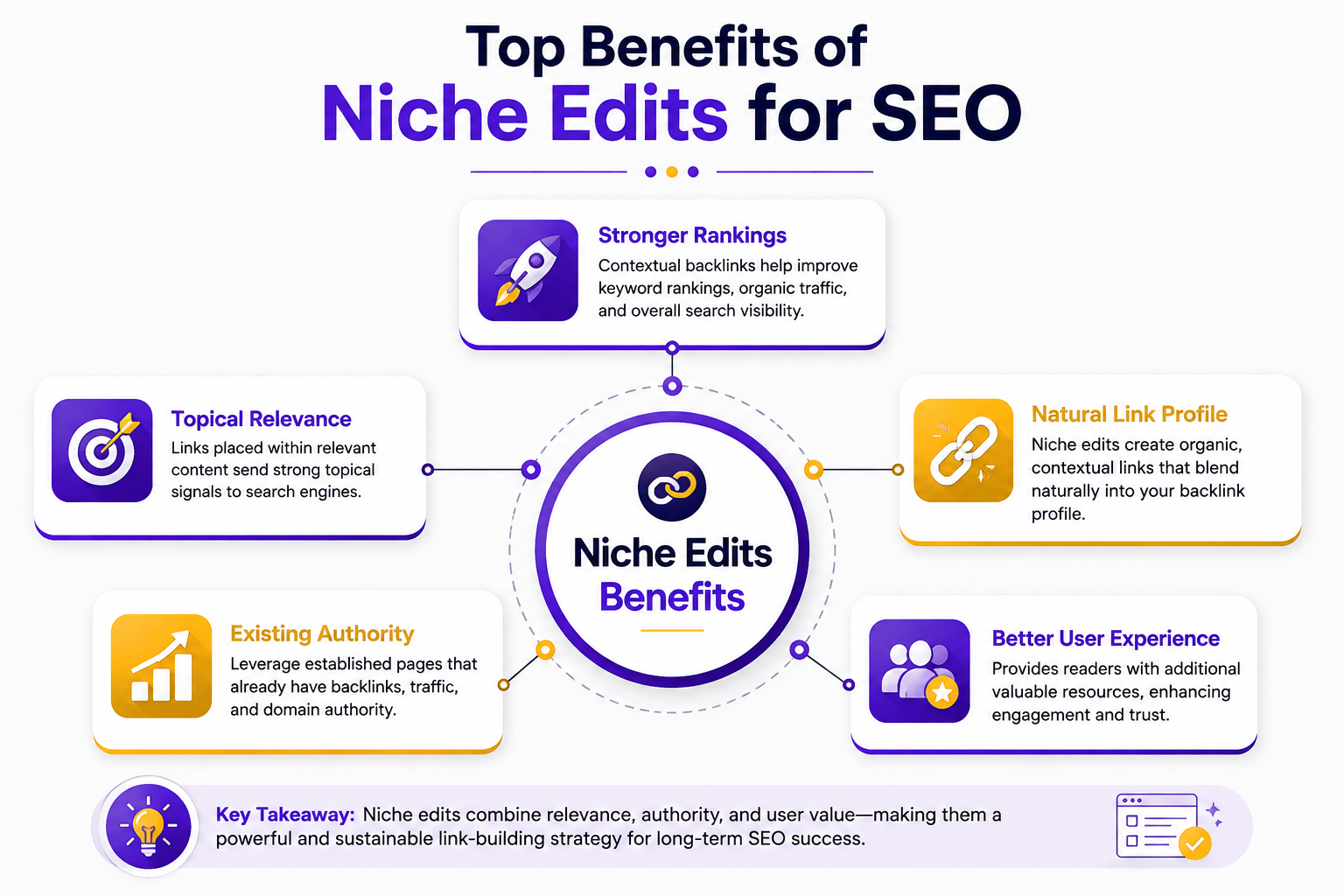
Niche edits have become one of the most widely used link-building strategies because they combine topical relevance, editorial placement, and existing page authority. Instead of earning a backlink from a newly published article, niche edits place your link within content that is already indexed, trusted by search engines, and potentially generating organic traffic.
However, niche edits are not a magic solution for higher rankings. Their success depends on the quality of the website, the relevance of the content, the natural placement of the backlink, and whether the link genuinely benefits readers. When these elements come together, niche edits can strengthen your overall SEO strategy and complement other white-hat link-building methods.
Build Strong Topical Relevance
Search engines analyze the relationship between linked pages. A backlink placed within highly relevant content sends stronger topical signals than a link placed on an unrelated website. This contextual relevance helps search engines better understand your page and its subject matter.
Benefit from Existing Authority
One of the biggest advantages of niche edits is that the backlink is added to a page that may already have backlinks, keyword rankings, and consistent organic traffic. Rather than waiting for a new article to gain authority, your link becomes part of an established page.
Improve the User Experience
A well-placed niche edit provides readers with additional resources that naturally expand on the topic they are already reading. Instead of interrupting the content, the backlink adds value by directing users to more detailed or complementary information.
Support a Natural Link Building Strategy
A healthy backlink profile includes a mix of different link types. Niche edits work best when combined with guest posting, digital PR, editorial mentions, and other white-hat strategies. This balanced approach creates a more natural and sustainable link profile over time.
SEO Benefit
Why It Matters
Topical Relevance
Helps search engines understand the relationship between pages.
Existing Authority
Leverages already indexed pages that may have backlinks and traffic.
Better User Experience
Provides readers with useful, contextual resources.
Balanced Link Profile
Complements guest posting, digital PR, and other white-hat SEO strategies.
The infographic below summarizes the five key SEO advantages of using high-quality niche edits as part of a balanced link-building strategy.
Types of Niche Edits
Not all niche edits are created equal. Depending on your SEO goals and the publisher’s editorial policies, contextual backlinks can be added in different ways. Understanding these variations helps you choose the most appropriate strategy while maintaining a natural and sustainable backlink profile.
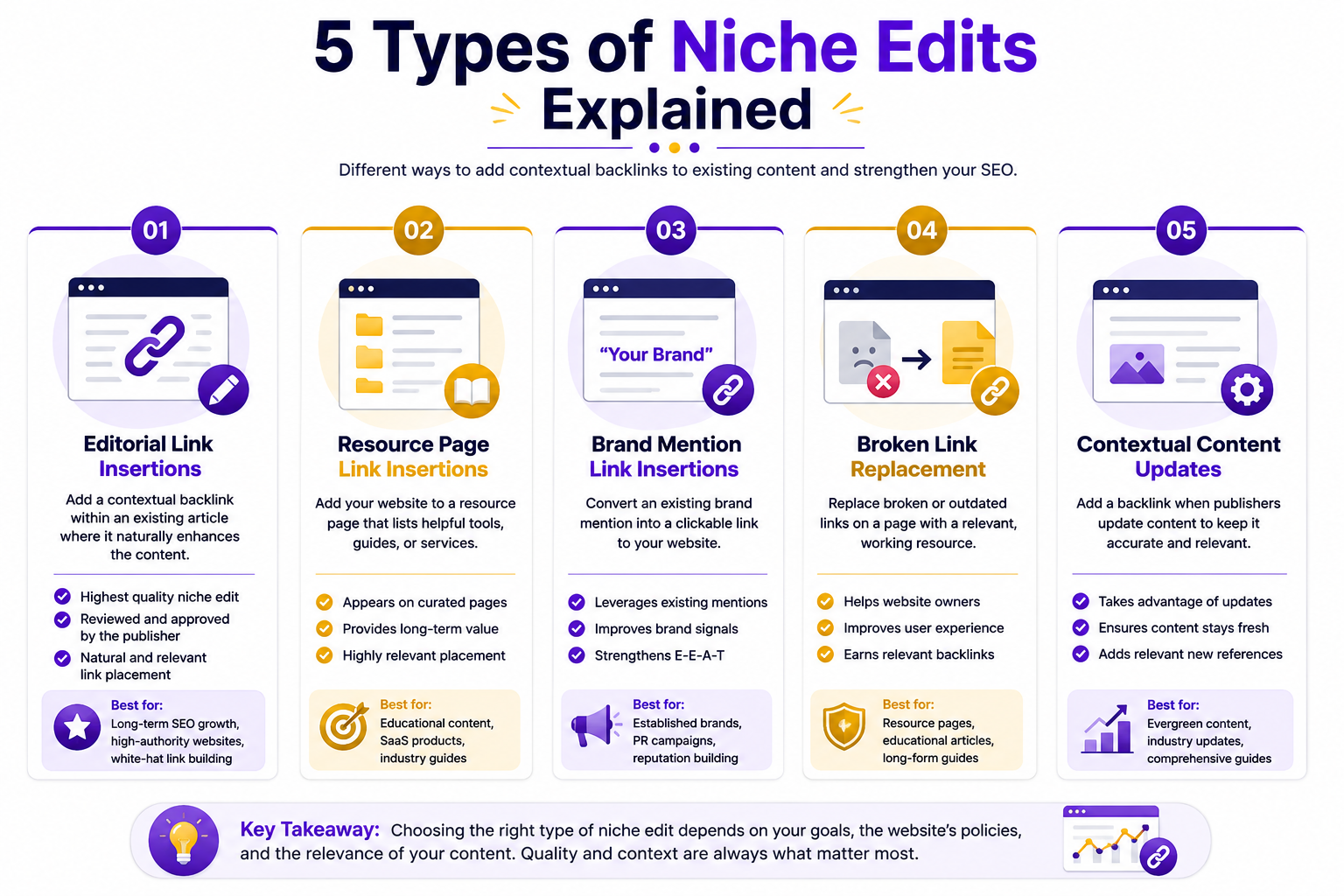
Below are the five most common types of niche edits used by SEO professionals.
1. Editorial Link Insertions
Editorial link insertions involve adding a contextual backlink to an existing article where it naturally enhances the content. Because the link is reviewed and approved by the publisher, this is generally considered the highest-quality type of niche edit.
Some websites maintain resource pages that recommend useful tools, guides, or services. For example, businesses looking for a reliable screen recorder can be added as a valuable resource when the tool genuinely helps users. If your content genuinely provides value, we can add your website as a new resource in an editorial update.
Best for:
Educational content
SaaS products
Industry guides
3. Brand Mention Link Insertions
Sometimes a website mentions your brand without linking to it. In these cases, you can contact the publisher and request that the existing mention be updated with a relevant backlink.
Best for:
Established brands
PR campaigns
Reputation building
4. Broken Link Replacement
When a webpage contains a broken or outdated external link, website owners may replace it with a relevant working resource. If your content matches the topic, this creates an opportunity to earn a valuable contextual backlink while helping improve the user experience.
Best for:
Resource pages
Educational articles
Long-form guides
5. Contextual Content Updates
Publishers regularly update older articles to keep them accurate and relevant. During these updates, they may add new references and contextual backlinks to improve the quality of the content.
The infographic below compares the five most common types of niche edits and explains when each strategy is most effective.
Niche Edits vs Guest Posting
Both niche edits and guest posting are valuable link-building strategies, but they serve different purposes. Niche edits involve adding a contextual backlink to an existing article, while guest posting requires publishing a brand-new article on another website.
Each approach has its own advantages depending on your SEO goals, budget, and timeline. Rather than repeating the full comparison here, we’ve created a dedicated guide that explains the differences, benefits, costs, and ideal use cases in detail.
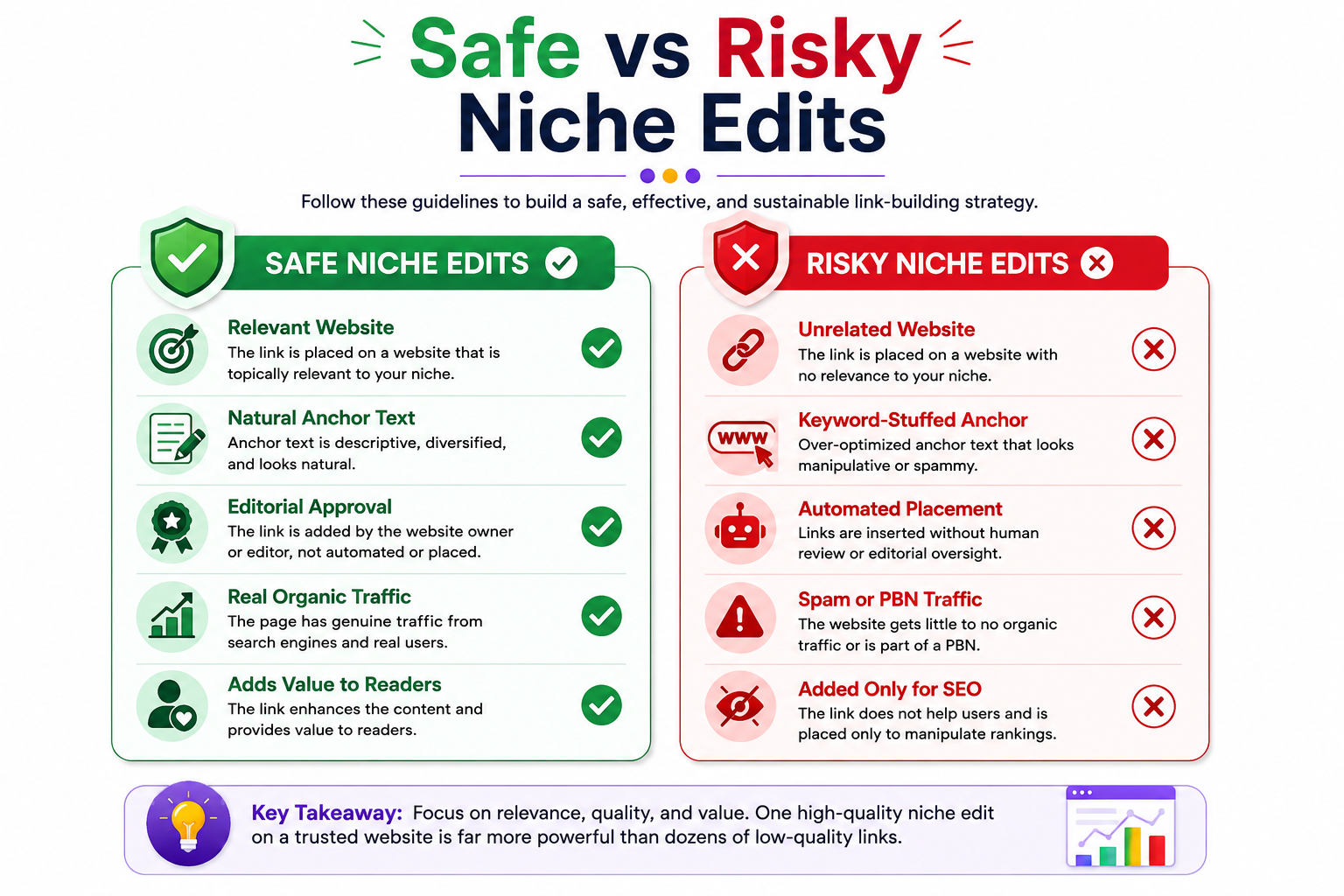
Niche edits are not inherently risky. Like any link-building strategy, their safety depends on how the links are acquired, where they’re placed, and whether they provide genuine value to readers. High-quality niche edits added naturally to relevant content on reputable websites can be an effective part of a long-term SEO strategy.
Problems usually arise when backlinks are placed on low-quality websites, private blog networks (PBNs), spammy pages, or articles that have little topical relevance. Search engines are designed to detect manipulative link schemes, so prioritizing quality over quantity is essential.
What Makes a Niche Edit Safe?
A safe niche edit should meet these criteria:
✔️ Published on a relevant website within your niche.
✔️ Placed naturally within the existing content.
✔️ Uses descriptive, non-spammy anchor text.
✔️ Adds value for readers instead of existing only for SEO.
✔️ Appears on a page with real organic traffic and editorial quality.
Warning Signs to Avoid
Be cautious if a provider offers:
❌ Hundreds of niche edits for extremely low prices.
❌ Links from unrelated websites.
❌ Over-optimized exact-match anchor text.
❌ PBNs or obvious link farms.
❌ No information about the websites where links will be placed.
SEO Best Practice
Rather than chasing the highest Domain Rating (DR), focus on topical relevance, organic traffic, editorial standards, and content quality. One well-placed contextual backlink from a trusted website can be more valuable than dozens of low-quality links.
Safe Niche Edit ✅
Risky Niche Edit ❌
Relevant website
Unrelated website
Natural anchor text
Keyword-stuffed anchor
Editorial approval
Automated placement
Real organic traffic
Spam or PBN traffic
Adds value to readers
Added only for SEO
The infographic below highlights the differences between safe and risky niche edits, helping you identify link-building practices that support long-term SEO success.
How Much Do Niche Edits Cost?
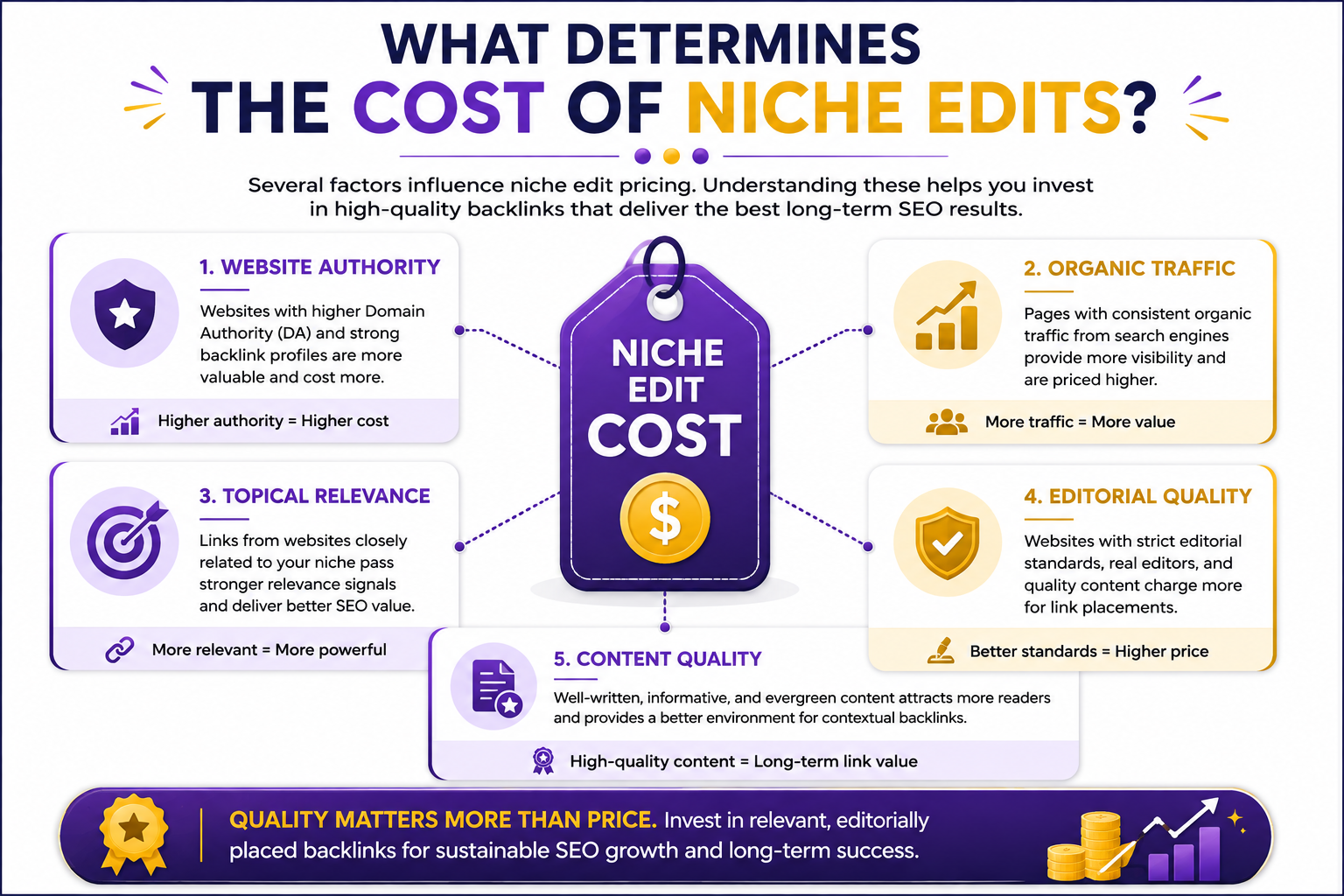
The cost of niche edits varies significantly depending on the quality of the website, its authority, organic traffic, niche relevance, and editorial standards. While low-cost offers may seem attractive, pricing often reflects the quality of the website and the long-term value of the backlink.
Most reputable SEO agencies and outreach providers focus on acquiring links from real websites with genuine traffic rather than simply offering the cheapest option. Investing in high-quality niche edits can deliver better long-term SEO results than purchasing multiple low-quality backlinks.
Average Niche Edit Pricing
Although prices vary, the following ranges are common in the industry:
Website Quality
Typical Price Range
New or Low-Authority Website
$30–$80
Mid-Authority Website
$80–$200
High-Authority Website
$200–$500+
Premium Editorial Websites
$500–$2,000+
What Affects the Cost?
Several factors influence the price of a niche edit:
Website Authority – Established websites with strong backlink profiles usually charge more.
Organic Traffic – Pages receiving consistent search traffic are generally more valuable.
Topical Relevance – Links from websites closely related to your niche often deliver stronger SEO value.
Editorial Standards – Websites with strict review processes typically command higher prices.
Content Quality – Well-written, evergreen articles provide better long-term link opportunities.
Should You Buy the Cheapest Niche Edits?
Not necessarily.
Extremely cheap niche edits often come from low-quality websites, expired domains, spam networks, or pages with little organic visibility. These links may provide little value and, in some cases, can introduce unnecessary SEO risk.
Instead of focusing only on price, evaluate:
✔️ Topical relevance
✔️ Organic traffic
✔️ Editorial quality
✔️ Natural link placement
✔️ Overall website trust
A single high-quality niche edit can often outperform several low-quality backlinks.
💡 Pro Tip
When comparing providers, ask for examples of recently placed niche edits, traffic metrics, and the types of websites they work with. Transparency is usually a good indicator of quality.
📊 Comparison Table
Cheap Niche Edit
Quality Niche Edit
Lowest price
Long-term SEO value
Low-quality websites
Relevant authority websites
Little or no traffic
Real organic traffic
Automated placement
Editorially reviewed placement
Short-term focus
Sustainable rankings
Frequently Asked Questions About Niche Edits
Are niche edits safe for SEO?
Yes, niche edits are safe for SEO when they are placed naturally within relevant, high-quality content on trusted websites. The best niche edits provide additional value to readers, use natural anchor text, and follow Google’s quality guidelines. Avoid links from spammy websites, private blog networks (PBNs), or pages created solely for selling backlinks.
Do niche edits still work in 2026?
Yes. Niche edits remain an effective white-hat link-building strategy in 2026 when they are earned through reputable websites with genuine traffic and editorial standards. High-quality contextual backlinks continue to improve topical authority, rankings, and referral traffic over the long term.
What is the difference between a niche edit and a guest post?
A niche edit adds a backlink to an existing, already-indexed article, while a guest post requires publishing a brand-new article on another website. Niche edits can produce faster results because the page may already have authority, backlinks, and search engine visibility.
How much do niche edits cost?
The cost of niche edits varies depending on website authority, organic traffic, niche relevance, editorial quality, and publisher reputation. Quality niche edits generally cost more because they are placed on trusted websites that provide long-term SEO value instead of temporary ranking gains.
How long does it take for niche edits to show SEO results?
Most niche edits begin showing measurable SEO improvements within 4 to 12 weeks, although the timeline depends on your website’s authority, keyword competition, crawl frequency, and the quality of the linking page. Results are usually gradual rather than immediate.
Are niche edits better than guest posts?
Neither strategy is universally better. Niche edits are ideal for acquiring backlinks from existing authoritative pages, while guest posts are better for publishing fresh content, building brand awareness, and earning multiple contextual links. Many successful SEO campaigns use both strategies together.
Can niche edits hurt my website?
Only low-quality niche edits can hurt your website. Links placed on irrelevant, spammy, or manipulated websites may increase SEO risk. Choosing editorially reviewed placements on relevant websites with real organic traffic helps minimize risk and supports sustainable rankings.
What makes a high-quality niche edit?
A high-quality niche edit is placed naturally within relevant content on an authoritative website with genuine traffic. It uses descriptive anchor text, appears editorially approved, adds value to readers, and fits naturally within the surrounding content instead of looking promotional.
Should I choose the cheapest niche edit service?
Not necessarily. Extremely cheap niche edits often come from low-quality websites with little traffic or weak editorial standards. Investing in fewer, high-quality contextual backlinks usually provides better long-term SEO performance than purchasing large numbers of inexpensive links.
How do I choose the right niche edit provider?
Look for providers that offer transparent website metrics, real organic traffic, relevant niche placements, editorial approval, natural anchor text, and examples of previous work. A reputable provider should prioritize quality and relevance over quantity.
Final Thoughts
Choosing the right link-building strategy is about more than simply acquiring backlinks—it’s about earning relevant, high-quality links that provide long-term value for both users and search engines. When implemented correctly, niche edits can strengthen your website’s authority, improve topical relevance, and support sustainable organic growth without relying on manipulative SEO tactics.
The most successful niche edit campaigns focus on quality over quantity. Rather than chasing hundreds of inexpensive backlinks, invest in contextual placements on trusted, relevant websites with real organic traffic and strong editorial standards. A single well-placed backlink often delivers more value than dozens of low-quality links.
If you’re considering niche edits as part of your SEO strategy, remember that they work best alongside other proven link-building methods such as link building outreach, guest posting, digital PR, broken link building, and editorial outreach.
. A balanced backlink profile is more natural, more resilient, and better aligned with long-term search engine success.
Ready to Build High-Quality Contextual Backlinks?
If you’re looking for editorially placed niche edits on real, relevant websites, explore our Niche Edits Service to learn how we help businesses earn high-quality backlinks that support long-term SEO growth.