Spending money on backlinks is easy. Knowing whether that money was well spent is a different story.
You might build links for several months and see your rankings improve, but does that mean the campaign is making you money? What if your website gets more traffic but your enquiries stay the same? And how do you explain the results to a client who wants to know what their investment has actually achieved?
These are the questions that matter when measuring link building ROI. A growing backlink profile can be encouraging, but it doesn’t automatically translate into more customers or higher revenue.
In this guide, we’ll break down how to calculate link building ROI, which numbers are worth tracking, and how to judge whether a campaign is delivering value. We’ll also work through a practical example so you can apply the same approach to your own website or client campaigns.
What Is Link Building ROI?
Link building ROI tells you whether the time and money you spend acquiring backlinks are delivering a worthwhile return for your business.
For example, imagine you spend ₹20,000 on a link-building campaign. Over the following months, some of your target pages attract more organic traffic, and a few generate additional enquiries. Those results are encouraging, but you still need to work out whether the campaign contributed enough value to justify its cost.
That’s where ROI comes in. Instead of looking only at how many backlinks you acquired, you look at the bigger picture: what the campaign cost, what changed, and whether those changes translated into business value.
One important distinction: better rankings don’t automatically mean a positive ROI. A page can move up in search results without generating more customers. Likewise, a backlink might bring relevant referral traffic even if you don’t see an immediate ranking improvement.
The goal is to connect your link-building investment to meaningful results as fairly as possible. That means looking beyond backlink counts and considering traffic, leads, conversions, costs, and revenue where the data supports those conclusions.
How to Calculate Link Building ROI
The calculation uses two figures: the financial return attributed to the campaign and its total cost.
The Link Building ROI Formula
ROI (%) = (Net Return ÷ Total Cost) × 100
Where:
Net return: The financial return attributed to the campaign minus its total cost.
Total cost: All relevant campaign expenses, including labour, content, tools, and placement costs where applicable.
For businesses that can estimate it reliably, incremental contribution profit is often more useful than gross revenue because it accounts for the variable costs of delivering additional sales.
A Worked Example: Calculating Link Building ROI
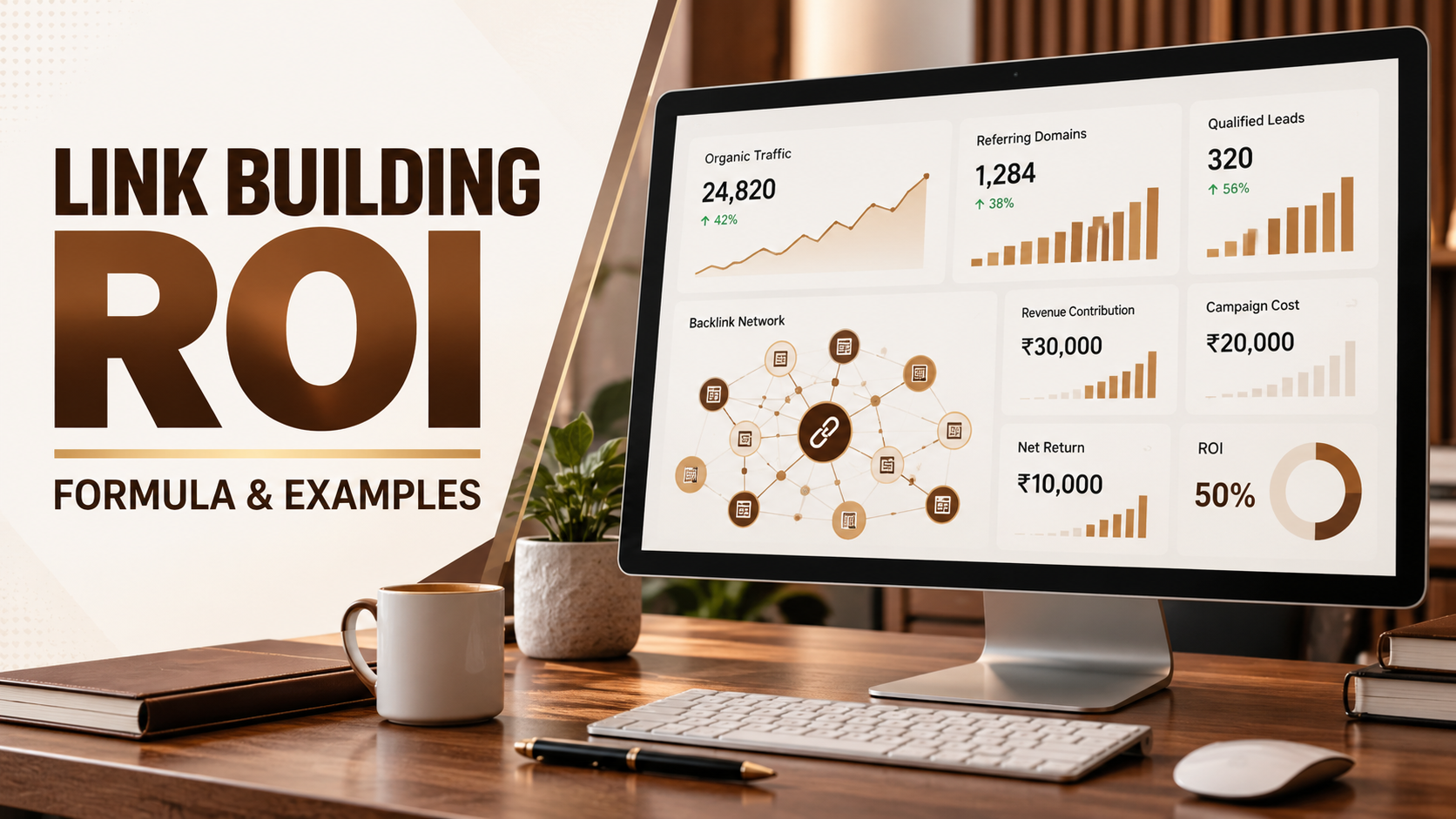
Suppose a business spends ₹20,000 on a link-building campaign. It estimates that the campaign contributed ₹30,000 in additional contribution profit before deducting the campaign cost.
Metric
Amount
Campaign cost
₹20,000
Estimated incremental contribution profit
₹30,000
Net return
₹10,000
ROI
50%
Calculation
ROI = ((₹30,000 − ₹20,000) ÷ ₹20,000) × 100
ROI = 50%
In this hypothetical example, the campaign generates an estimated ₹30,000 in incremental contribution profit before campaign costs. After deducting the ₹20,000 campaign cost, the net return is ₹10,000.
This means the estimated contribution profit is ₹1.50 for every ₹1 spent on the campaign. After recovering the campaign cost, the additional return is ₹0.50 per rupee invested, equivalent to a 50% ROI.
Important: This result depends on whether the estimated profit can reasonably be attributed to the campaign. Increased sales alone do not prove that backlinks caused the improvement.
What Costs Should You Include?
A realistic ROI calculation should account for the resources used to run the campaign, not just the price of acquiring links.
Staff time spent planning, reviewing links, reporting, and coordinating the campaign
Avoid double-counting expenses. If your agency fee already includes content creation and outreach, don’t add those costs again unless they were billed separately.
One important point to remember is that paying for a backlink purely to manipulate search rankings can violate Google’s spam policies. Sponsored placements should be appropriately qualified, typically using rel="sponsored" or rel="nofollow". When evaluating a paid placement, consider its genuine promotional value, audience relevance, and compliance with search engine guidelines—not just the possibility of improving rankings.
7 Metrics to Track When Measuring Link Building ROI
A backlink campaign can look successful on paper and still fail to deliver meaningful business results. You might acquire links from several websites, see your Domain Rating increase, and notice better rankings. But are those changes bringing the right visitors to your website or generating more business?
To answer that question, you need to look at a combination of backlink, search performance, website traffic, and financial metrics. No single number tells the whole story, but together they can help you evaluate your campaign more accurately.
1. Quality Referring Domains Acquired
A referring domain is a website that links to your website. If three different websites link to you, you have three referring domains, even if one website links to you multiple times.
However, acquiring more referring domains isn’t automatically a sign of success. A relevant link from a genuine industry publication may be more useful to your business than several links from unrelated websites created primarily to sell placements.
When reviewing newly acquired referring domains, consider:
Relevance: Does the website cover topics related to your industry or audience?
Editorial quality: Does it publish useful content for real readers?
Link placement: Does the link make sense in the context of the article?
Referral potential: Could the link bring visitors who are genuinely interested in your services?
Link attributes: Is the link appropriately qualified, particularly when it is sponsored or paid?
You can monitor new and lost referring domains using backlink analysis tools such as Ahrefs or Semrush. Review important linking pages manually instead of relying only on authority scores.
Why it matters: This metric shows what your campaign acquired. It doesn’t prove that the links improved rankings, traffic, or revenue.
2. Keyword Rankings for Target Pages
Rankings help you understand how your target pages perform for relevant search queries over time.
For example, if you acquire links to a service page targeting a commercial keyword, monitor whether that page gains visibility for the queries that matter to your business.
Look at the trend rather than relying on a single ranking check. Search positions fluctuate, and improvements may also result from content changes, technical SEO work, competition, or other factors.
Where to check: Open the Performance report in Google Search Console and review queries, pages, clicks, impressions, and average position. Filter the report to focus on the pages targeted by your campaign.
Why it matters: Improved rankings can be an encouraging intermediate result, but rankings alone don’t tell you whether the campaign generated additional customers or profit.
3. Organic Search Clicks and Landing-Page Traffic
Rankings matter partly because they can help bring people to your website. That’s why you should check whether your target pages are receiving more relevant traffic.
In Google Search Console, compare organic clicks and impressions before and after the campaign. Use comparable date ranges and review the specific pages you targeted rather than relying solely on site-wide totals.
For example, a service page might receive more impressions but little change in clicks. That’s different from a page that gains visibility and attracts more relevant visitors.
Where to check:
Google Search Console: Organic search clicks, impressions, click-through rate, and average position.
Google Analytics 4: Landing-page performance and engagement from organic search sessions.
These tools measure different things, so their numbers won’t necessarily match.
Why it matters: Additional relevant traffic can create more opportunities for leads or sales, but its financial value depends on what visitors do next.
4. Referral Traffic from Backlinks
Not every valuable backlink needs to produce an immediate improvement in search rankings. A link can also send interested readers directly to your website.
Suppose an industry publication mentions your service in a relevant article. Readers who click that link may already understand the problem you solve, making them potential customers.
Track referral traffic to see whether your links are bringing visitors from external websites. Pay attention to the source, landing page, engagement, and conversions.
Where to check: In Google Analytics 4, open Reports → Acquisition → Traffic acquisition. Review the available source and medium dimensions to identify referral traffic and examine the performance of those sessions.
Why it matters: Referral visitors can provide a more direct connection between a linking website and business outcomes. However, a visit alone isn’t a sale, so track leads and conversions as well.
5. Leads, Sales, and Conversion Rate
This is where backlink reporting becomes more closely connected to business performance.
If your website exists to generate enquiries, measure qualified leads. If you sell products online, measure purchases and their financial contribution. If you provide B2B services, track how many enquiries eventually become paying clients.
Imagine a backlink campaign brings 200 additional visitors to a service page. That number becomes more meaningful when you know how many visitors submitted an enquiry, how many enquiries were qualified, and how many became customers.
Useful metrics include:
Qualified enquiries generated
Purchases or completed bookings
Conversion rate
Lead-to-customer rate
Revenue or contribution profit from resulting sales
Use Google Analytics 4 to measure properly configured key events and conversions. Where possible, connect these results with your CRM or sales records, particularly if your business has a longer sales cycle.
Why it matters: Leads and sales provide stronger evidence of business value than link counts or rankings alone. You still need to estimate how much of that value can reasonably be attributed to the campaign.
6. Cost per Acquired Link and Cost per Qualified Lead
A campaign can acquire many links while consuming too much time or money. Measuring costs helps you understand whether the approach is commercially sustainable.
Start with the average cost of acquiring a link.
Cost per acquired link = Total campaign cost ÷ Number of links acquired
For example, if a campaign costs ₹40,000 and acquires 20 qualifying links, the average cost is ₹2,000 per link.
This is an efficiency measure, not a quality score. A campaign that acquires inexpensive links from irrelevant websites isn’t necessarily better than one that earns fewer relevant editorial links.
If your campaign generates qualified leads, you can also calculate cost per qualified lead.
Cost per qualified lead = Total campaign cost ÷ Number of qualified leads
Use the same cost basis and measurement period when comparing campaigns. If one campaign includes content production and another excludes it, their cost figures won’t be directly comparable.
Why it matters: These calculations help you compare campaign efficiency and identify approaches worth investigating further. They don’t replace the need to measure the financial value of the results.
7. Incremental Revenue or Contribution Profit
Financial outcomes are what allow you to calculate monetary ROI.
Revenue is the money generated from sales. Contribution profit goes a step further by accounting for the variable costs associated with fulfilling those sales. When reliable data is available, contribution profit can provide a more useful basis for evaluating returns.
Consider an e-commerce business that generates additional orders after a marketing campaign. The full sales value isn’t necessarily the profit available to cover marketing costs: product costs, shipping, payment processing, returns, and other variable expenses may reduce the amount retained.
For a service business, the calculation may instead use the contribution from additional clients after relevant delivery costs.
The challenge is attribution. If revenue rises after a backlink campaign, you cannot automatically assign the entire increase to link building. Other marketing efforts, pricing changes, seasonality, and website improvements may also have influenced the result.
Combine your sales or accounting records with analytics data, CRM records, and campaign reporting. Document how you estimated incremental results and acknowledge uncertainty where the evidence is limited.
Why it matters:Incremental financial value is the key input for a meaningful ROI calculation. If you cannot estimate it credibly yet, report campaign costs and measurable performance separately rather than presenting an unsupported ROI percentage.
From Backlinks to Business Results
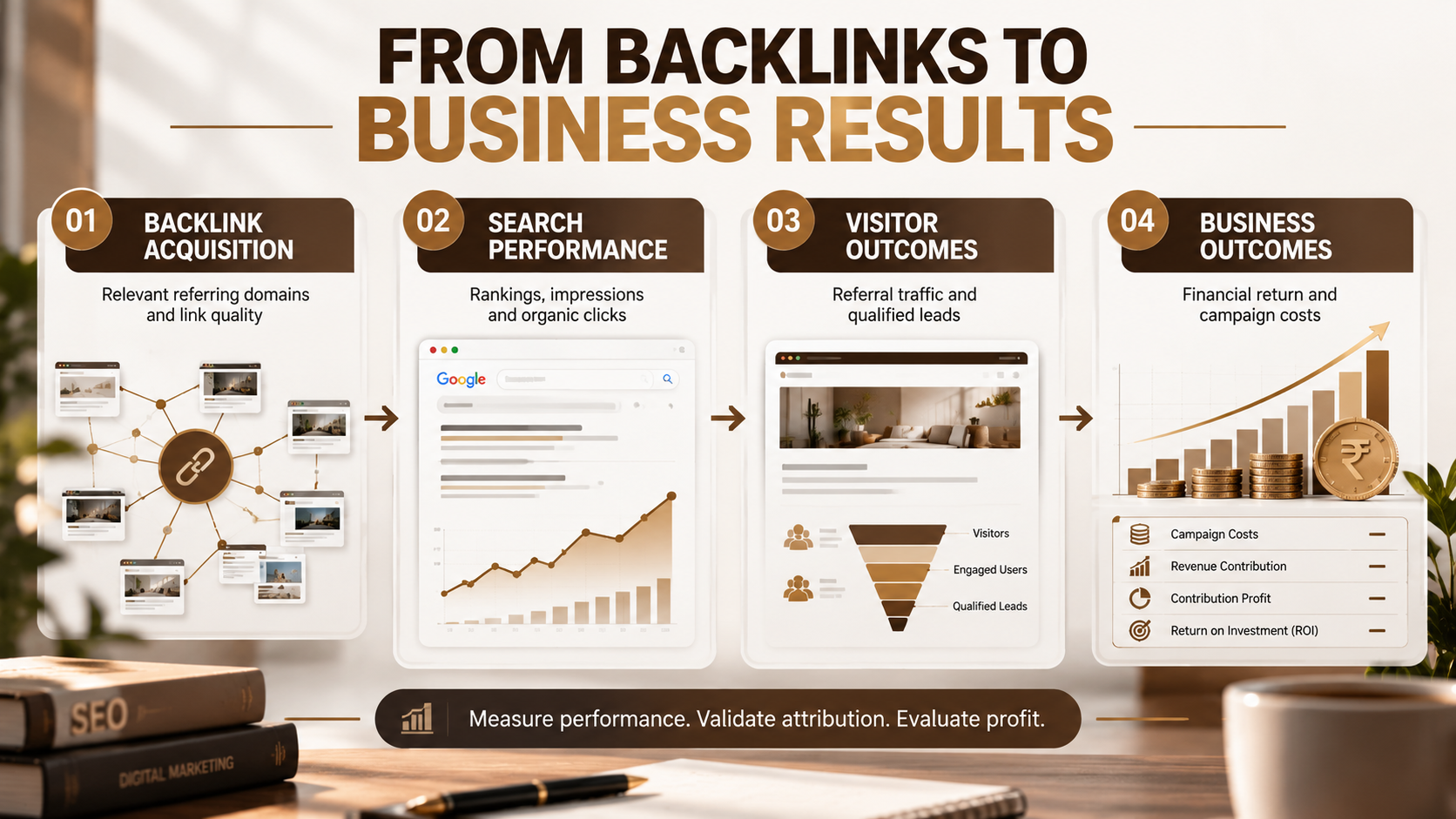
The following framework shows how to connect link-building activity with business outcomes without assuming that every stage is caused by the previous one.
Measurement stage
What to track
What it tells you
Backlink acquisition
Relevant referring domains and link quality
What the campaign acquired
Search performance
Rankings, impressions, and organic clicks
How target pages perform in search
Visitor outcomes
Referral traffic and qualified leads
Whether relevant visitors are reaching your site
Business outcomes
Sales, contribution profit, and campaign costs
Whether a financial return can be reasonably estimated
The key takeaway: Backlinks are an input, not proof of financial success. Measure the links you acquire, monitor what happens to your target pages, and evaluate business outcomes before deciding whether a campaign is delivering value.
How to Track Link Building ROI Using SEO Tools
You don’t need an expensive analytics setup to start measuring link-building performance. A few tools, a consistent tracking process, and reliable campaign records can tell you much more than a monthly report showing only how many backlinks you acquired.
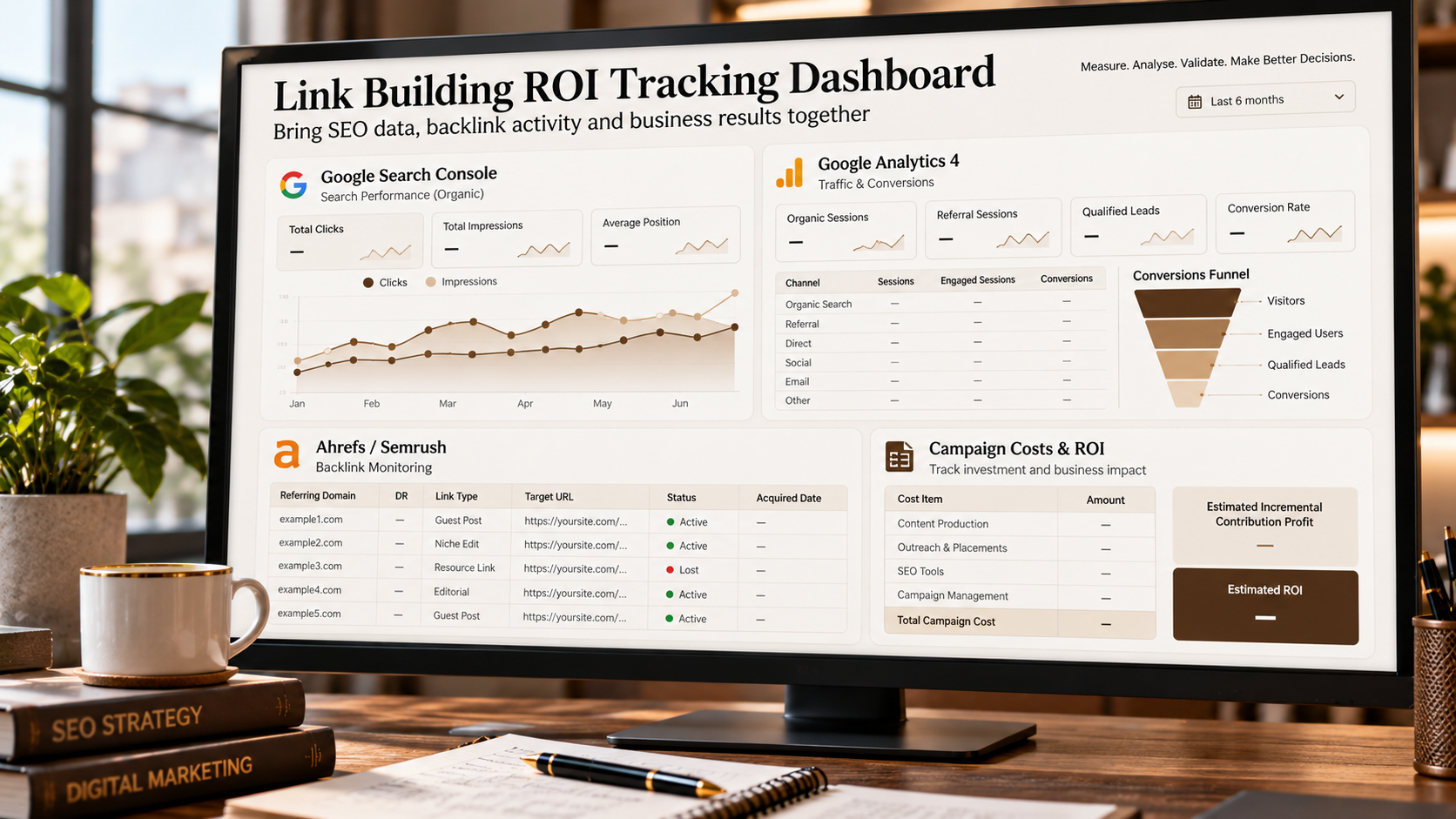
The key is to connect three things: the links you build, the performance of the pages you’re targeting, and the business results those pages generate. Each tool gives you a different part of the picture, so it’s important to understand what the data actually tells you.
1. Use Google Search Console to Track Search Performance
Google Search Console helps you understand how your website performs in Google Search. You can review clicks, impressions, click-through rate, and average position to see how your target pages perform over time.
Start by opening the Performance report and selecting a suitable date range. Then use the Pages filter to focus on a URL that received backlinks during your campaign.
Compare its performance with an earlier period of similar length. Look at organic clicks and impressions first, then review the queries bringing visitors to that page.
For example, if a service page begins receiving more organic clicks after a campaign, that’s a useful performance signal. However, it doesn’t prove that backlinks caused the improvement. Content updates, technical changes, seasonality, and changes in search demand may also influence results.
What to track: Clicks, impressions, click-through rate, average position, and the specific pages targeted by your campaign.
2. Use Google Analytics 4 to Measure Traffic and Conversions
Search visibility is only part of the story. You also need to understand what happens after visitors arrive at your website.
Google Analytics 4 helps you examine traffic sources, landing pages, engagement, and conversions. Its Traffic acquisition report shows where sessions originate and can help you distinguish referral traffic from organic search traffic.
To review referral traffic, open Reports → Acquisition → Traffic acquisition. Examine the available session source and medium dimensions to identify traffic from external websites. You can also filter the report by landing page to investigate how visitors behave after arriving on a campaign-related page.
If your website generates enquiries or sales, make sure the relevant conversion events are configured correctly. For a service business, this might include a successfully submitted enquiry form. For an online store, it might include a completed purchase.
What to track: Referral sessions, organic search sessions, engagement, configured key events, leads, purchases, and revenue where applicable.
3. Use a Backlink Analysis Tool to Monitor Acquired Links
Google Search Console and Analytics won’t provide every detail you need about your backlink campaign. A backlink analysis tool can help you monitor newly discovered and lost backlinks, referring domains, anchor text, and linking pages.
Tools such as Ahrefs and Semrush can help you review these changes and investigate whether the links you acquired are relevant to your campaign.
Keep a record of the actual linking page, the target URL, the date the link was acquired, and whether the link is still present. Review important placements manually rather than treating a third-party authority score as proof of quality.
Remember that backlink tools may discover links at different times and report different totals. A newly acquired link may not appear in a tool’s database immediately.
What to track: New and lost referring domains, linking pages, target URLs, anchor text, link attributes, and the date each link was discovered or verified.
4. Record Campaign Costs and Results in a Spreadsheet
Use a spreadsheet to bring your campaign costs, acquired links, performance data, and business outcomes together. This gives you one consistent record to review each month and makes reporting easier.
Use a structure like this:
Field
What to record
Campaign period
Start date and reporting period
Target page
URL receiving backlinks
Linking website
Referring domain and linking page
Link acquisition date
Date acquired or verified
Campaign cost
Content, outreach, tools, and other relevant expenses
Organic performance
Clicks and impressions from Search Console
Referral performance
Relevant sessions from Analytics
Business outcomes
Qualified leads, sales, or contribution profit
Notes
Content changes, technical work, seasonality, or other factors
This record helps you compare campaign activity with subsequent performance and makes it easier to explain your findings to a client or business owner.
5. Compare Results Against a Baseline
Before launching a campaign, record the existing performance of the pages you intend to target. Without a baseline, it’s difficult to determine whether anything changed during the campaign.
Choose a reasonable pre-campaign period and compare it with a later period of similar length. Where possible, account for seasonality and major changes to the website.
For a stronger analysis, compare the targeted pages with similar pages that did not receive the same link-building activity. This can help reveal whether the targeted pages behaved differently, although it still cannot isolate the effect of backlinks perfectly.
Keep notes about other changes made during the measurement period, including new content, internal linking, site migrations, and technical SEO improvements.
The aim is to build a more credible picture of what happened, not to claim that every improvement came from link building.
6. Bring the Data Together in a Monthly Report
At the end of each reporting period, combine the main findings into a short summary that connects campaign activity with performance and business outcomes.
Reporting area
Questions to answer
Link acquisition
What relevant links were acquired or lost?
Search performance
Did clicks and impressions change on target pages?
Referral traffic
Did the acquired links send relevant visitors?
Conversions
Were more qualified leads or sales recorded?
Costs
How much did the campaign cost in total?
Financial return
Can incremental contribution profit be reasonably estimated?
Next steps
Should the campaign continue, change direction, or be evaluated for longer?
If the financial return cannot yet be estimated reliably, say so. Reporting the measured outcomes and explaining the limitations is more useful than presenting a precise ROI percentage based on assumptions.
A good report should help someone understand what happened, what the evidence supports, and what the campaign team plans to do next.
How to Attribute SEO Results to Link Building
One of the hardest parts of measuring link building ROI is figuring out what actually caused the improvement.
Imagine you acquire backlinks to a service page, and three months later its organic traffic increases. It’s tempting to credit the campaign, but what if you also updated the page, improved internal linking, or published several supporting articles during that period?
The backlinks may have contributed, but the traffic increase alone doesn’t tell you how much of the change came from them. A more reliable approach is to establish a baseline, monitor specific pages, and look at other changes that could have influenced performance.
Establish a Baseline Before the Campaign
Before acquiring links, record how your target pages are performing. This gives you a reference point for evaluating what happens later.
Record the page’s organic clicks, impressions, relevant search queries, referral traffic, and conversions where available. Also document its existing backlink profile and any planned content or technical SEO work.
Without a baseline, you may struggle to distinguish a meaningful improvement from normal fluctuations.
Track the Pages That Receive Backlinks
Monitor the specific URLs targeted by your campaign rather than relying only on site-wide traffic.
For example, if your campaign focuses on three service pages, review their performance individually. Check whether their organic clicks, impressions, relevant rankings, and conversions change over time.
Google Search Console allows you to compare performance across date ranges and filter results by page or query. These comparisons help you identify changes, although they don’t establish what caused them. <Cite refs={[“turn410976search0″,”turn410976search1”]}/>
Compare Similar Time Periods
Choose comparison periods that make sense for your website and business.
Comparing one month with the previous month can be useful, but it may be misleading if demand changes seasonally or the periods contain different traffic patterns. When sufficient historical data is available, year-over-year comparisons can help reveal recurring seasonal changes.
Google recommends reviewing longer-term traffic patterns when investigating changes in search performance. <Cite refs={[“turn410976search2”]}/>
Don’t assume that every increase or decrease is related to backlinks. Check whether the search demand for your target queries changed and whether other website improvements occurred during the same period.
Account for Other SEO Changes
Link building rarely happens in isolation. A website may also receive new content, title updates, technical fixes, improved internal links, or changes to its navigation during the same campaign.
Keep a record of these activities and their dates. If several changes happen together, be cautious about assigning the resulting improvement to one specific activity.
For example, if a page gains backlinks and receives a substantial content update in the same week, the available data may not allow you to separate the effect of each change reliably.
Use Comparison Pages Where Possible
If you have several similar pages, compare the performance of pages included in the link-building campaign with pages that did not receive the same activity.
Suppose two service pages had broadly similar traffic patterns before the campaign. You acquire links to one page but leave the other unchanged. If their performance later diverges, that difference may provide useful evidence to investigate.
However, this is not a controlled experiment. The pages may differ in search demand, competition, content quality, or other characteristics. Treat the comparison as supporting evidence rather than definitive proof.
Separate Measured Results From Estimated Returns
Your report should distinguish between what you directly observed and what you believe the campaign contributed.
Type of evidence
Example
What it establishes
Directly measured
A referring domain links to a target page
The link was acquired or verified
Directly measured
Organic clicks increased
Search traffic changed
Directly measured
More enquiries were recorded
The business received more enquiries
Estimated attribution
Some additional enquiries resulted from the campaign
A reasoned estimate, subject to uncertainty
Financial estimate
The attributed enquiries generated additional contribution profit
The basis for estimating financial ROI
This distinction makes your reporting more credible. It also helps clients understand why a campaign can show promising SEO progress before its financial return can be measured confidently.
The bottom line: You rarely have enough evidence to credit every ranking or revenue improvement entirely to link building. The goal is to combine reliable tracking, sensible comparisons, and transparent assumptions to make the best-supported assessment possible.
How Long Does It Take to See Link Building ROI?
One of the biggest mistakes in link building is expecting results too quickly. You acquire backlinks, wait a few weeks, and wonder why rankings or enquiries haven’t changed.
The reality is that link building doesn’t follow a fixed timeline. Some pages may show changes in search visibility relatively quickly, while others may take considerably longer to produce measurable results. The outcome depends on factors such as your website’s existing authority, the competitiveness of your target queries, the quality of your content, and the links you acquire.
It’s also important to separate early SEO signals from actual financial returns. A page gaining impressions is not the same as a page generating qualified leads, and new leads don’t necessarily mean the campaign has become profitable.
Early Signs of Progress
During the early stages of a campaign, focus on whether the work is being implemented properly and whether your target pages begin showing meaningful changes.
Useful indicators include:
Newly acquired backlinks being discovered and remaining live.
Changes in impressions and rankings for relevant search queries.
Increased organic clicks to targeted pages.
Referral visits from relevant linking websites.
These are useful signals to monitor, but none guarantees that a campaign will eventually generate a positive financial return.
When Can You Expect Business Results?
Business results often require more time to evaluate because search visibility must translate into visitor interest, enquiries, and sales.
For example, a B2B company may need several months to determine whether additional organic traffic is generating qualified enquiries and whether those enquiries are turning into paying customers. A website selling lower-priced products may be able to observe purchases sooner, although proving that backlinks contributed to those purchases can still be difficult.
Rather than promising a universal number of weeks or months, establish a measurement period appropriate to your business, sales cycle, and available data.
How Often Should You Measure Link Building ROI?
Track campaign activity regularly, but avoid drawing firm conclusions from every short-term fluctuation.
Measurement frequency
What to review
Weekly
Link acquisition progress, newly discovered links, and implementation issues
Monthly
Target-page rankings, clicks, impressions, referral traffic, and conversions
Quarterly
Campaign costs, broader performance trends, lead quality, and estimated financial returns
These are suggested reporting intervals, not guaranteed timelines for seeing results. A new website with limited historical data may require a longer observation period than an established website with consistent traffic and conversion tracking.
When Should You Reassess a Campaign?
Review your measurement plan if you cannot reliably track the results, if your website undergoes major changes, or if the campaign’s original goals no longer match your business priorities.
Before drawing conclusions, make sure your tracking is working correctly and that you have allowed enough time to collect meaningful data. If results remain unclear, report what you have measured and explain what still needs further evaluation.
The key takeaway: Link building ROI has no guaranteed timeline. Measure progress consistently and evaluate results using evidence rather than arbitrary deadlines or promises of guaranteed rankings.
Link Building ROI by Business Type
A link-building campaign doesn’t deliver the same kind of value for every business. An online store may care most about profitable sales, while a B2B company may focus on qualified leads that turn into long-term clients.
That’s why it’s important to choose ROI metrics that reflect how your business actually makes money. Tracking the wrong outcome can make a useful campaign look unsuccessful—or make a poor investment look better than it really is.
E-commerce Websites
For an online store, the main objective is usually to generate additional profitable orders.
Track organic traffic to product and category pages, referral visits, completed purchases, average order value, and contribution profit. If a campaign supports pages that attract more customers, evaluate whether those additional sales justify the cost.
Don’t treat total revenue as profit. Product costs, shipping, payment processing, returns, and other variable expenses can significantly reduce the amount a business retains.
B2B and SaaS Businesses
B2B businesses often have longer sales cycles, so a visitor may take weeks or months to become a paying customer.
Track qualified leads, demo requests, trial registrations, sales-qualified opportunities, and closed deals. Where possible, connect website analytics with CRM records to follow leads through the sales process.
A campaign that generates fewer but better-qualified leads may be more valuable than one that produces a large increase in unqualified enquiries.
Local Service Businesses
For plumbers, consultants, contractors, and other local service providers, the priority is usually generating relevant enquiries from potential customers.
Measure calls, completed enquiry forms, booking requests, qualified leads, and the number of enquiries that become paying customers. Referral traffic from relevant local publications may also provide value.
Make sure you distinguish genuine enquiries from spam submissions and duplicate leads. Otherwise, your reported results may overstate the campaign’s business impact.
Affiliate Websites
Affiliate websites generally earn money when visitors complete qualifying actions through affiliate links.
Track organic traffic to monetized pages, affiliate link clicks, conversions reported by affiliate networks, and commissions earned. Compare the additional commissions you can reasonably attribute to the campaign with the total cost of link building and related content production.
Remember that higher traffic does not guarantee higher commissions. The visitors must be interested in the offers, and the content must help them make an informed decision.
SEO Agencies
For an SEO agency, link-building ROI matters at two levels: the results delivered to clients and the profitability of the agency’s own service.
Client reporting should focus on agreed outcomes, such as relevant referring domains, target-page performance, qualified leads, and financial results where measurable. Internally, the agency should also track delivery costs, staff time, tools, and campaign margins.
Avoid promising a specific ranking increase or financial return simply because a certain number of backlinks will be delivered. The outcome depends on factors beyond the agency’s direct control.
The key takeaway: Choose metrics based on how your business earns money. Link acquisition, rankings, and traffic help explain campaign performance, but the most meaningful ROI assessment connects those indicators to the business outcomes that matter to you.
Common Link Building ROI Measurement Mistakes
Even when a link-building campaign shows promising results, a few common reporting mistakes can make its performance look better or worse than it really is.
The following mistakes can distort your ROI calculations, hide unnecessary costs, and make it harder to decide whether a campaign deserves further investment.
1. Treating Every Backlink as Equally Valuable
A campaign that acquires 50 backlinks isn’t automatically better than one that acquires 15.
The relevance of the linking website, the quality of its content, the context of the link, and the potential to reach a relevant audience all matter. A high backlink count can be misleading if many links come from irrelevant or low-quality sources.
Evaluate the links you acquire instead of judging a campaign solely by quantity.
2. Using DR or DA as Proof of ROI
Domain Rating (DR) and Domain Authority (DA) are third-party metrics used to estimate aspects of a website’s backlink strength or ranking potential. They are not Google’s own ranking scores and do not measure revenue or profit.
An increase in DR or DA may be useful when reviewing a backlink profile, but it doesn’t prove that your campaign generated more customers or delivered a positive financial return.
Use these metrics as supporting indicators, not as substitutes for business results.
3. Crediting All Organic Growth to Link Building
Suppose your website’s organic traffic increases by 30% after a backlink campaign. It might be tempting to attribute the entire increase to your new links.
However, the website may also have received new content, technical improvements, stronger internal linking, or changes in search demand. Competitors’ performance and search engine updates can also affect traffic.
Compare target-page performance over time, document other SEO activities, and be transparent about what you can and cannot attribute to the campaign.
4. Ignoring the Full Campaign Cost
Calculating ROI using only the price of acquiring backlinks can make a campaign appear more profitable than it really is.
Content production, prospect research, outreach, tools, and campaign management may all contribute to the total cost. Leaving out substantial expenses creates an incomplete picture.
Include relevant costs consistently, and avoid counting the same expense twice when it is already included in an agency or freelancer fee.
5. Confusing Revenue With Profit
Revenue is not the same as profit.
For example, a campaign might be associated with ₹1,00,000 in additional sales, but the business may have incurred substantial product, delivery, transaction, and fulfilment costs to generate those sales.
If you use gross revenue as the return figure without accounting for the relevant costs, you may overstate the financial benefit.
Where reliable data is available, use incremental contribution profit for a more meaningful assessment. Clearly state which financial measure you use in your ROI calculation.
6. Evaluating the Campaign Too Early
Link building doesn’t produce results on a fixed schedule. Judging a campaign after only a short period may lead you to abandon useful work before meaningful outcomes can be assessed.
At the same time, waiting indefinitely isn’t a sound strategy. Set a reasonable evaluation period, track intermediate indicators, and review whether the campaign is acquiring relevant links and making progress toward its objectives.
The right evaluation period depends on the website, the campaign, the competitive environment, and the business’s sales cycle.
7. Reporting an ROI Percentage Without Explaining the Assumptions
A report stating that a campaign delivered a 150% ROI can sound convincing, but the number is only useful if readers understand how it was calculated.
Explain the total campaign cost, the financial return used in the formula, and how you estimated the portion attributable to link building.
If the return is uncertain, say so. An honest estimate with clear limitations is more useful than a precise percentage built on unsupported assumptions.
The key takeaway: Good ROI reporting separates link acquisition, SEO performance, and financial outcomes. Track all three, explain your assumptions, and avoid presenting correlations or third-party metrics as proof of business success.
How to Create a Monthly Link Building ROI Report
A link-building report should do more than list the backlinks acquired during the month. It should help you understand what the campaign achieved, how performance changed, what it cost, and whether there is enough evidence to justify the investment.
You don’t need an elaborate reporting system to get started. A consistent report that combines backlink data, search performance, conversions, and campaign expenses is often more useful than a complicated dashboard filled with metrics nobody acts on.
What to Include in Your Report
Start with the information that helps you evaluate the campaign and make decisions.
Reporting area
What to include
Campaign activity
New and lost links, referring domains, and target pages
Search performance
Organic clicks, impressions, and relevant ranking changes
Referral traffic
Visits from linking websites and their engagement
Business outcomes
Qualified leads, purchases, and conversions
Campaign expenses
Content, outreach, tools, placements, and management
Financial results
Estimated incremental contribution profit and ROI, where measurable
Next steps
Priorities, issues to investigate, and planned adjustments
Keep the reporting period consistent and compare results with a relevant baseline. If the campaign began halfway through the month, make that clear rather than comparing the results as though the campaign had been running for the entire period.
How to Calculate ROI in Your Report
Use the same ROI formula throughout your reporting:
ROI (%) = ((Attributed Financial Return − Total Campaign Cost) ÷ Total Campaign Cost) × 100
Before publishing the result, verify that the financial return and campaign cost use consistent definitions.
For example, if you calculate the return using incremental contribution profit, don’t compare it with campaign costs that omit significant expenses. Also document how you estimated the contribution attributable to link building.
If the financial return cannot yet be estimated reliably, report the measured outcomes and costs separately. You can still provide a useful performance update without forcing an ROI percentage into the report.
How to Explain the Results to a Client
A good client report answers three questions:
What happened? Summarize the links acquired, target-page performance, referral traffic, and business outcomes.
What does it mean? Explain which changes are encouraging, which results remain uncertain, and what other factors may have influenced performance.
What happens next? Identify the work that should continue, the problems that need attention, and the next measurement period.
Avoid filling the report with raw numbers without explaining why they matter. If rankings improved but leads remained unchanged, say so and investigate the possible reasons. If referral traffic generated qualified enquiries, highlight that result without assuming that every visit will become a customer.
A Simple Monthly Reporting Checklist
Before sending your monthly report, confirm that the figures are accurate, the reporting period is clearly defined, and any assumptions about financial returns are documented. Check that the report distinguishes measured results from estimates and identifies the next actions based on the available evidence.
The key takeaway: A useful monthly link-building report should help you understand campaign performance, communicate results honestly, and make informed decisions about your next investment.
When Should You Continue, Adjust, or Stop a Link Building Campaign?
Not every link-building campaign delivers the results you expect straight away. Some campaigns acquire relevant links but need more time to show measurable changes. Others generate plenty of backlinks without producing meaningful improvements in traffic, leads, or sales.
The decision to continue, adjust, or stop should depend on the quality of the work, the evidence collected so far, the campaign’s cost, and the time available to evaluate results.
When to Continue the Campaign
Continuing may make sense when the campaign is acquiring relevant links, the target pages are performing as expected, and the budget remains reasonable.
You may also see encouraging early indicators, such as increased search impressions, more relevant referral traffic, or improvements in qualified enquiries. These signals don’t guarantee a positive ROI, but they can justify continued monitoring when the campaign is still within its planned evaluation period.
Before continuing, check that the links meet your quality standards and that the campaign remains aligned with your business goals.
When to Adjust Your Approach
An adjustment may be appropriate when the campaign is active but the results aren’t meeting expectations.
For example, you might discover that your outreach is attracting websites with little relevance to your audience, or that the pages receiving backlinks aren’t converting visitors into enquiries.
Depending on the problem, you could:
Refine your prospecting criteria to focus on more relevant websites.
Improve the usefulness and search intent alignment of your target pages.
Review your outreach messaging and publisher selection.
Investigate conversion tracking and landing-page performance.
Reassess how the budget is divided between content, outreach, and other campaign activities.
Change the part of the process that the evidence suggests is underperforming rather than abandoning the entire campaign without investigation.
When to Stop the Campaign
Stopping or pausing may be sensible when the campaign repeatedly fails to meet its quality standards, costs exceed the approved budget, or the methods being used create unacceptable risk.
For example, if a provider relies on irrelevant placements, manipulative link schemes, or promises of guaranteed ranking improvements, continuing may not be worth the risk. Google’s spam policies explain that links created primarily to manipulate search rankings can violate its link spam guidelines.
You should also reconsider a campaign when its business rationale no longer holds up, even after allowing a reasonable period for evaluation.
A Practical Decision Framework
Situation
Recommended action
Relevant links are being acquired and results are progressing
Continue monitoring
Links are acquired, but target pages show little progress
Investigate and adjust
Traffic improves, but qualified leads do not
Review page relevance and conversions
Costs rise without a credible path to business value
Reassess the budget and approach
The provider uses manipulative or unacceptable tactics
Pause or stop and investigate
These are decision guidelines, not automatic rules. Consider the campaign’s objectives, the reliability of the data, the time elapsed, and any other SEO work that may have influenced the results.
The key takeaway: Review your campaign against its original objectives, quality standards, and budget. Continue when the evidence supports further investment, adjust when you identify a fixable problem, and pause or stop when the risks or costs outweigh the likely benefits.
Frequently Asked Questions About Link Building ROI
What Is a Good Link Building ROI?
There is no universal ROI percentage that every link-building campaign should achieve. A worthwhile return depends on your campaign costs, profit margins, business goals, and the reliability of your financial attribution. Compare the results against your own targets rather than relying on an arbitrary industry benchmark.
How Do You Calculate ROI on Backlinks?
Use the ROI formula explained above, making sure you include the full campaign cost and a clearly defined financial return. The most important part is ensuring that the return you attribute to link building is supported by evidence and that any assumptions are explained.
Can You Measure the ROI of a Single Backlink?
Sometimes, but it can be difficult. You may be able to identify referral visits or conversions from a specific linking website. However, isolating the effect of that backlink on organic rankings or revenue is much harder because search performance depends on many factors. Evaluate individual links where the data supports it, but assess the broader campaign as well.
How Long Does It Take for Link Building to Produce Results?
There is no fixed timeline. Search visibility, referral traffic, and business conversions can change at different rates, and some campaigns may take longer to evaluate than others. Monitor progress consistently and choose a measurement period appropriate to your website, competition, and sales cycle.
Is Domain Rating a Reliable Measure of Link Building ROI?
No. Domain Rating (DR) is a third-party metric associated with Ahrefs, while Domain Authority (DA) is a metric developed by Moz. Neither directly measures financial ROI or represents a Google ranking score. They can provide supporting information about a backlink profile, but you should also track traffic, conversions, campaign costs, and financial outcomes.
Which Tools Can Help Measure Link Building ROI?
Google Search Console helps you evaluate search performance, while Google Analytics 4 can help you understand traffic sources and configured conversions. Backlink analysis tools such as Ahrefs and Semrush help monitor acquired and lost links. For financial ROI, combine these sources with campaign expense records and, where possible, CRM or accounting data.
How Do You Prove Link Building ROI to a Client?
Start with a clear baseline, document the links acquired and the campaign costs, and report changes in target-page performance, referral traffic, leads, and sales. Explain how you estimate the contribution of link building and acknowledge other factors that may have influenced results. When the financial return cannot be established reliably, report measured outcomes without claiming a definitive ROI figure.
Final Thoughts
Link building ROI isn’t just about how many backlinks you acquire or how much your website’s authority score increases. It’s about understanding whether the time and money you invest are contributing to results that matter to your business.
Start by tracking the quality of your links, monitoring the performance of your target pages, and recording the full cost of your campaign. Then look beyond rankings and traffic to assess qualified leads, sales, and financial returns wherever reliable data is available.
Remember that not every improvement can be attributed to backlinks alone. Be transparent about what you can measure, what you can reasonably estimate, and what remains uncertain.
The most useful link-building report isn’t the one with the biggest numbers. It’s the one that helps you understand what’s working, where your budget is going, and what you should do next.