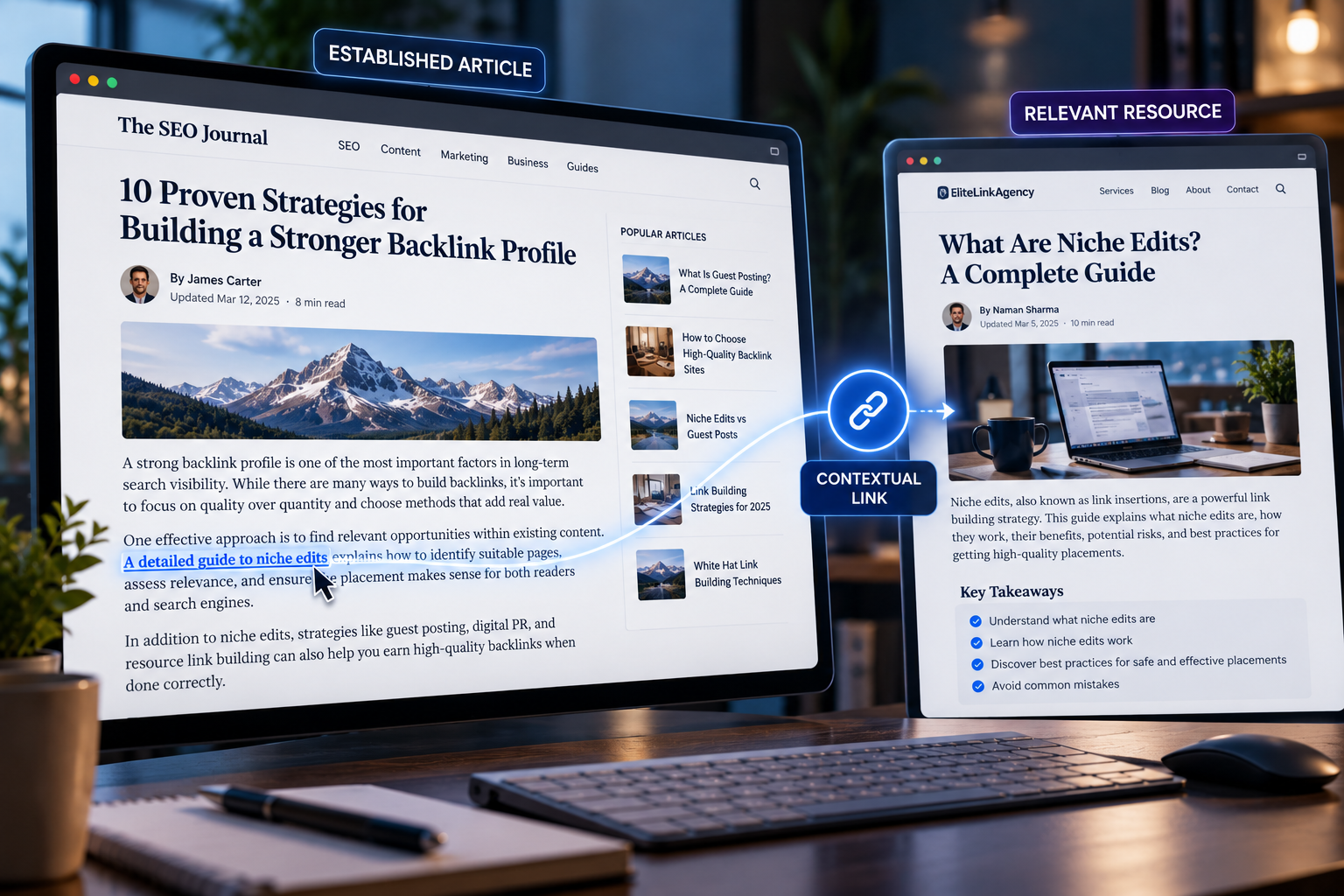
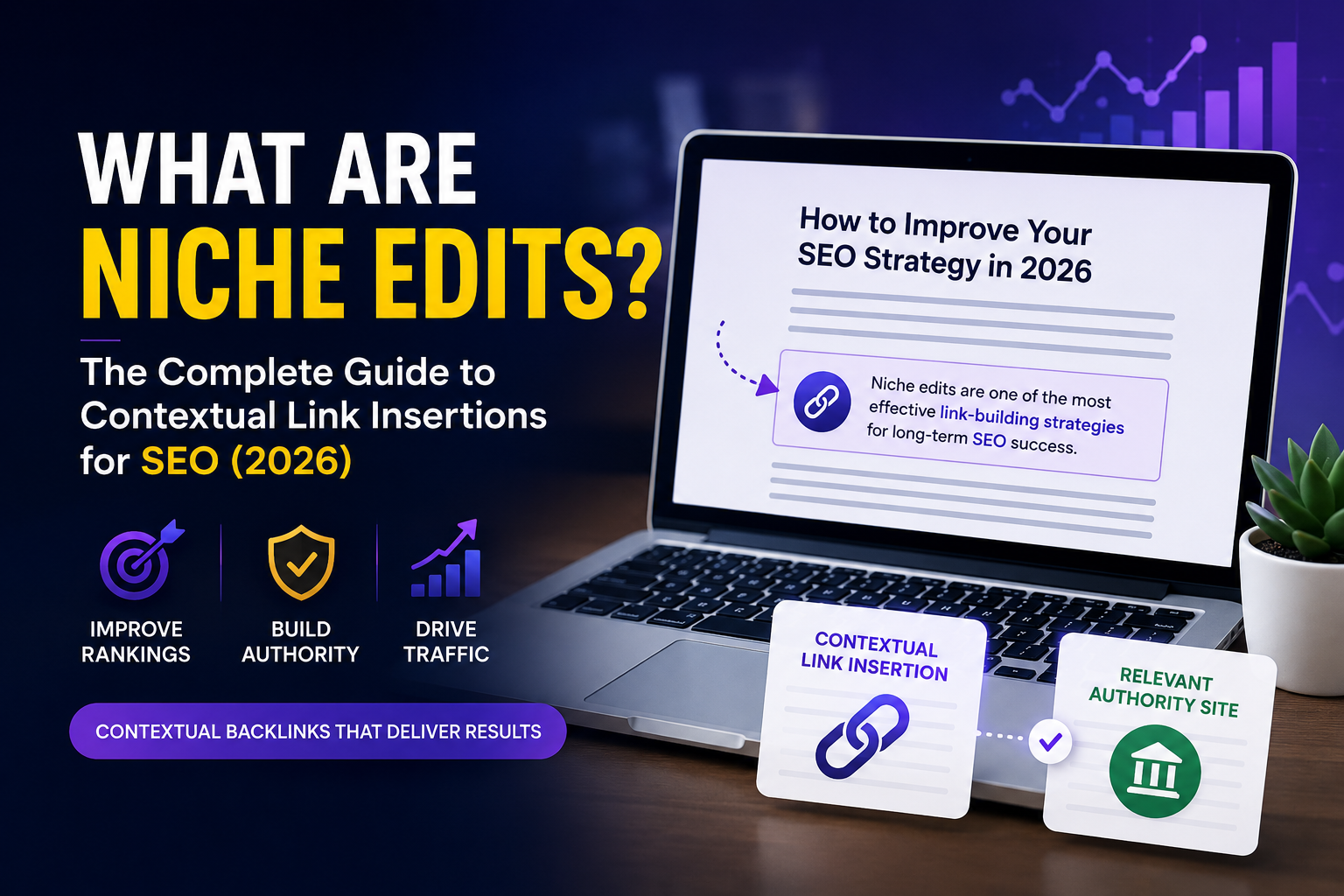
If you’re building backlinks, you’ve probably come across niche edits, also known as link insertions or contextual link placements. Instead of publishing a completely new guest post, a niche edit adds a relevant link to an article that already exists on another website.
But do niche edits work for SEO?
They can. However, the quality of the placement matters far more than simply finding a website with a high Domain Rating (DR) or Domain Authority (DA).
A relevant link placed naturally within a useful, established article can be a worthwhile backlink opportunity. A link inserted into an unrelated or low-quality page simply because the domain has a high metric may offer little value.
In this guide, we’ll look at when niche edits can make sense, why some placements are stronger than others, the risks to watch for, and a practical way to evaluate a niche edit before pursuing it.
Do Niche Edits Actually Work for SEO?
Niche edits can be useful when the backlink is placed on a relevant, established page and genuinely fits the surrounding content.
An existing article may already be indexed, rank for relevant searches, receive organic traffic, and have backlinks of its own. Those characteristics make the page worth evaluating as a potential link source.
However, a niche edit does not guarantee higher rankings.
SEO performance depends on many factors, including the relevance and quality of the content, competition, internal linking, technical SEO, the overall backlink profile, and whether the page satisfies search intent.
That’s why it’s better to think of a niche edit as one component of a broader SEO strategy, rather than a shortcut to rankings.
What determines whether a niche edit is worthwhile?
Before considering a placement, look at:
Topical relevance between the linking page and your content
Organic visibility of the specific page
Whether the page is indexed
The quality of its existing backlinks
The context surrounding the proposed link
Anchor text
The quality of the destination page
The overall quality of the host website
The number and nature of other outbound links
The most important question is simple:
Does the link genuinely make sense on this page?
If the answer is yes, you have a much stronger starting point.
Why Can Niche Edits Work?
The appeal of a niche edit is that you’re working with an existing piece of content rather than creating an entirely new article.
An established page may already have search visibility, backlinks, internal links, and a history of being crawled. Those characteristics can make an existing page more interesting than a brand-new page with no search history.
But an old page isn’t automatically a good page.
Existing pages may already have search visibility
A relevant article may already rank for keywords and attract organic visitors.
For example, an established article about guest posting could already rank for several related searches. If your resource genuinely expands on something discussed in that article, a contextual reference may make sense.
The important distinction is between:
An established, relevant page
and
An old page that simply happens to exist.
Age alone doesn’t make a backlink valuable.
Context makes the link more useful
A good niche edit should fit naturally into the surrounding discussion.
Imagine an article explaining different guest-posting strategies. A reference to a detailed guide explaining how to evaluate guest-posting websites could be useful to the reader.
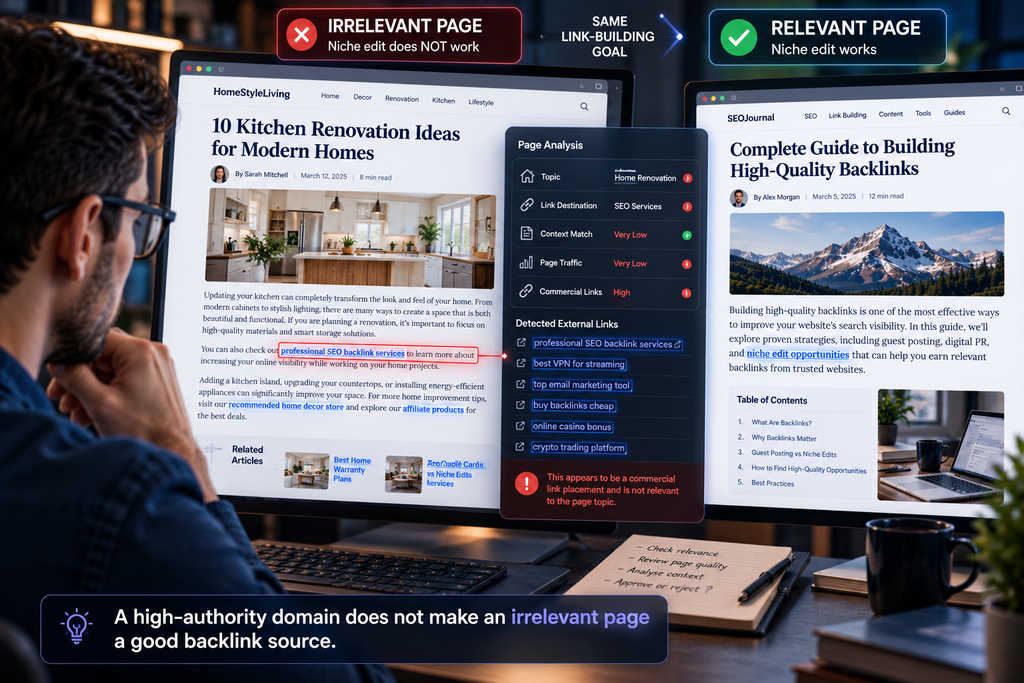
Now imagine placing the same link into an unrelated article about home renovation.
The second placement doesn’t become valuable just because the host domain has a high DR.
Context matters.
The destination page matters too
The backlink is only one side of the equation.
The page receiving the link should provide something genuinely useful to the person who clicks it.
Before building the link, make sure the destination:
Matches the anchor text
Satisfies the searcher’s intent
Provides useful information
Is easy to navigate
Adds something beyond the linking article
Is worth referencing
A strong backlink should lead to a strong resource.
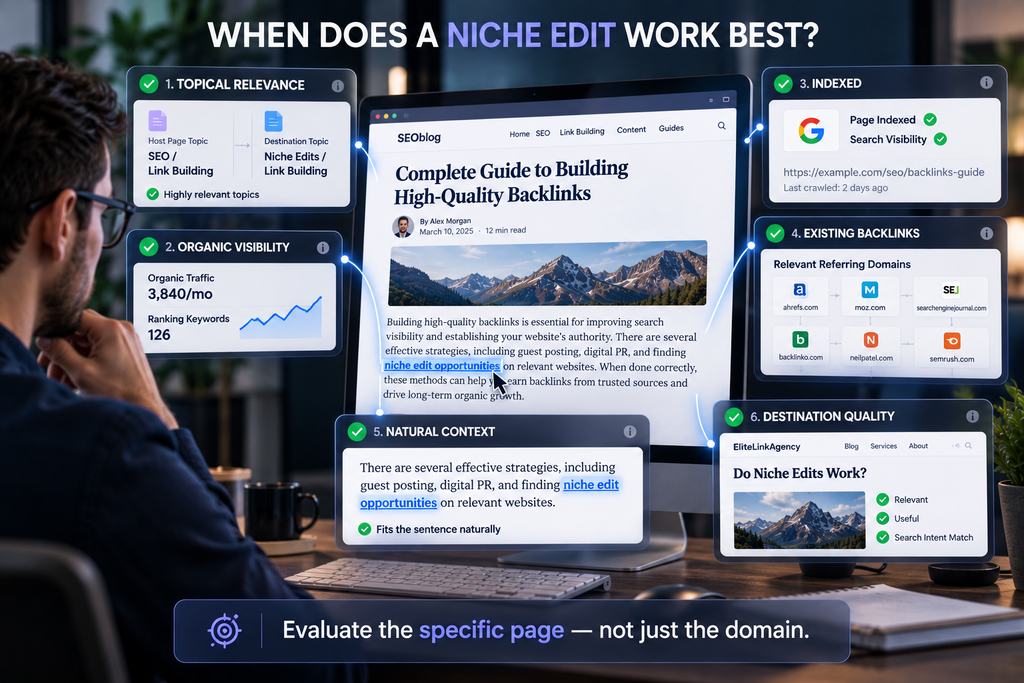
When Do Niche Edits Work Best?
The best opportunities usually have several characteristics in common.
1. The website is topically relevant
Start by examining the host website.
If you’re promoting an SEO resource, a website focused on SEO, digital marketing, content marketing, online business, or a closely related subject may be a logical prospect.
The website doesn’t have to cover exactly the same topic, but there should be a reasonable connection.
2. The specific page has organic visibility
Don’t evaluate only the domain.
A website can have significant overall traffic while the individual article offered for your link receives almost no search traffic.
Look at the specific URL.
Useful signals include:
Ranking keywords
Organic traffic
Search impressions
Existing backlinks
Internal links
Current relevance
3. The page is indexed
An established-looking article isn’t necessarily useful if it isn’t appearing in search.
Check whether the page is indexed and whether it has any meaningful search visibility.
If someone offers a niche edit but won’t provide the exact URL before placement, that’s a reason to be cautious.
4. The page has existing backlinks
A page that has earned relevant backlinks may have stronger established signals than one that has never attracted references from other websites.
Don’t simply count referring domains.
Look at their:
Relevance
Quality
Diversity
Context
Ten relevant referring domains can be more useful for evaluation than hundreds of questionable ones.
5. The link fits naturally
Read the paragraph where the link will be added.
Ask:
Would this reference improve the article for the reader?
If the answer is yes, the placement has a stronger editorial rationale.
If the sentence has to be awkwardly rewritten just to insert a keyword, reconsider the opportunity.
6. The destination deserves the recommendation
A niche edit shouldn’t be used to send readers to a weak page simply because you want another backlink.
The destination should genuinely expand on the topic.
That makes the backlink useful from both a search and user perspective.
When Do Niche Edits Not Work?
A niche edit isn’t automatically valuable simply because it appears inside an existing article.
Several situations should make you reconsider a placement.
Irrelevant websites or pages
A high-authority domain doesn’t make an unrelated article a good backlink source.
Look for a logical connection between:
Website → Page → Link → Destination
If that chain doesn’t make sense, the placement is weak.
Pages with little or no search visibility
Don’t assume that a page inherits the entire strength of its domain.
A high-DR website can contain pages that have:
No ranking keywords
Little organic traffic
Few backlinks
Weak internal linking
Outdated content
Always evaluate the actual URL.
Articles overloaded with commercial links
Look at the other outbound links.
Several useful references aren’t automatically a problem. The concern is a page that appears to exist mainly to host commercial backlinks.
If every paragraph contains unrelated promotional links, investigate further.
Forced anchor text
Don’t force an exact-match keyword into a sentence where it doesn’t belong.
Natural anchors can include:
Brand names
Partial-match phrases
Descriptive phrases
URLs
Natural language
The anchor should describe the destination and fit the sentence.
Weak destination pages
More backlinks won’t fix a page that doesn’t satisfy search intent.
If your target page is thin, outdated, difficult to navigate, or doesn’t provide useful information, improve the page before focusing heavily on link acquisition.
Websites that appear built primarily for selling links
Review several pages, not just the one you’re being offered.
Watch for:
Large numbers of unrelated topics
Thin articles
Repetitive commercial content
Excessive paid-looking placements
Suspicious backlink patterns
Very little genuine organic visibility
One signal isn’t necessarily enough to reject a site, but multiple warning signs should make you cautious.
Does DR or DA Matter for Niche Edits?
DR and DA can be useful filtering metrics, but they shouldn’t be treated as proof that a backlink is valuable.
DR is Ahrefs’ metric for evaluating the relative strength of a website’s backlink profile, while DA is Moz’s predictive domain-level metric.
Neither is a Google ranking factor.
When evaluating a niche edit, I would prioritise the following:
Factor
Importance
Topical relevance
Very High
Specific-page organic visibility
Very High
Contextual placement
Very High
Page indexing
Very High
Existing rankings
High
Quality referring domains
High
Content quality
High
Anchor text
Medium–High
DR / DA
Medium
Domain age
Low–Medium
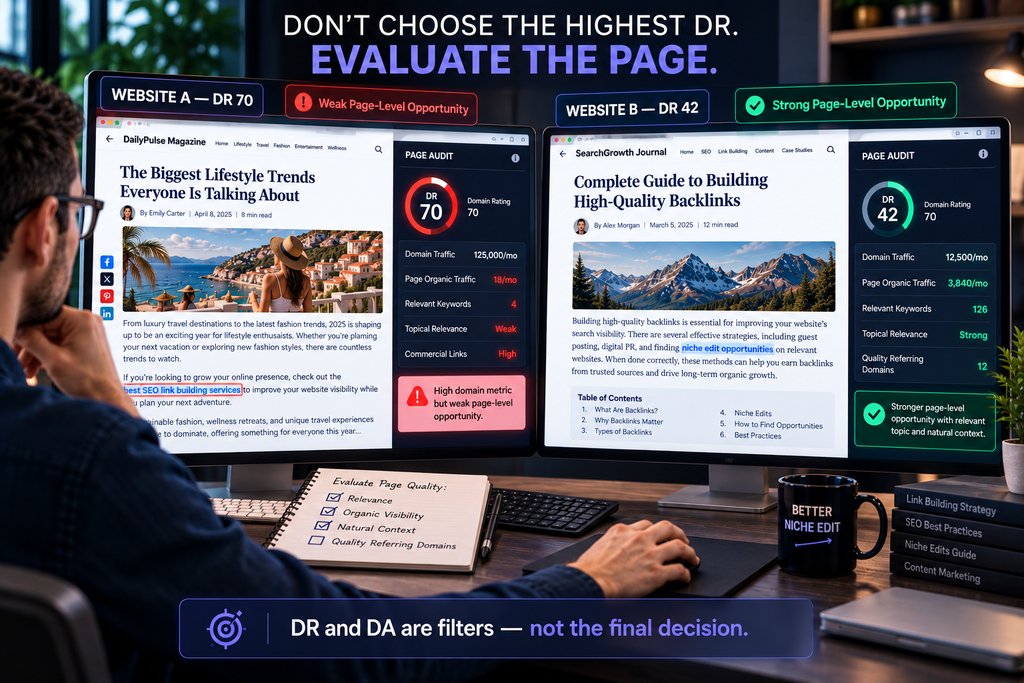
A simple example
Website A
DR 70
High domain-level traffic
Proposed page has little search visibility
Weak topical relevance
Many commercial outbound links
Website B
DR 42
Strong topical relevance
Proposed page ranks for relevant queries
Existing organic traffic
Natural link placement
Useful content
Website B deserves serious consideration even though its DR is lower.
Use DR and DA to filter prospects. Don’t use them to make the final decision.
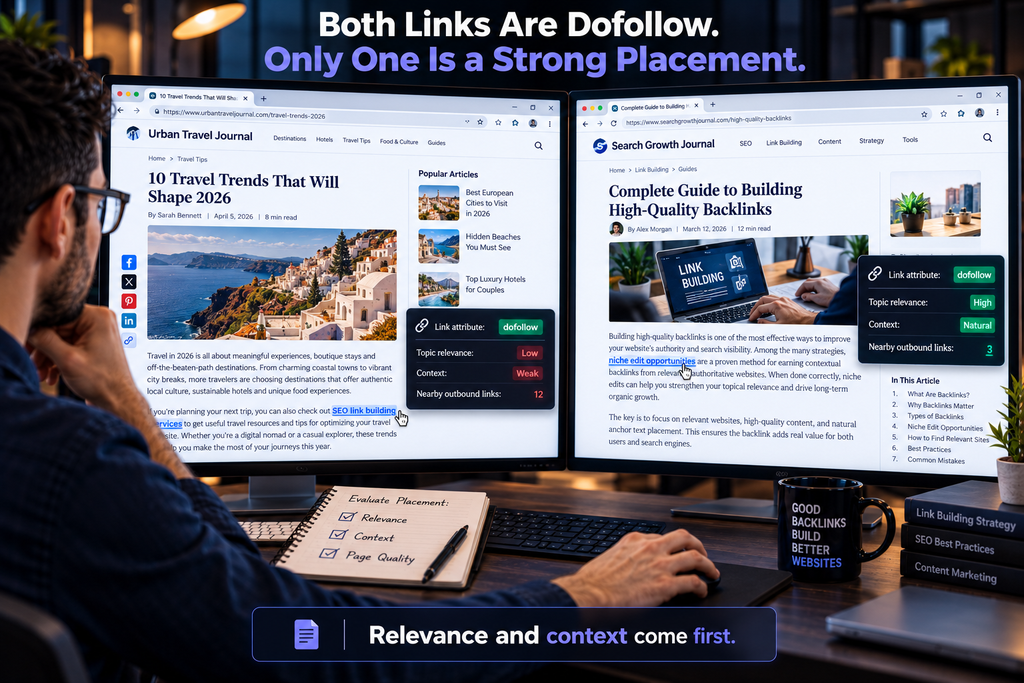
Do Dofollow Niche Edits Work Better?
“Dofollow niche edits” are often discussed in link-building campaigns because ordinary links without qualifying attributes can be crawled and considered by search systems.
But dofollow alone does not make a backlink valuable.
A relevant contextual link on a quality page is a much better opportunity than an unrelated dofollow link on a weak page.
What should you evaluate first?
Prioritize:
Relevance
Page quality
Organic visibility
Context
Anchor text
Host-site quality
Link attributes
The link attribute is only one part of the assessment.
What about nofollow links?
Nofollow links aren’t necessarily useless.
They can still:
Send referral traffic
Help people discover your content
Provide brand exposure
Contribute to a natural-looking backlink profile
The right goal isn’t to collect links based solely on whether they are dofollow.
It’s to acquire relevant and useful references.
Important note about paid placements
If a niche edit is a paid placement, don’t describe it as an ordinary editorial endorsement simply because it is inserted into existing content.
Google’s current guidance says paid links intended to pass ranking credit can fall under link spam, and recommends qualifying paid links with rel="sponsored" or rel="nofollow".
That distinction is important when evaluating commercial niche-edit campaigns.
How to Tell if a Niche Edit Is Worth It
Instead of relying on one metric, use a simple scoring framework.
Niche Edit Quality Scorecard
Evaluation Factor
Points
What to Check
Topical relevance
2
Website and page closely relate to your topic
Organic traffic
2
Specific page has genuine search visibility
Page indexing
1
Page is indexed and accessible
Existing rankings
1
Page ranks for relevant queries
Page-level backlinks
1
Quality referring domains exist
Contextual placement
1
Link naturally fits the article
Natural anchor
1
Anchor accurately describes destination
Outbound-link quality
1
Page isn’t overloaded with unrelated commercial links
Total
10
This is not a Google ranking formula. It’s a practical framework for comparing prospects consistently.
8–10: Strong opportunity
The placement has most of the characteristics you want.
6–7: Investigate further
There may be one weakness, such as limited traffic on a recently published but highly relevant article.
0–5: Usually skip
Multiple weaknesses suggest the placement isn’t worth prioritizing.
How to Evaluate a Niche Edit Before Getting the Link
Before agreeing to a placement, ask for the exact page URL.
Then work through this checklist.
1. Is the website relevant?
Review its main categories and recent content.
2. Is the specific page relevant?
Don’t assume the whole domain is relevant just because its homepage is.
3. Is the page indexed?
Check its search visibility and index status.
4. Does the page receive organic traffic?
Look at the specific URL rather than only the domain’s estimated traffic.
5. Does it rank for relevant keywords?
Ranking keywords can help confirm that the page has genuine search visibility.
6. Does it have quality referring domains?
Look beyond the raw number.
7. Does the backlink fit naturally?
Read the surrounding paragraph before approving the placement.
8. Is the anchor text appropriate?
It should accurately describe the destination and sound natural.
9. Does the page have excessive outbound links?
Review the page’s existing external links.
10. Would a real reader find the link useful?
This is the final test.
If the answer is no, keep looking.
How Long Does It Take for Niche Edits to Work?
There is no universal timeline for a niche edit to produce a measurable SEO result.
The updated page first needs to be discovered and processed. Even after that happens, your target page may not immediately change position.
Ranking depends on many other factors, including:
Competition
Content quality
Search intent
Internal linking
Existing authority
Technical SEO
Overall backlink profile
That’s why judging a placement after a few days can be misleading.
What should you monitor?
After the link is placed, track:
Organic impressions
Organic clicks
Average position
Ranking keywords
Organic traffic
Referral traffic
Whether the backlink remains live
Google Search Console can help you monitor impressions, clicks, queries, and average position for the destination page.
Look for trends rather than one-day changes.
A useful comparison could be the four weeks before placement versus the following four to eight weeks, while remembering that other SEO changes may also influence the result.
Are Niche Edits Safe for SEO?
There isn’t a simple “safe” or “unsafe” label for every niche edit.
The key distinction is between a genuinely useful editorial reference and a link acquired primarily to manipulate rankings.
Google’s current spam policies identify buying or selling links for ranking purposes, excessive link exchanges, automated link creation, and other manipulative practices as examples of link spam. Google also says paid links used for advertising or sponsorship are acceptable when appropriately qualified with rel="sponsored" or rel="nofollow".
That means the way a backlink is acquired matters.
Warning signs to avoid
Be cautious with:
Irrelevant websites
Link networks or PBN-style placements
Large-scale automated link acquisition
Excessive exact-match anchors
Pages overloaded with commercial links
Thin content created primarily for links
Placements with no genuine reader benefit
The safest editorial principle is straightforward:
The link should have a legitimate reason to exist on the page.
Niche Edits vs Guest Posts
Niche edits and guest posts can both support a link-building campaign, but they offer different advantages.
Factor
Niche Edit
Guest Post
Content creation
Usually lower
Required
Placement
Existing article
New article
Topic control
Limited
Higher
Context control
Moderate
Higher
Existing page history
Yes
No
Best use
Relevant existing pages
New, purpose-built content
A niche edit may make sense when a strong existing article already covers the subject.
A guest post may make more sense when you want control over the topic and surrounding content.
Yes, niche edits can work—but the placement matters more than the label.
The strongest opportunities tend to have:
Strong topical relevance
An established and useful page
Organic search visibility
A natural contextual placement
Appropriate anchor text
A useful destination page
A healthy host website
Don’t choose a niche edit simply because the site has a high DR or DA.
Instead, evaluate the specific website, specific page, specific placement, and specific destination.
And don’t expect one backlink to transform rankings overnight.
Niche edits are best viewed as one part of a broader SEO strategy that includes helpful content, internal linking, technical SEO, and a diverse approach to earning relevant references.
If you remember one thing from this guide, make it this:
Don’t buy the metric. Evaluate the placement.
Frequently Asked Questions
Do niche edits work?
They can, when the placement is relevant, useful, and naturally integrated into an established page. Results aren’t guaranteed and depend on the broader SEO context.
Are niche edits worth it?
They can be worth considering when you find a genuinely relevant page with useful content and real search visibility. The quality of the specific placement should determine the decision.
Do niche edits work in SEO?
Niche edits can be part of an SEO link-building strategy, particularly when the existing page and destination have a strong topical connection. However, they shouldn’t be treated as a guaranteed ranking tactic.
Are niche edits good for SEO?
A relevant contextual reference can be useful, but the quality of the host page, destination page, and overall backlink strategy matters more than simply obtaining a niche edit.
How long do niche edits take to work?
There is no fixed timeframe. Search engines need to discover and process the updated page, while ranking changes depend on competition and many other SEO factors.
Do dofollow niche edits work better?
A dofollow link may be relevant to a traditional link-building campaign, but the dofollow attribute alone doesn’t make a backlink valuable. Relevance, context, and page quality should come first.
What makes a good niche edit?
A good niche edit has a relevant host page, genuine search visibility, useful content, natural placement, appropriate anchor text, and a destination page that adds value to the reader.
Are niche edits safe?
The tactic should be evaluated based on how the link is acquired and used. Manipulative paid links and other link schemes can violate Google’s spam policies. Paid links should be appropriately qualified.
Are niche edits better than guest posts?
Neither is universally better. Niche edits use existing content, while guest posts give you greater control over a new article. Choose based on the quality and relevance of the actual opportunity.