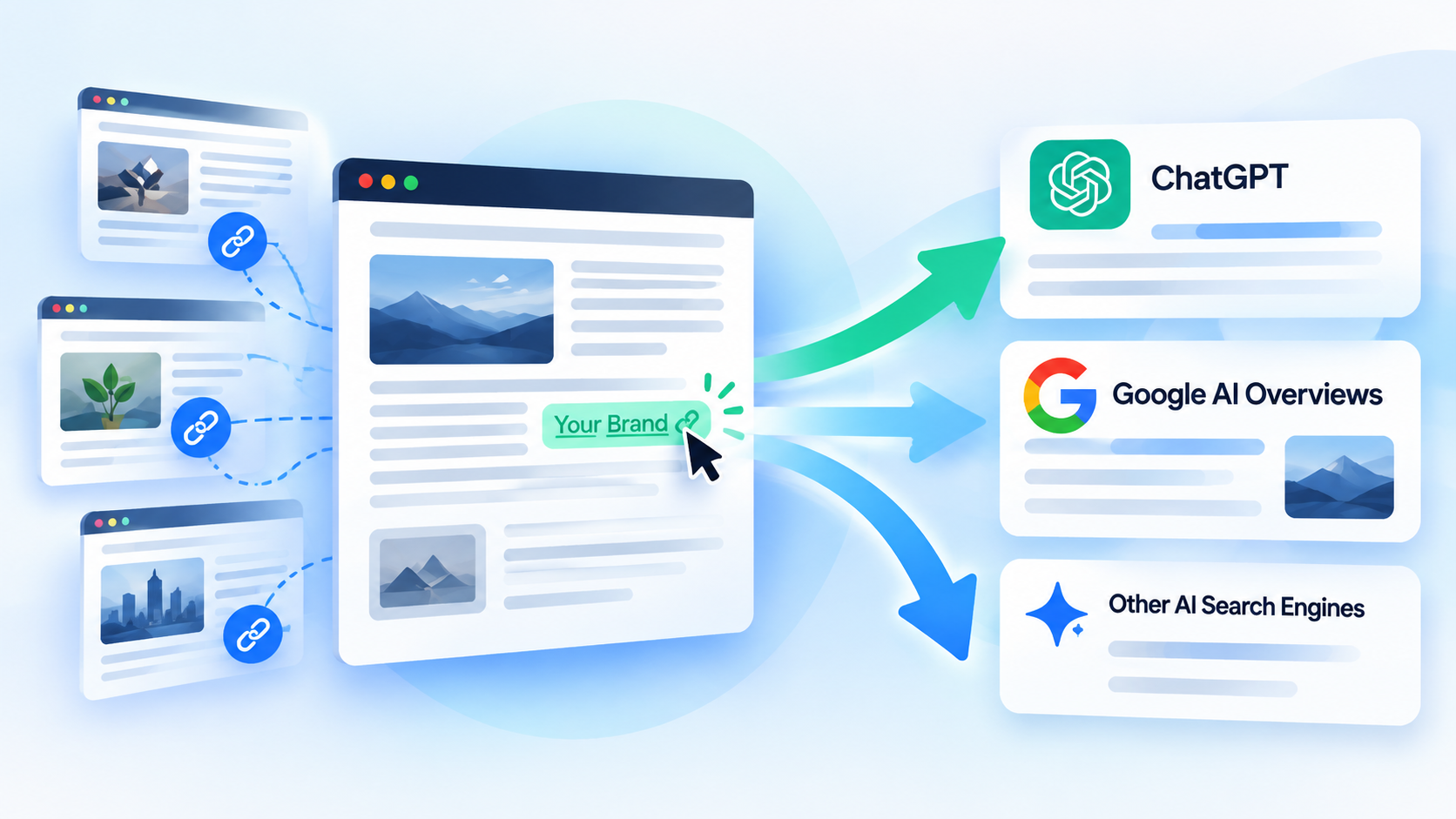
Search is changing fast. Ranking on Google is no longer the only way people discover businesses, products, and information. Platforms such as ChatGPT and Google AI Overviews are changing how users find and evaluate sources online.
This shift has made niche edits for AI search an important topic for brands looking beyond traditional rankings. Contextual backlinks placed within relevant, established content can strengthen authority, topical relevance, and connections between your brand and the subjects you want to be known for.
However, backlinks alone do not guarantee visibility or citations in AI-generated answers. The real opportunity lies in earning relevant placements on trusted pages that both search engines and AI-driven systems can discover, understand, and associate with your brand.
What Are Niche Edits for AI Search?
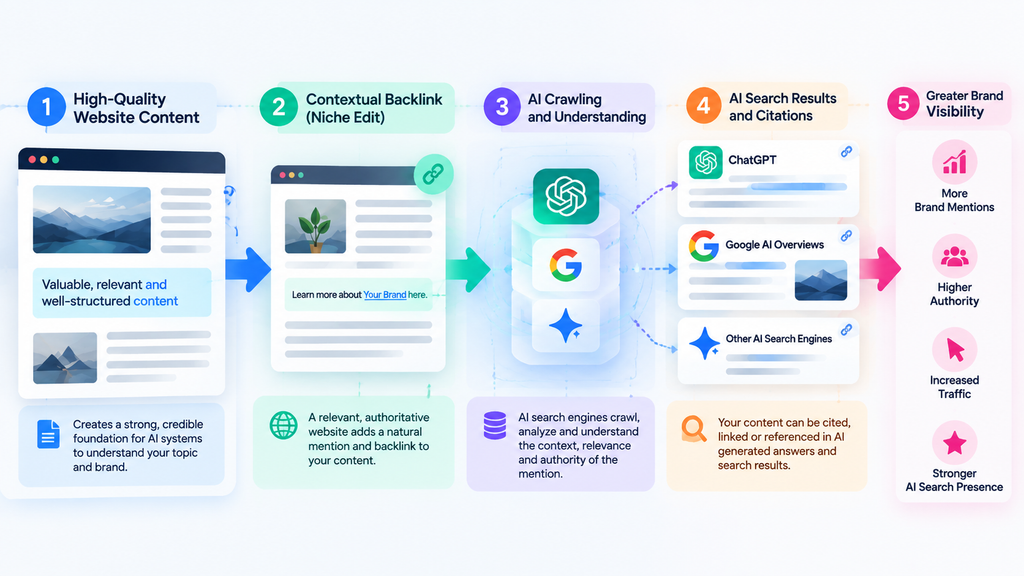
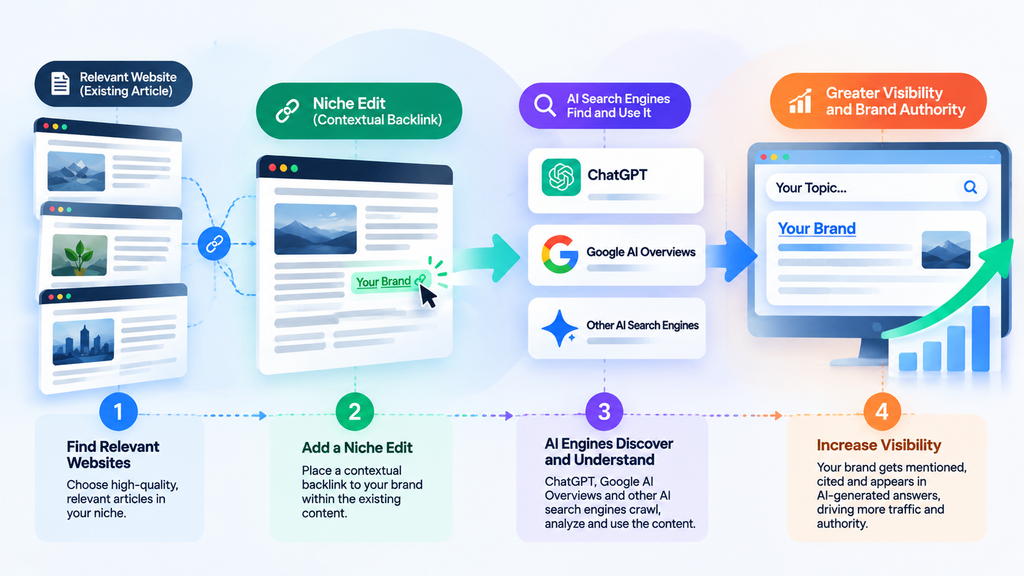
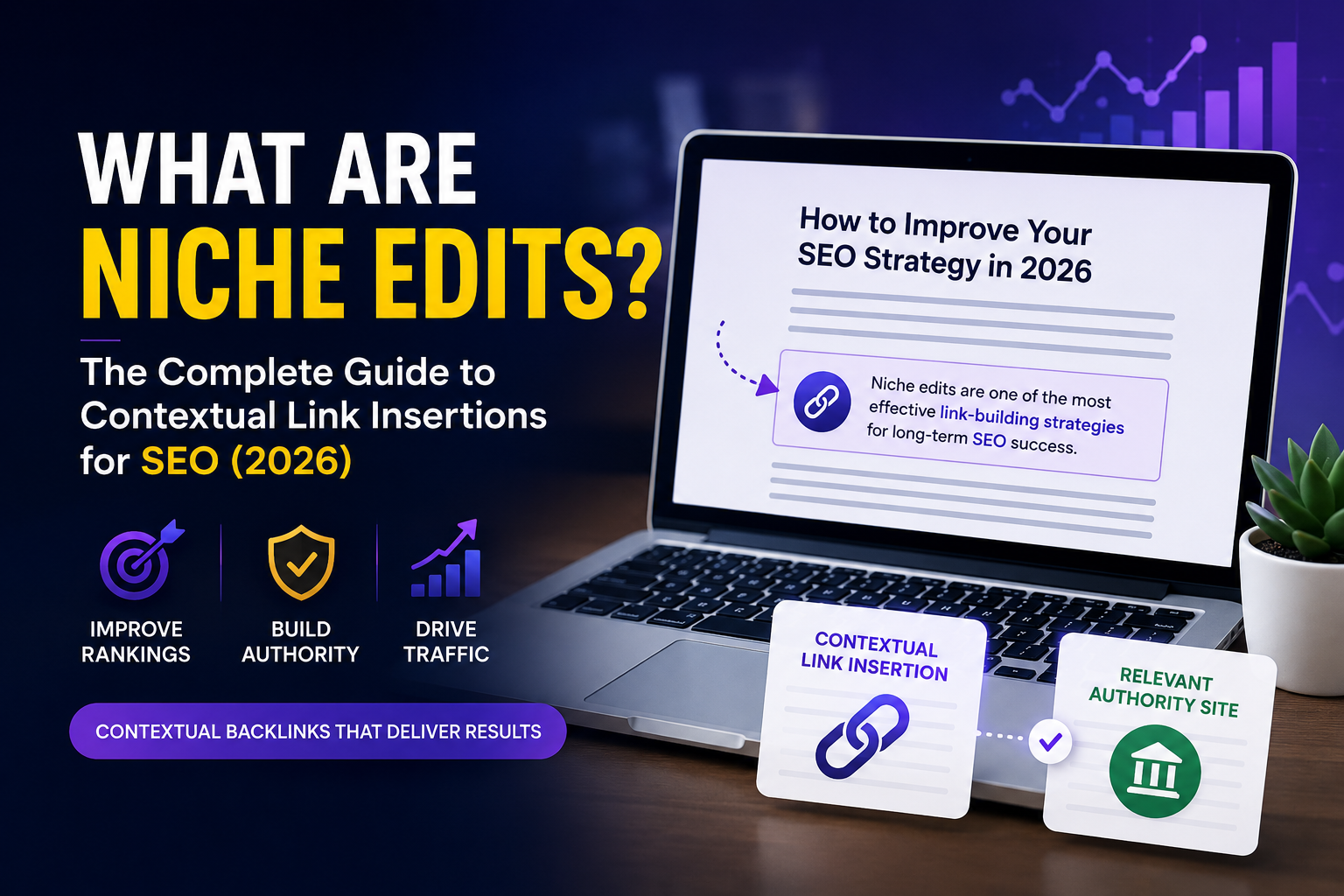
Niche edits for AI search are contextual backlinks added to existing, relevant content on established websites. Unlike a new guest post, the link is placed naturally within a page that has already been published and may already have search visibility, backlinks, topical relevance, or authority.
For AI-focused SEO, the goal goes beyond simply acquiring a dofollow backlink. The placement should strengthen the contextual relationship between your brand, website, and the topic being discussed.
For example, an SEO agency would gain more contextual value from a natural mention within an established article about link building than from an unrelated page chosen only because the domain has a high authority metric.
The key factors are relevance, context, page quality, authority, and natural placement. These signals can support traditional SEO while also creating stronger brand and topic associations across the wider search ecosystem.
Do Niche Edits Actually Influence AI Search Visibility?
Niche edits can support AI search visibility, but the relationship is not as simple as getting a backlink and appearing in ChatGPT or Google AI Overviews.
Traditional search engines use links as one of many signals for discovering pages and understanding authority and relevance. AI-powered search experiences can also surface information from websites they consider useful, relevant, and trustworthy. This makes the quality and context of your online presence increasingly important.
A well-placed niche edit can contribute by connecting your brand or page with relevant topics on established third-party websites. It can also strengthen traditional SEO signals that help important pages become easier to discover through search.
However, a backlink does not guarantee an AI citation. AI visibility can depend on several factors, including content quality, topical relevance, brand mentions, source credibility, crawlability, and how clearly your website demonstrates expertise around a subject.
For this reason, niche edits should be treated as one part of a broader AI search and SEO strategy—not as a shortcut to appearing in AI-generated answers.
How ChatGPT, Google AI Overviews and AI Search Engines Find Sources
AI search does not work exactly like traditional Google rankings. Instead of simply displaying a list of blue links, AI-powered search experiences can combine information from multiple sources to generate a direct response.
Systems such as Google AI Overviews and AI-powered search tools may surface webpages that provide clear, relevant, and useful information for a particular query. The sources that appear are not necessarily the websites with the highest domain authority or the largest number of backlinks.
Several factors can contribute to whether a source is discoverable and useful within this ecosystem, including:
Topical relevance: How closely the page matches the subject or question.
Content quality: Whether the information is clear, useful, accurate, and sufficiently detailed.
Source credibility: Whether the website and author demonstrate trustworthy expertise around the topic.
Brand and entity signals: How consistently a company, product, or person is associated with a particular subject across the web.
Crawlability and indexability: Whether search systems can access and understand the content.
Third-party mentions and links: Relevant references from other websites can help strengthen a brand’s wider web presence.
This is where niche edits become interesting. A contextual placement on a genuinely relevant page can create another meaningful connection between your brand and a topic. The objective should therefore be more than building link equity; it should be earning placements in contexts where the brand naturally belongs.
Backlinks vs Brand Mentions vs Citations: What Matters for AI Search?
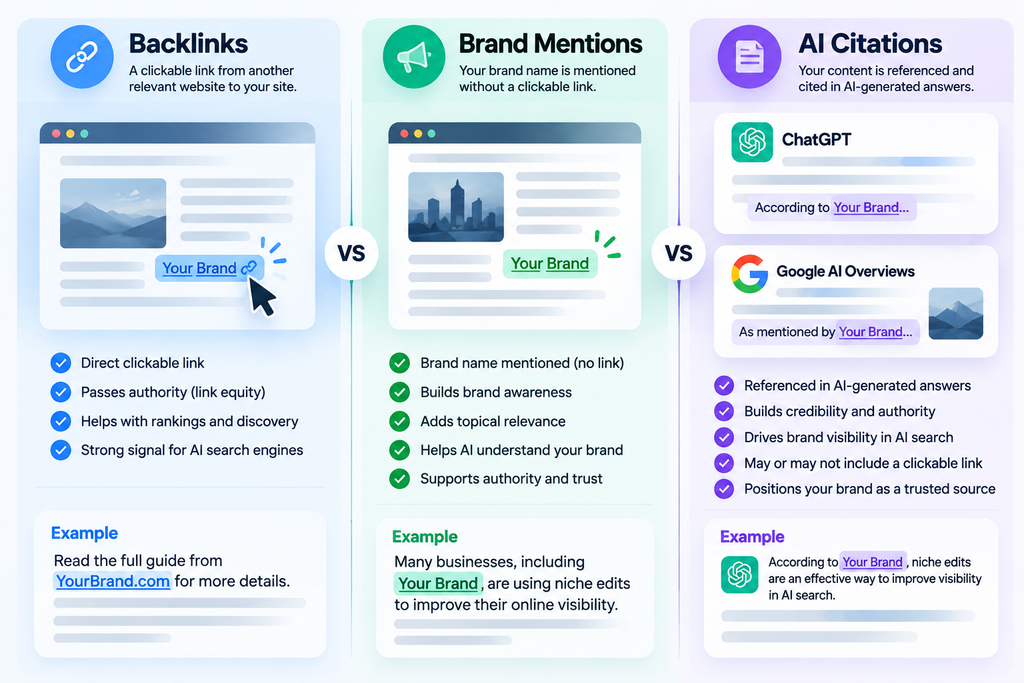
Backlinks, brand mentions, and citations are related, but they are not the same thing. Understanding the difference is important when building niche edits for AI search.
A backlink is a clickable link from another website to your site. In traditional SEO, relevant backlinks can help search engines discover pages and contribute to signals associated with authority and relevance.
A brand mention occurs when another website discusses or references your company, product, service, or expertise. It may include a backlink, but it does not have to. Consistent mentions across relevant sources can help establish clearer associations between a brand and the topics it operates within.
An AI citation happens when an AI-powered search experience references or links to a source used to support its generated response. Earning backlinks does not automatically result in these citations.
For an AI-focused strategy, this means chasing links alone may be too narrow. A stronger approach is to secure contextual placements where the brand, topic, supporting information, and link naturally reinforce each other.
The ideal niche edit should therefore provide more than link equity. It should place your brand within a relevant conversation on a credible page, giving both users and search systems clearer context about what your business is associated with.
How Niche Edits Can Strengthen Topical Authority and Brand Associations
A strong niche edit does more than point a link toward a website. It places that website within an existing conversation about a relevant subject.
Suppose a cybersecurity company earns a contextual link from an established article discussing data protection. The surrounding content, anchor text, referring page, and destination page all share a clear topical relationship. This provides much stronger context than placing the same link on a general website with little connection to cybersecurity.
This is why topical relevance should often take priority over headline authority metrics when evaluating niche edit opportunities.
For AI search, these contextual relationships may also help reinforce how a brand is represented across the web. Repeated, credible associations between a company and its specialist topics create a clearer digital footprint than backlinks acquired from unrelated pages simply because they have attractive SEO metrics.
An effective AI-focused niche edit should therefore connect four elements:
When all four align, the placement becomes useful for readers while supporting the broader authority and topical signals behind your SEO strategy.
Traditional Niche Edits vs AI-Focused Niche Edits
Traditional niche edits and AI-focused niche edits use the same basic method: placing a relevant backlink within existing content. The difference is mainly in how the placement opportunity is evaluated.
A traditional campaign may focus heavily on SEO metrics such as domain authority, organic traffic, referring domains, and dofollow links. An AI-focused approach still considers these factors, but places greater emphasis on topical context, brand relevance, source quality, and whether the page is genuinely useful within its subject area.
Traditional Niche Edits
AI-Focused Niche Edits
Focus on backlink acquisition
Focus on links, context, and brand association
Often prioritise DR/DA
Prioritise topical and page-level relevance
Target pages with SEO authority
Target credible, useful and relevant content
Keyword-focused anchor text
Natural anchors and contextual brand mentions
Success measured mainly through rankings
Rankings, visibility, mentions and AI citations can all be monitored
Domain-level metrics influence selection
Page quality and contextual fit receive greater attention
The goal is not to abandon traditional link-building principles. Instead, AI-focused niche edits apply stricter relevance and contextual criteria when deciding where a brand should appear.
A website with a high DR but little topical connection may be less attractive than a respected industry publication with an existing article directly related to your target subject.
That shift—from “Where can we get a link?” to “Where should this brand naturally be referenced?”—is the key difference.
What Makes a Good Niche Edit for AI Search?
Not every backlink from an established website is a good niche edit. For AI search and traditional SEO alike, the quality of the page and its contextual relevance matter more than simply securing a link.
Before choosing a placement, evaluate these factors:
1. Strong Topical Relevance
The existing article should closely relate to your business, target page, or area of expertise. A natural topical connection gives the link meaningful context rather than making it look like an unrelated insertion.
2. A Quality Existing Page
Look beyond domain-level metrics. Review whether the individual page contains useful content, ranks for relevant keywords, attracts organic traffic, earns backlinks, or demonstrates clear expertise around the subject.
3. Natural Context Around the Link
The backlink should fit naturally within the existing discussion. Avoid inserting a link into a sentence or paragraph simply because a keyword happens to appear there.
4. Relevant Destination Page
The linked page should genuinely help someone reading the source article. Sending every niche edit to a homepage or commercial landing page can create a weaker contextual connection than linking to the most relevant resource.
5. Credible Website
Check the overall quality of the publisher. Websites filled with unrelated sponsored posts, excessive outbound links, thin content, or obvious link-selling footprints deserve additional scrutiny.
6. Natural Anchor and Brand Reference
Use anchor text that makes sense within the sentence. Branded, descriptive, and contextually relevant anchors can create a more natural relationship than repeatedly forcing exact-match keywords.
For AI-focused campaigns, the objective is not to collect the largest possible number of links. It is to build credible third-party connections that strengthen how your brand is associated with its core topics across the web.
How to Find Niche Edit Opportunities for AI Search
Finding niche edits for AI search requires more than building a list of websites with high authority scores. The goal is to identify existing pages where your brand or resource would add genuine contextual value.
Start With Your Target Topics
Define the subjects you want your brand to be associated with. Instead of starting with a list of websites, begin with the questions, keywords, and problems your potential customers are searching for.
Review Existing Search Results
Search those topics on Google and examine the pages already performing well. Look for relevant guides, comparisons, resource pages, and educational articles where your expertise or content could naturally contribute additional value.
Check AI Search Results
Test important industry questions across AI-powered search experiences and observe which publications and pages are repeatedly referenced. These sources can provide useful insight into the types of content being surfaced for your topic.
However, appearing as an AI citation today does not guarantee that the same source will continue to appear, so this should be treated as a research signal rather than the only selection criterion.
Evaluate the Individual Page
Once you identify a potential placement, analyse the page itself. Check its topical relevance, content quality, organic visibility, backlinks, outbound links, freshness, and whether your proposed destination genuinely improves the reader’s experience.
Look for a Natural Content Gap
Finally, identify where your brand, research, guide, statistic, or resource could logically add value. The strongest niche edit should feel like part of the original article—not a backlink added afterwards purely for SEO.
This approach changes niche-edit prospecting from finding websites that accept links to finding relevant conversations where your brand deserves to be included.
Good vs Bad Niche Edits for AI Search: A Practical Example
Two websites can have similar authority metrics while providing completely different value from a niche edit. Consider an SEO software company trying to build visibility around backlink analysis.
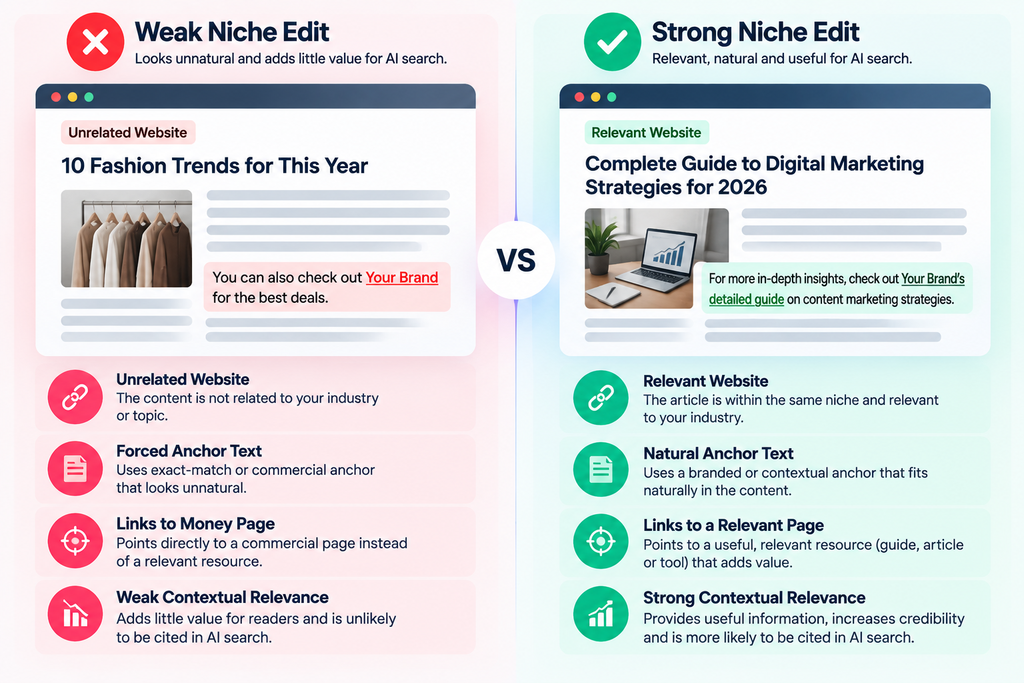
A Weak Niche Edit
The company secures a dofollow link from a high-DR general blog. The article briefly mentions SEO but mainly covers broad digital marketing topics. An exact-match anchor such as “best backlink analysis software” is inserted into an existing paragraph and links directly to a commercial page.
The domain metrics may look impressive, but the placement has several weaknesses:
Limited topical relevance
Forced anchor text
Little contextual connection to the destination
A publisher covering numerous unrelated subjects
No meaningful brand reference
A Stronger Niche Edit
Now imagine the same company earns a placement within an established guide about analysing competitor backlinks.
The article already discusses backlink data, referring domains, anchor text, and competitor research. The company is naturally referenced as a relevant resource, with a contextual link pointing to a detailed guide or tool that helps readers complete the task being discussed.
Here, the publisher, page topic, surrounding content, brand reference, and destination page all align.
That contextual alignment is what an AI-focused niche edit should aim for.
Rather than asking only, “How strong is this domain?”, ask:
“Does it make sense for our brand to be mentioned on this specific page?”
If the answer is clearly yes, the placement is far more likely to provide genuine SEO and brand value.
Niche Edits vs Digital PR for AI Search Visibility
Niche edits and digital PR can both strengthen a brand’s presence across the web, but they achieve this in different ways.
Niche edits focus on earning contextual links and mentions within relevant content that already exists. This gives you greater control over topical relevance, the destination page, and the context surrounding the link.
Digital PR, on the other hand, focuses on earning editorial coverage through original research, expert commentary, newsworthy stories, data, or industry insights. A successful campaign may generate brand mentions and links across multiple authoritative publications.
For AI search, these strategies can complement each other:
Niche Edits
Digital PR
Placement within existing content
New editorial coverage
Highly targeted topical relevance
Broader brand exposure
Greater control over target pages
Less control over links and anchors
Useful for specific SEO priorities
Useful for authority and brand awareness
Can build contextual backlinks
Can generate links and unlinked brand mentions
An effective strategy does not necessarily require choosing one over the other.
Niche edits can help build targeted topical connections, while digital PR can expand the number of credible third-party sources discussing your brand. Used together, they can create a broader and more natural web presence than relying on a single link-building tactic.
How to Measure the Impact of Niche Edits on AI Search Visibility
Measuring niche edits for AI search requires looking beyond traditional keyword rankings. AI-generated results can change frequently, and there is no single metric that proves a backlink caused an AI citation.
Instead, monitor several signals together.
Track Traditional SEO Performance
Start with familiar metrics such as keyword rankings, organic impressions, clicks, referring domains, and the performance of the page receiving the niche edit. Google Search Console can help identify whether visibility improves over time.
Monitor Important AI Search Queries
Create a list of prompts and questions closely related to your products, services, and expertise. Periodically check whether your brand or content appears in relevant AI-generated responses.
Track Brand Mentions and Citations
Look for changes in how frequently your brand is mentioned or referenced across relevant third-party websites and AI search experiences. Pay attention not only to direct links but also to the context in which your brand appears.
Measure the Target Page
Monitor the specific page receiving the backlink. Changes in impressions, rankings, referral traffic, and organic clicks can provide more useful insight than looking only at domain-wide metrics.
Compare Results Over Time
Avoid judging a niche edit after a few days. Record the placement date and establish a baseline before comparing performance over the following weeks and months.
Most importantly, avoid attributing every improvement to a single backlink. SEO and AI visibility are influenced by multiple factors. The objective is to identify whether relevant niche edits contribute to a broader pattern of improving search visibility, authority, and brand presence over time.
Common Mistakes to Avoid With Niche Edits for AI Search
AI search does not make traditional link-building quality standards irrelevant. If anything, focusing on context and credibility makes careful placement selection even more important.
Choosing Domains Based Only on DR or DA
A high authority score does not automatically make a website relevant. Review the actual page, its content, organic visibility, audience, and relationship to your topic before pursuing a placement.
Ignoring Page-Level Relevance
A relevant domain can still contain an irrelevant page. The strongest niche edits appear within content that closely matches the subject of the destination page.
Forcing Exact-Match Anchor Text
Repeatedly using commercial exact-match anchors can make placements look unnatural. Use branded, descriptive, partial-match, and other contextually appropriate anchors where they make sense.
Linking Every Placement to a Money Page
Not every backlink needs to point directly to a service or product page. Useful guides, original research, statistics, and other informational resources can sometimes provide a much more natural destination.
Treating AI Citations as Guaranteed Results
No legitimate niche edit can guarantee that ChatGPT, Google AI Overviews, or another AI system will cite a particular website. AI-generated responses and their sources can change.
Scaling Before Proving Quality
Acquiring hundreds of weak placements is not the objective. Start with highly relevant opportunities, monitor their impact, and refine your selection criteria before increasing volume.
The biggest mistake is treating AI search as an excuse to repeat old link-building tactics under a new name. The better approach is to become more selective about where, why, and how your brand is referenced.
Do You Need Niche Edits for ChatGPT and Google AI Overviews?
You do not need niche edits simply because you want your brand to appear in ChatGPT, Google AI Overviews, or other AI-powered search experiences. There is no direct formula where acquiring a certain number of backlinks results in AI citations.
What matters is building a broader digital presence that makes your website and brand credible, discoverable, and strongly associated with the topics you want to compete for.
Niche edits can support that strategy by earning relevant contextual links and mentions from established third-party content. However, they work best alongside:
High-quality, original website content
Strong technical SEO and crawlability
Relevant internal linking
Consistent brand and entity information
Original research, statistics, or expert insights
Editorial mentions and digital PR
Authoritative and relevant backlinks
The objective should therefore not be “build backlinks for ChatGPT.”
A better objective is to create enough credible evidence across your own website and relevant third-party sources that your brand becomes a useful and trusted resource within its specialist topics.
Niche edits can contribute to that process, but they should be treated as one component of a wider SEO and AI-search visibility strategy.
FAQs About Niche Edits for AI Search
Do niche edits help with ChatGPT visibility?
Niche edits can support the wider authority, relevance, and third-party presence of a brand, but they do not guarantee visibility in ChatGPT. The quality and context of the referring page are more important than simply acquiring more backlinks.
Can niche edits help with Google AI Overviews?
Relevant backlinks may support the broader SEO signals surrounding a website, but there is no guaranteed method for earning a citation in Google AI Overviews. Helpful content, technical accessibility, topical relevance, authority, and credible external references should work together.
How many niche edits do I need for AI search?
There is no ideal number. Ten highly relevant contextual placements can represent a stronger strategy than hundreds of unrelated links. Focus on quality, relevance, and natural acquisition rather than reaching a fixed backlink target.
Are brand mentions important for AI search?
Brand mentions can strengthen your overall presence across relevant third-party sources, particularly when the surrounding content clearly connects your company with its specialist topics. They should complement backlinks rather than be viewed as a replacement for them.
Should niche edits use exact-match anchor text?
Not always. Anchor text should fit naturally within the surrounding content. A healthy strategy can include branded, descriptive, partial-match, and other contextually relevant anchors instead of repeatedly forcing the same commercial keyword.
Are niche edits enough for AI SEO?
No. Niche edits should form part of a broader strategy that includes useful content, technical SEO, topical authority, brand mentions, digital PR, internal linking, and relevant backlinks. The goal is to build a credible web presence rather than optimise for one isolated AI-search signal.
Final Thoughts: Building Niche Edits for an AI-Driven Search World
AI search is changing how brands are discovered, but the fundamentals of earning trust and authority across the web still matter.
The difference is that successful niche edits for AI search should not be approached as simple backlink placements. Relevance, page quality, contextual fit, brand mentions, and the usefulness of the destination page all deserve greater attention.
Rather than chasing links based solely on DR, DA, or volume, focus on earning placements where your brand genuinely belongs. These contextual relationships can support traditional SEO while strengthening your wider topical presence across the web.
At Elite Link Agency, we focus on relevant, contextual niche edit opportunities rather than links selected purely by headline metrics. If you want to strengthen your backlink profile with placements aligned with your industry and SEO goals, explore our niche edit services and build a strategy focused on relevance, quality, and long-term search visibility.